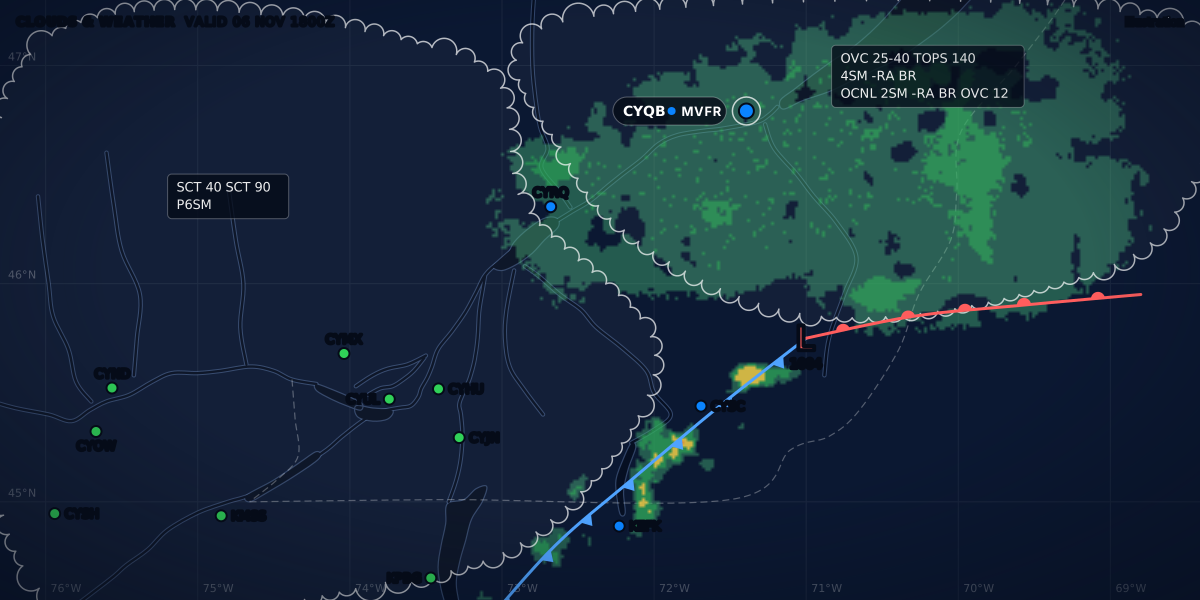
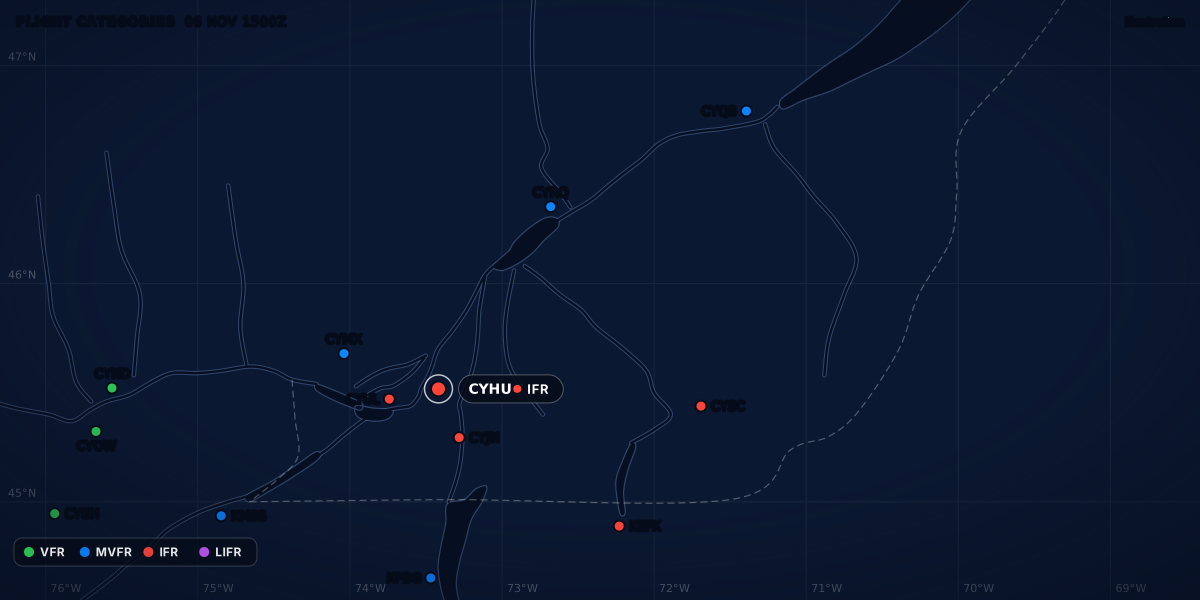
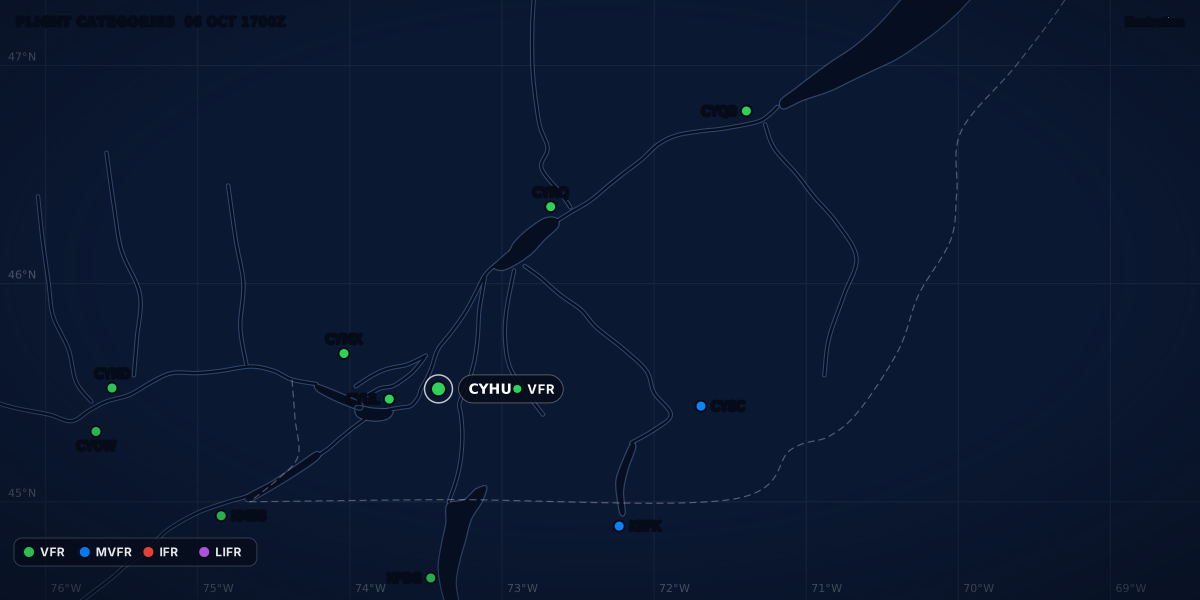
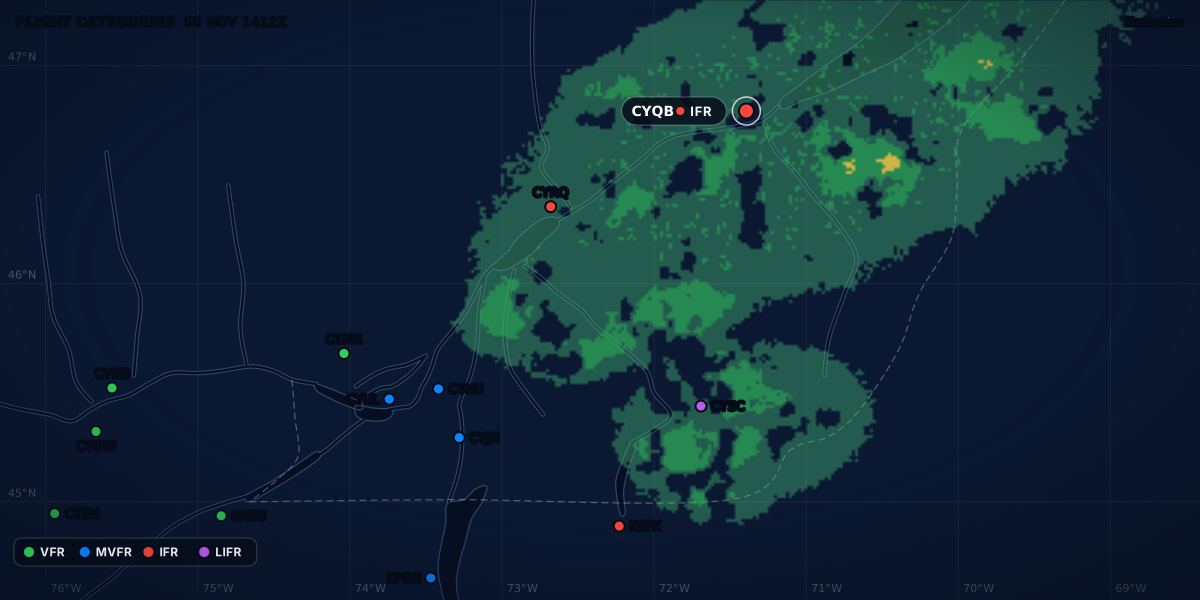
FLIGHT CATEGORIES 01 OCT 1800Z
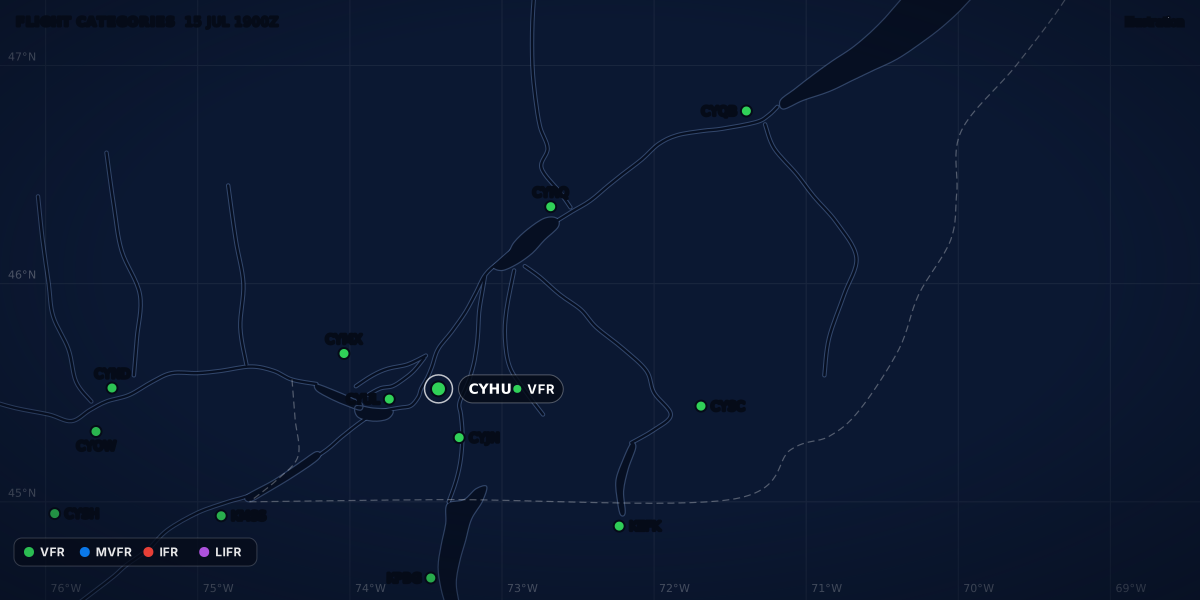
VFRMVFRIFRLIFR
Illustration
Personal minimums checklist: limits you can check in a METAR
Turn the FAA PAVE checklist into numbers you can check in a METAR or TAF: ceiling, visibility, crosswind, gusts, night and density altitude. Printable sheet.
 Jp Valery
13 min read
Personal minimums are the weather limits you set for yourself, above the legal ones. A checklist asks you for numbers, such as “ceiling: ____ ft”. This one also shows where each number appears in a METAR or a TAF, so you can hold a report against your limits in a few seconds.
Set them at home, before you look at any forecast. They are the first step of a weather briefing. The worksheet below adapts two FAA documents: the Personal Minimums Checklist (FAA-P-8740-56), known as PAVE, and the article Getting the Maximum from Personal Minimums (FAA Aviation News, May/June 2006), which adds the wind and density altitude lines. Print it, fill in the blanks, sign it and date it.
Your personal minimums worksheet
- Ceiling: at least ____ ft
- Visibility: at least ____ SM
- Wind: no more than ____ kt
- Gusts: no more than ____ kt, gust factor ____ kt
- Crosswind: no more than ____ kt (____ % of the POH value)
- Runway length: ____ % more than the POH distance
- Density altitude: no more than ____ ft
- Ceiling: at least ____ ft
- Visibility: at least ____ SM
- Wind: no more than ____ kt, gusts ____ kt
- Crosswind: no more than ____ kt
- Night takeoffs and landings: ____ in the last ____ days
- Precision approach: ceiling ____ ft and visibility ____ SM above the minimums
- Non-precision approach: ceiling ____ ft and visibility ____ SM above the minimums
- Missed approaches: no more than ____ before I divert
- Takeoff: ceiling ____ ft, visibility ____ SM
- Instrument approaches: ____ in the last ____ days
- Takeoffs and landings: ____ in the last ____ days
- Hours in this make and model: ____ in the last ____ days
- Sleep: ____ hours in the last 24 hours
- Alcohol: none in the last ____ hours
- Fuel reserve: ____ h by day, ____ h at night
- Reports and forecasts: not more than ____ hours old
- Allowance for delays: ____ minutes
- Signed ____ Date ____ Reviewed with ____
The units are those of North American reports: feet and statute miles (SM). If your reports give the visibility in metres, write your limit in metres.
Set limits before you look at the weather
No regulation sets personal minimums. The pre-flight rules ask you to know the weather. In Canada, the pilot-in-command must “be familiar with the available weather information that is appropriate to the intended flight” (CARs 602.72). In the United States, 14 CFR 91.103 asks you to “become familiar with all available information concerning that flight”, with weather reports and forecasts named for a flight under IFR or away from an airport.
Neither rule says what weather is good enough for you. Your personal minimums do. The FAA article calls them “the human factors equivalent of reserve fuel”: a buffer between the skills a flight needs and the skills you have.
Write them down first. The PAVE checklist says to use it “at home as you start planning a flight and again just before you make your final decision to fly.” It also says to never make your minimums less restrictive while you plan a specific flight, “or else external pressures will influence you.”
Transport Canada’s best practices in general aviation say that a personal minimums checklist covers the “knowledge, skills and tools you need for flying and maintenance tasks”. The only example they give is for maintenance. So this page builds on the FAA’s checklist.
PAVE in one table
PAVE stands for the four risk categories of the checklist: Pilot, Aircraft, enVironment and External pressures.
| Category | What the FAA checklist asks you to set | Where you check it | |
|---|---|---|---|
| P | Pilot | Takeoffs and landings, and hours in the make and model, in the last ____ days. Sleep, food and water, alcohol, drugs or medication, stress, illness. | Your logbook, and yourself |
| A | Aircraft | Fuel reserves (VFR and IFR, day and night). Experience in type. Performance: gross weight, load distribution, density altitude, performance charts. Avionics, charts, clothing, survival gear. | The POH and the aircraft |
| V | enVironment | Crosswind as a % of the POH maximum. Runway length as a % more than the POH distance. Reports and forecasts not more than ____ hours old. Icing within your and the aircraft’s capabilities. VFR ceiling and visibility, day and night. IFR margins above the approach minimums. | The METAR, the TAF and the runway data |
| E | External pressures | An allowance for delays. Diversion or cancellation plans. Telling the people you are meeting. Briefing your passengers on the plan B. Personal needs for an unexpected stay. | Your trip plan |
Most of the enVironment row lives in a weather report. The next section maps it, group by group.
Each limit, and where it shows in a report
Here is a real report from Montréal / St-Hubert (CYHU): IEM archive, October 1, 2026, 18:00 UTC (14:00 EDT). The archive stores it without the word METAR. It is a routine report, so the word is added back here.
Now check it against our day-VFR sample: a ceiling of 3,000 ft, a visibility of 5 SM and a crosswind of 10 kt.
| Limit | Where it shows | In this report | Inside the sample? |
|---|---|---|---|
| Ceiling | The lowest BKN, OVC or VV layer, in hundreds of feet above ground |
OVC029: 2,900 ft |
No: 100 ft below 3,000 ft |
| Visibility | The number before SM |
9SM: 9 SM |
Yes |
| Wind and gusts | The wind group: mean speed, then G and the peak gust |
18010G15KT: 10 kt, gusts 15 kt (a gust factor, gust minus mean, of 5 kt) |
Check your wind and gust lines |
| Crosswind | Not in the report: work it out from the wind and your runway | At most 10 kt steady, 15 kt in the gusts | Steady: yes, on any runway. Gusts: no, if the runway is more than about 42° off the wind |
| Night | Not in the report: compare the time group with the end of civil twilight | 011800Z: 14:00 EDT |
Day |
| Density altitude | Canadian reports: a remark after the sea-level pressure | DENSITY ALT 900FT |
Only if you set a line for it |
| Age | The time group, in UTC | 011800Z |
Check your “not more than ____ hours old” line |
Ceiling. It is the first layer reported as broken (BKN) or overcast (OVC); a vertical visibility (VV) is an obscured ceiling (TC AIM MET 8.2). Few and scattered layers never count. The guide what is a ceiling covers the edge cases. This report misses the limit by 100 ft. That is still outside: a limit works only as a line.
Visibility. Canadian reports give the prevailing visibility in statute miles and fractions (MET 8.2).
Wind and gusts. A Canadian METAR adds G and the peak gust when gusts exceed the mean speed by 5 kt or more and reach 15 kt or more (MET 8.2). A Canadian TAF shows a gust only when it is forecast to exceed the mean speed by 10 kt or more (MET 7.3). So a TAF with no G can still hide gusts under that threshold.
Crosswind. The crosswind is never more than the wind speed. So a wind whose mean and gust are both at or under your crosswind limit cannot break it, on any runway. Here the 10 kt mean cannot. The 15 kt gust gives more than 10 kt of crosswind on a runway more than about 42° off the wind (15 × sin 42° = 10.04 kt). METAR wind is in degrees true (MET 8.2), so convert it to magnetic before you compare it with a runway number. Which crosswind to compare with your limit, steady or gust, is in crosswind limits and gusts. The PAVE checklist writes this limit as a share of your POH’s maximum value: with a POH value of 15 kt, a 10 kt limit is 67% of it.
Night. No group says “night”. In Canada, night is “the time between the end of evening civil twilight and the beginning of morning civil twilight” (CARs 101.01), and 14 CFR 1.1 uses the same words, with the times of the Air Almanac. To compare a report time with that moment at your field, see when night starts.
Density altitude. A Canadian METAR gives it after the sea-level pressure when it is 200 ft or more above the aerodrome elevation (MET 8.2). Where the report does not give it, compute it from the METAR. PAVE puts density altitude under aircraft performance, so set this line with your POH and your runway.
TAF. The same groups apply to every forecast period. Check every period that covers your flight, TEMPO and PROB groups included (what they mean).
ClearMETAR Pro runs this check on five of your numbers: ceiling, visibility, wind, gusts and crosswind (steady and in gusts, on the best runway end). A “Day only” switch counts night as outside your limits. The latest report and every forecast period outside them show in amber, TEMPO and PROB groups included, and the app can alert you for the stations in your favorites. One set of limits covers every station. It has no density altitude line: keep that one on paper.
What came next that afternoon
The ceiling came down, then rain and mist cut the visibility.
| UTC (EDT) | Wind, visibility, weather and clouds | Ceiling | Visibility | Category |
|---|---|---|---|---|
| 17:00 (13:00) | 24010KT 9SM SCT037 BKN046 OVC066 |
4,600 ft | 9 SM | VFR |
| 18:00 (14:00) | 18010G15KT 9SM OVC029 |
2,900 ft | 9 SM | MVFR |
| 19:35 (15:35) | 20011G17KT 5SM -RA BR BKN019 OVC029 |
1,900 ft | 5 SM | MVFR |
| 19:49 (15:49) | 19007G15KT 2 1/4SM -RA BR SCT017 OVC023 |
2,300 ft | 2 1/4 SM | IFR |
| 21:00 (17:00) | 20008KT 2 1/4SM -RA BR SCT006 BKN023 BKN031 OVC036 |
2,300 ft | 2 1/4 SM | IFR |
Selected real reports from CYHU, IEM archive, October 1, 2026. The categories use the limits of the Aviation Weather Center. A category is a summary, not a rule: the flight categories guide explains them, and the legal minimums are the law.
The 18:00 report was the first one that afternoon below the 3,000 ft ceiling of our sample. With the example of the FAA pamphlet How to Obtain a Good Weather Briefing (FAA-P-8740-30), 2,000 ft and 5 miles, the first report under those numbers was the 19:35 one. The visibility fell to 2 1/4 SM, IFR, 1 hour and 49 minutes after the 18:00 report.
A worked worksheet: day VFR, night VFR, IFR
| Line | Day VFR: our sample | Night VFR: an FAA example | IFR: the PAVE form |
|---|---|---|---|
| Ceiling | 3,000 ft | 5,000 ft | ____ ft above the approach minimums |
| Visibility | 5 SM | 7 to 8 miles | ____ SM above the approach minimums |
| Crosswind | 10 kt | Not given | ____ kt |
| Where it comes from | The sample of our flight categories guide | The author of the FAA article, for herself | FAA-P-8740-56 |
None of these numbers is a rule.
Day VFR. Our sample is for a new private pilot. It is the same as in the flight categories guide, and it sits at the top of the MVFR band. The FAA pamphlet FAA-P-8740-30 gives another example: “you might use personal minimums of 2,000 feet and 5 miles instead of the regulatory VFR minimums of 1,000 feet and 3 miles.”
To find your own numbers, the FAA article suggests a method. Write down the lowest ceiling and visibility you have flown comfortably in the last 6 to 12 months, by day and by night. Do the same for wind: the most challenging wind you have comfortably flown, “not necessarily the most challenging wind conditions you have managed to survive without bending an airplane.” Those are your baseline.
Night VFR. The FAA article’s author writes that for night VFR she “would not be comfortable with anything less than a ceiling of at least 5,000, and visibility of at least seven to eight miles.” FAA-P-8740-30 gives the reason to add a margin: “Allow more margin for weather at night. Scud clouds, lower clouds, and even the horizon may be difficult or impossible to see on dark nights.” These are comfort limits. The legal recency rule for passengers at night is in night currency.
IFR. The PAVE form asks for margins above the published minimums: a ceiling and a visibility for precision approaches, the same for non-precision approaches, a maximum number of missed approaches before you divert, and takeoff minimums. I am a private pilot, not an instrument pilot or instructor, so this page gives no IFR sample numbers. Set them with an instrument instructor.
When to make them stricter
The PAVE checklist says that “it is okay to make your minimums more restrictive at any time.” The FAA article gives a rule of thumb. If you face any of these:
- Pilot: illness, medication, stress or fatigue; a lack of currency, for example no flying for several weeks.
- Aircraft: an unfamiliar airplane, or unfamiliar avionics or equipment.
- enVironment: airports and airspace with different terrain or unfamiliar characteristics.
- External pressures: “must meet” deadlines, passenger pressures.
Then adjust your baseline by at least:
- 500 ft more ceiling;
- ½ mile more visibility;
- 500 ft more runway length;
- 5 kt less wind.
Add the adjustment once for each condition you face. If your experience is limited or you do not fly often, the article suggests doubling the values.
With one condition, for example an airplane you have not flown before, our day sample becomes 3,500 ft, 5½ SM and a 5 kt crosswind, with 500 ft more runway (computed). The article’s own example is a night cross-country to an unfamiliar airport, after a full workday. For it, the article adds 1,000 ft to the ceiling, 1 mile to the visibility and 1,000 ft to the runway length: twice the adjustment. On our day sample, two adjustments give 4,000 ft and 6 SM (computed).
Wind and runways count too. AC 61-98E (3.1.1) takes a pilot who is current but has flown only in light or moderate wind at airports with long runways. That pilot “should consider acquiring additional takeoff and landing experience in stronger wind conditions or at airports with short runways” before carrying passengers in those conditions.
When to relax them, never below the law
The PAVE checklist is strict about this: “You should never make your minimums less restrictive unless a significant positive event has occurred.” The FAA article describes one way to do it. After several months of flying comfortably to your baseline, you might relax one value, for example a daytime visibility of 5 miles to 4. It adds two cautions:
- Never relax a limit for a specific flight. Decide when no flight is waiting.
- Change one value at a time, and never when a special condition, such as an unfamiliar aircraft or fatigue, is present.
The article also suggests talking your limits through with a flight instructor. AC 61-98E lists “lower personal minimums” for the ceiling, the visibility, the wind and the approach minimums among the sample proficiency goals of its Appendix C.
There is a floor. FAA-P-8740-30 says to reduce your limits gradually “to whatever limits you find comfortable at or above the legal limits.” In the controlled airspace around an airport, the basic VFR floor is 3 miles of visibility in a Canadian control zone (CARs 602.114), and 3 SM with a 1,000 ft ceiling in the United States (14 CFR 91.155(c) and (d)). In a European control zone, you need a 1,500 ft ceiling and 5 km of ground visibility to take off or land, unless ATC clears you (SERA.5005(b)). The full rules by airspace, altitude and time of day, cloud clearances included, are in VFR weather minimums, and special VFR is a separate case.
Go or no go
Hold the latest METAR and every TAF period of your flight against your sheet, for the departure, the destination and the alternate. Then read the PAVE rule:
Be wary if you have an item that’s marginal in any single risk factor category. But if you have items in more than one category, you may be headed for trouble.
If you have marginal items in two or more risk factors/categories, don’t go!
The trip itself pushes. The checklist warns: “The more important the trip, the more tendency there is to compromise your personal minimums, and the more important it becomes to have alternate plans.” The FAA article adds that “pre-established hard numbers” make a “no go” or “divert” decision easier, and that a written set makes it easier to explain to your passengers.
The limits still apply after takeoff. FAA-P-8740-30: “Wait it out or turn around if you find en route weather lowering below your personal limits.”
- My limits were written before I looked at today's weather
- Latest METAR and TAF for departure, destination and alternate: every period of my flight inside every line
- Reports and forecasts no older than my limit
- Marginal items: none, or in one PAVE category only
- Pilot: rested, fed, recent enough; no alcohol inside my limit
- Aircraft: fuel reserve, and performance for the runway and the density altitude
- Plan B ready: diversion or cancellation, passengers told
- En route, below my limits: wait it out or turn around
Review them
The PAVE checklist asks you to “periodically review and revise your checklist as your personal circumstances change, such as your proficiency, recency, or training.” Its form ends with lines for your name, “Date Revised” and “Reviewed with”.
Two required events are good moments to do it. In Canada, you must have completed a recurrent training program within the 24 months before the flight (CARs 401.05(2)(a)). In the United States, you need a flight review within the last 24 calendar months (14 CFR 61.56(c)). AC 61-98E’s sample flight instructor’s flight review checklist (Appendix D) lists “risk management (RM) and personal minimums” in the ground discussion and a “personal minimums worksheet” in its last step. Its sample instrument proficiency check checklist (Appendix I) lists the same worksheet in its last step. Bring yours.
I fly from two fields with no weather report, CSE4 and CSB3. At a field like that, every weather line of the sheet is checked against a report from another airport. The guide to weather without a METAR covers how far to trust it.
Sources
- Personal Minimums Checklist (FAA-P-8740-56, AFS-810, 1996), Federal Aviation Administration
- Getting the Maximum from Personal Minimums, by Susan Parson, FAA Aviation News, May/June 2006, Federal Aviation Administration
- How to Obtain a Good Weather Briefing (FAA-P-8740-30, AFS-8, 2008): Weather Judgment, Federal Aviation Administration
- AC 61-98E, Currency Requirements and Guidance for the Flight Review and Instrument Proficiency Check (October 30, 2024): 3.1.1 and Appendices C, D and I, Federal Aviation Administration
- TC AIM (TP 14371) 2026-2, MET 7.3 and 8.2: wind, gusts, visibility, ceiling and density altitude in TAFs and METARs, Transport Canada
- CARs 602.72 Weather information, Justice Laws Website
- CARs 602.114 Minimum visual meteorological conditions for VFR flight in controlled airspace, Justice Laws Website
- CARs 101.01 Interpretation (night), Justice Laws Website
- CARs 401.05 Recency requirements, paragraph (2)(a), Justice Laws Website
- Best practices in general aviation: Create a personal checklist, Transport Canada
- Personal minimums checklist for maintenance, Transport Canada
- 14 CFR 91.103 Preflight action, eCFR
- 14 CFR 91.155 Basic VFR weather minimums, paragraphs (c) and (d), eCFR
- 14 CFR 1.1 General definitions (night), eCFR
- 14 CFR 61.56 Flight review, paragraph (c), eCFR
- Regulation (EU) No 923/2012 (SERA), SERA.5005(b), consolidated text of 1 May 2025, EUR-Lex
- Graphical Forecasts for Aviation (GFA) help: flight category limits, NOAA Aviation Weather Center
- ASOS/METAR archive: CYHU, October 1, 2026, Iowa Environmental Mesonet
Rules checked on
Common questions
What are good personal minimums for a new private pilot?
Our day-VFR sample is a 3,000 ft ceiling, 5 SM of visibility and a 10 kt crosswind; the FAA pamphlet FAA-P-8740-30 gives 2,000 ft and 5 miles as its example. Both are personal starting points, not rules: build yours from the weather you have flown comfortably in the last 6 to 12 months, as the FAA article Getting the Maximum from Personal Minimums suggests.
What does PAVE stand for?
Pilot, Aircraft, enVironment and External pressures: the four risk categories of the FAA Personal Minimums Checklist (FAA-P-8740-56). The checklist says that if you have marginal items in two or more categories, don't go.
Can personal minimums be lower than the legal minimums?
No. FAA-P-8740-30 says to reduce personal minimums only to limits you find comfortable at or above the legal limits, and the legal VFR minimums of your airspace (for example CARs 602.114 in Canadian controlled airspace, 14 CFR 91.155 in the US) apply whatever your own numbers say.

Let the app do the decoding.
ClearMETAR turns every METAR and TAF into one plain sentence. Free on iPhone.