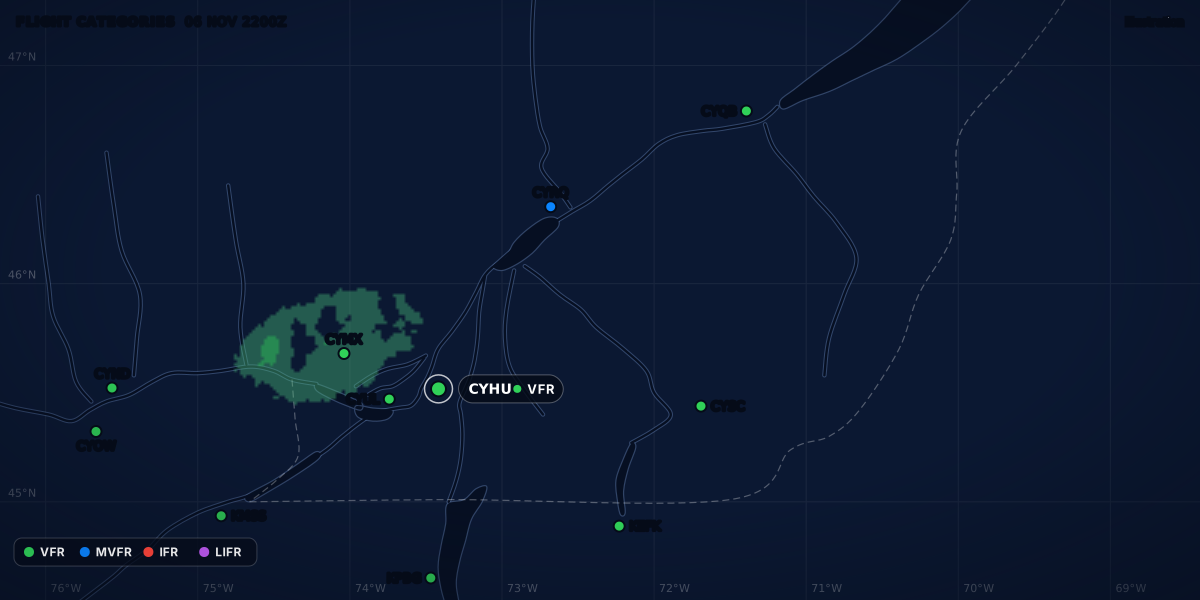
FLIGHT CATEGORIES 06 NOV 2253Z
VFRMVFRIFRLIFR
Illustration
Night currency requirements for passengers: US, Canada, EASA
Before a night flight with passengers: 3 full-stop landings in 90 days (US), 5 night take-offs and landings in 6 months (Canada), 1 in 90 days (EASA).
 Jp Valery
10 min read
Night currency decides whether you may take someone with you after dark. It is not the night rating, and it is not the definition of night. Canada, the US and Europe each count different landings, over 90 days or 6 months. The US even counts them in its own window of the night. For the time night starts at your airport, read when night starts for pilots. This page covers what you must have flown before the flight.
The three systems in one table
| United States | Canada | EASA and UK | |
|---|---|---|---|
| Rule | 14 CFR 61.57(b) | CARs 401.05(2)(b) | FCL.060(b)(2) |
| Applies when | You are pilot in command, the aircraft carries persons, and it is between 1 hour after sunset and 1 hour before sunrise | A passenger is on board and the flight is wholly or partly by night | You are pilot in command at night and carry passengers |
| Look-back | 90 days | 6 months | 90 days |
| What you need | 3 takeoffs and 3 landings, to a full stop | 5 night take-offs and 5 night landings | 1 take-off, approach and landing at night, or an instrument rating (IR) |
| When a landing counts | 1 hour after sunset to 1 hour before sunrise | End of evening civil twilight to start of morning civil twilight | EASA: end of evening to start of morning civil twilight, unless the authority sets another period. UK: 30 min after sunset to 30 min before sunrise |
| Aircraft | Same category, class and type (if a class or type rating is required), as sole manipulator of the controls | Same category and class | Same type or class, as pilot flying |
| Simulator | Approved full flight simulator, in a Part 142 course | Level B, C or D full-flight simulator | Full flight simulator (FFS) of that type or class |
| Also needed to fly with people | 3 takeoffs and 3 landings in 90 days, day or night (61.57(a)) | Recurrent training in the last 24 months, for every flight (401.05(2)(a)) | 3 take-offs, approaches and landings in 90 days (FCL.060(b)(1)) |
Night currency is not instrument currency. In the US and Canada, instrument currency is a separate rule (14 CFR 61.57(c), CARs 401.05(3)): see IFR currency.
United States: 14 CFR 61.57(b)
The rule is one long sentence in 14 CFR 61.57(b)(1):
“no person may act as pilot in command of an aircraft carrying persons during the period beginning 1 hour after sunset and ending 1 hour before sunrise, unless within the preceding 90 days that person has made at least three takeoffs and three landings to a full stop during the period beginning 1 hour after sunset and ending 1 hour before sunrise”
Read it in parts:
- The flight. The rule applies only when the aircraft carries persons, and only from 1 hour after sunset to 1 hour before sunrise. The regulation says “persons”, not “passengers”.
- The landings. You need three takeoffs and three landings, each to a full stop, made in that same window. A touch-and-go is not a landing to a full stop.
- The period. They must fall “within the preceding 90 days”.
- You. You “acted as sole manipulator of the flight controls” (61.57(b)(1)(i)).
- The aircraft. They count in “an aircraft of the same category, class, and type (if a class or type rating is required)” (61.57(b)(1)(ii)). For small aircraft that are not high performance, FAA guidance says this means category and class only: currency in a Cessna 152 also counts in a Cessna 172. The FAA still recommends that you get current in each make and model before you carry passengers (AC 61-98E 3.1.3).
- A simulator. The landings can be made in a full flight simulator approved for takeoffs and landings, with its visual system set to the same window, in an approved course at a Part 142 training center (61.57(b)(2)).
This window is not the US definition of night. Night in 14 CFR 1.1 starts at the end of evening civil twilight, and position lights go on at sunset under 14 CFR 91.209(a). The aviation night definition guide puts the three times on one timeline.
Who does not need it
Paragraph 61.57(e) lists the exceptions:
- Pilots employed by a Part 119 certificate holder that operates under Part 121, 125 or 135, on that holder’s flights, when they meet the sections of that part that 61.57(e) names ((e)(1) to (e)(3)).
- The pilot in command of a turbine-powered airplane type certificated for more than one pilot, with at least 1,500 hours and, among other conditions, one of two alternatives: 3 full-stop takeoffs and landings in the 1-hour window in such an airplane within the 6 months before the month of the flight, or 6 in a Part 142 simulator program within the 12 months before it ((e)(4)).
- A pilot who receives flight training from an authorized instructor, to meet 61.57(a) and (b), who meets every other requirement to act as pilot in command, with only the two of them on board ((e)(5)). This is how you get current again with an instructor.
- The examiner and the applicant during a practical test ((e)(6)).
Canada: CARs 401.05(2)(b)
The Canadian rule applies “where a passenger other than a flight test examiner designated by the Minister is carried on board the aircraft” (CARs 401.05(2)(b)). You must have completed, “within the six months preceding the flight”, in the same category and class of aircraft, or in a Level B, C or D full-flight simulator of the same category and class, at least:
- “(A) five night or day take-offs and five night or day landings, if the flight is conducted wholly by day, or”
- “(B) five night take-offs and five night landings, if the flight is conducted wholly or partly by night”
These counts are for aircraft other than gliders and balloons (401.05(2)(b)(i)). Gliders and balloons have their own counts in (ii) and (iii).
What it means in practice:
- Night is the regular night. In the CARs, night is “the time between the end of evening civil twilight and the beginning of morning civil twilight” (CARs 101.01). There is no 1-hour wait. A landing is a night landing as soon as civil twilight ends.
- Partly by night is enough. A flight that leaves at dusk and lands after civil twilight ends is “partly by night”. It needs the five night take-offs and five night landings.
- A passenger is “a person, other than a crew member, who is carried on board an aircraft” (CARs 101.01).
- Every licence holder. The rule binds any holder of a flight crew permit or licence (except a flight engineer licence) who exercises its privileges in the aircraft, not only the pilot in command.
- What the text does not say. Unlike the US rule, it does not say “to a full stop”. It also has no instrument-rating alternative.
The same subsection has a second condition for every flight, with or without passengers: a recurrent training program completed within the 24 months before the flight (401.05(2)(a)). The night rating itself, and what else changes for VFR after dark, are in the night VFR guide.
EASA and UK: FCL.060(b)
In EASA states, FCL.060(b) covers aeroplanes, helicopters, powered-lift aircraft, airships, VTOL-capable aircraft (VCA) and gyroplanes (Part-FCL, consolidated text of April 30, 2026). It says: “A pilot shall not operate an aircraft in commercial air transport or for carrying passengers:”
- “as PIC or co-pilot unless he or she has carried out, in the preceding 90 days, at least 3 take-offs, approaches and landings as a pilot flying in an aircraft of the same type or class or an FFS representing that type or class”
- “as PIC at night unless he/she: (i) has carried out in the preceding 90 days at least 1 take-off, approach and landing at night as a pilot flying in an aircraft of the same type or class or an FFS representing that type or class; or (ii) holds an IR”
What it means in practice:
- You need both. To carry passengers at night, you need the 3 take-offs, approaches and landings of (b)(1), day or night, and the 1 at night of (b)(2).
- An IR replaces the night landing only. It does not replace the 3 of (b)(1).
- Night can differ by state. FCL.010 defines night as “the period between the end of evening civil twilight and the beginning of morning civil twilight or such other period between sunset and sunrise as may be prescribed by the appropriate authority”. Check whether your authority set another period.
United Kingdom. UK Part-FCL keeps the same night condition, FCL.060(b)(2): 1 take-off, approach and landing at night in the preceding 90 days, or an IR (UK text of Part-FCL, up to date to November 5, 2026). The UK changed what “night” means in its FCL.010: “the time from half an hour after sunset until half an hour before sunrise (both times inclusive), sunset and sunrise being determined at surface level” (SI 2019/645, reg. 310(3)). So a UK night landing counts from 30 minutes after sunset.
Worked examples
The times below are computed with the code of the site’s night tool (NOAA equations, nearest minute). They are not official times, and they can differ from them by a minute.
St-Hubert and Plattsburgh, the same evening
Montréal / St-Hubert (CYHU) and Plattsburgh (KPBG) are 96 km apart, on each side of the border. On November 6, 2026, the sun set 2 minutes apart at the two airports. The night landings did not start at the same time:
| November 6-7, 2026 (EST) | CYHU, Canada | KPBG, United States |
|---|---|---|
| Sunset | 16:35 | 16:37 |
| End of civil twilight | 17:06 | 17:08 |
| Night landings count from | 17:06 (CARs 101.01) | 17:37 (61.57(b)) |
| Night landings count until | 06:10 (start of civil twilight) | 05:39 (1 hour before sunrise) |
| Sunrise, November 7 | 06:41 | 06:39 |
- A landing at 17:20 at St-Hubert counts toward the five Canadian night landings.
- The same landing at Plattsburgh is 12 minutes after civil twilight ends, so it is at night under 14 CFR 1.1. It does not count for 61.57(b): the window opens 17 minutes later, at 17:37.
- At Plattsburgh, the window opened 29 minutes after civil twilight ended. It closed 30 minutes before morning civil twilight began.
At a US airport, the Day and night panel of the ClearMETAR app gives the time from which night landings count for 61.57(b). It does not track your landings.
At 22:53Z (17:53 EST), 16 minutes into the window, Plattsburgh reported no cloud (CLR) and 10 statute miles of visibility. This is a real report (NOAA Aviation Weather Center, November 6, 2026, 22:53 UTC):
The report is VFR. That describes the sky, not you: the flight category is not a legal test, and your currency is in your logbook. The FAA adds that marginal weather has a large effect on night flights. Before a night flight in marginal weather, it says pilots should judge their own need for more proficiency and more planning (AC 61-98E 3.1.2).
Burlington in June
Short nights make a short window. At Burlington (KBTV), Vermont, on June 21, 2026 (EDT):
- Sunset 20:41. Civil twilight ends 21:18.
- The 61.57(b) window runs from 21:41 to 04:08 on June 22: 6 h 27 min.
- Morning civil twilight begins at 04:31. Sunrise is at 05:08.
A full-stop landing at 21:30 is at night under 14 CFR 1.1, but it is 11 minutes too early for 61.57(b). To get current in June, plan the three landings after 21:41.
London, the UK night
At London Heathrow (EGLL) on November 6, 2026, the sun set at 16:27 GMT. The UK licensing night started 30 minutes later, at 16:57. Civil twilight ended at 17:03. So a UK night landing for FCL.060 counted from 16:57, 6 minutes before civil twilight ended.
Sources
- 14 CFR 61.57: Recent flight experience: Pilot in command (paragraphs (a), (b) and (e)), eCFR
- 14 CFR 1.1: General definitions (night), eCFR
- 14 CFR 91.209: Aircraft lights, eCFR
- AC 61-98E: Currency Requirements and Guidance for the Flight Review and Instrument Proficiency Check (10/30/24), 3.1, Federal Aviation Administration
- CARs 401.05: Recency requirements, Justice Laws Website
- CARs 101.01: definitions (night, passenger), Justice Laws Website
- Regulation (EU) No 1178/2011, consolidated text of 30 April 2026, Annex I (Part-FCL): FCL.010 and FCL.060, EUR-Lex
- Regulation (EU) No 1178/2011, Annex I (Part-FCL), UK text: FCL.010 and FCL.060, legislation.gov.uk
- The Aviation Safety (Amendment etc.) (EU Exit) Regulations 2019 (SI 2019/645), regulation 310(3), legislation.gov.uk
- METAR data: KPBG report of November 6, 2026, 22:53 UTC, NOAA Aviation Weather Center
Rules checked on
Common questions
Do US night landings have to be to a full stop?
Yes. 14 CFR 61.57(b)(1) asks for three takeoffs and three landings "to a full stop" in the preceding 90 days, between 1 hour after sunset and 1 hour before sunrise, so a touch-and-go does not count.
When do night landings count in the US?
From 1 hour after sunset to 1 hour before sunrise (14 CFR 61.57(b)(1)), not from the end of civil twilight. At Plattsburgh (KPBG) on November 6, 2026, civil twilight ended at 17:08 EST and the window opened at 17:37 (computed).
How many night landings do I need to carry passengers in Canada?
Five night take-offs and five night landings in the six months before the flight, in the same category and class of aircraft or a Level B, C or D full-flight simulator (CARs 401.05(2)(b)(i)(B)). Night is the civil-twilight night of CARs 101.01, so a landing counts as soon as evening civil twilight ends.
Let the app do the decoding.
ClearMETAR turns every METAR and TAF into one plain sentence. Free on iPhone.