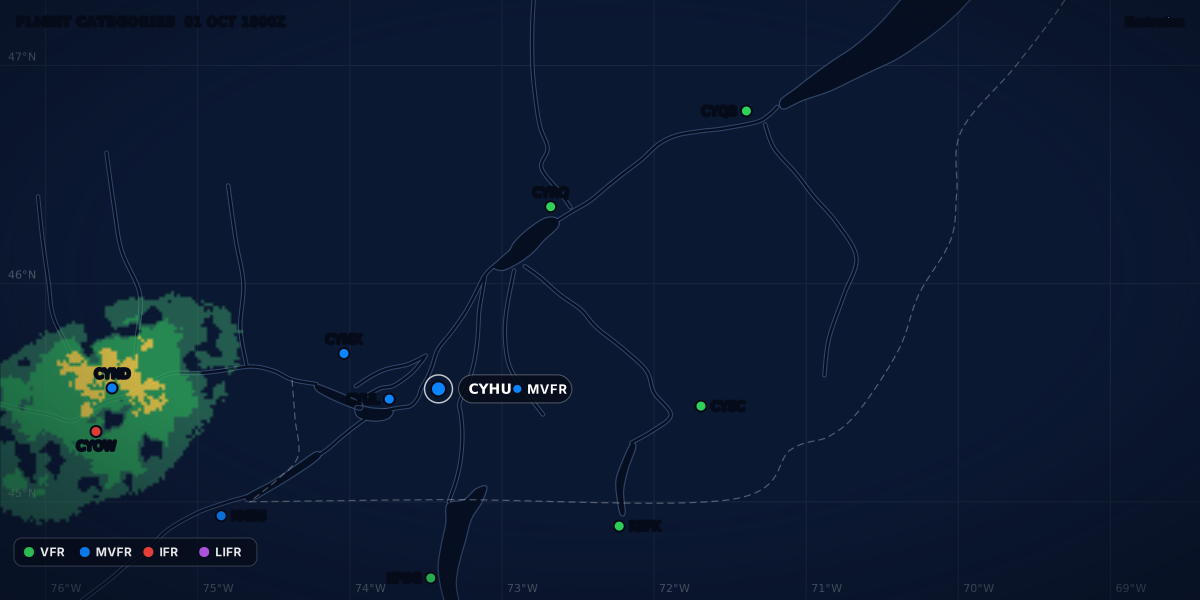
FLIGHT CATEGORIES 05 NOV 1412Z
VFRMVFRIFRLIFR
Illustration
VFR, MVFR, IFR and LIFR: flight categories explained
What VFR, MVFR, IFR and LIFR mean in a weather report, the exact ceiling and visibility limits, how to find the category, and what it does not tell you.
 Jp Valery
4 min read
Every weather report can be summed up in one word: VFR, MVFR, IFR or LIFR. That word is the flight category. It comes from two numbers in the METAR, the ceiling and the visibility, and it tells you at a glance how good or bad the weather is for flying by sight.
The names come from the flight rules, but a category is not a flight rule: the guide VFR vs IFR separates the rules, the conditions and the categories.
The four categories
| Category | Ceiling | Visibility | |
|---|---|---|---|
| VFR (visual flight rules) | above 3,000 ft | and | above 5 SM |
| MVFR (marginal VFR) | 1,000 to 3,000 ft | or | 3 to 5 SM |
| IFR (instrument flight rules) | 500 to below 1,000 ft | or | 1 to below 3 SM |
| LIFR (low IFR) | below 500 ft | or | below 1 SM |
Heights are above ground level. SM is statute miles. These are the limits of the US Aviation Weather Center (AWC GFA help). Transport Canada uses the same IFR, MVFR and VFR limits for the IFR outlook of its graphic area forecast (GFA), with no LIFR (TC AIM MET 4.9, Table 4.3).
To see how many days a year a field spends in the VFR category, read VFR days per year.
How to find the category
- Find the ceiling. It is the lowest cloud layer reported as broken (
BKN), overcast (OVC) or vertical visibility (VV). Few (FEW) and scattered (SCT) layers do not count. No such layer means no ceiling. The guide what is a ceiling covers the edge cases. - Find the visibility. It is the number before
SM. - Take the worse of the two. Each number gives a category. The report gets the lower one.
Two examples
Both reports are real-format examples, not real observations.
The ceiling is 2,800 ft (the broken layer): MVFR. The visibility is 15 SM: VFR. The worse of the two is MVFR.
The ceiling is 600 ft: IFR. The visibility is 2 SM: IFR. The category is IFR.
Colors
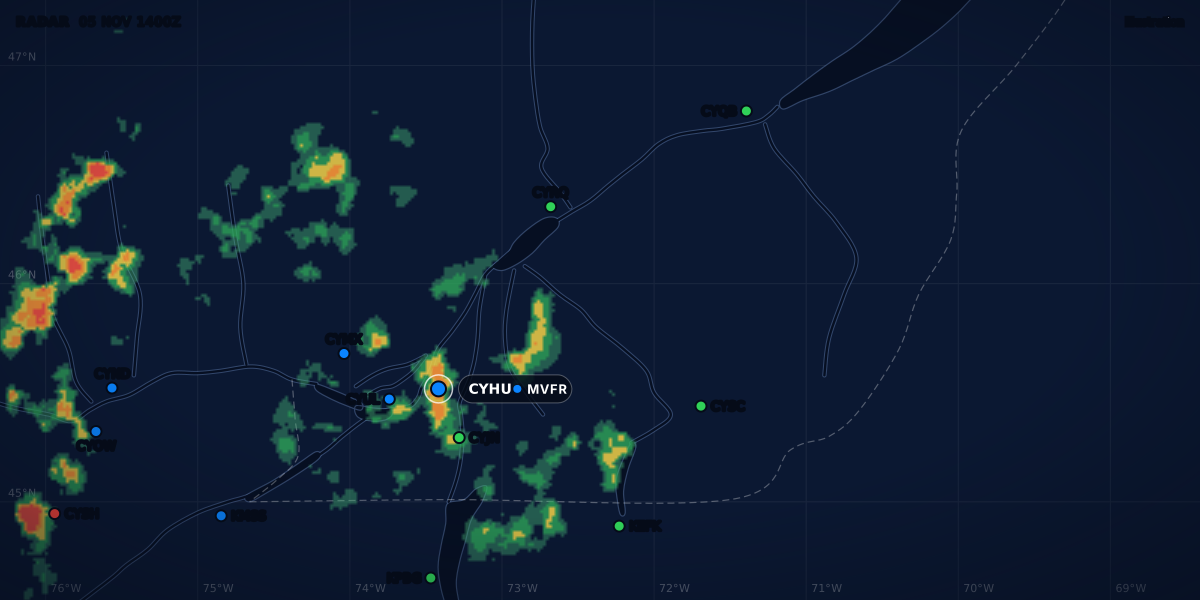
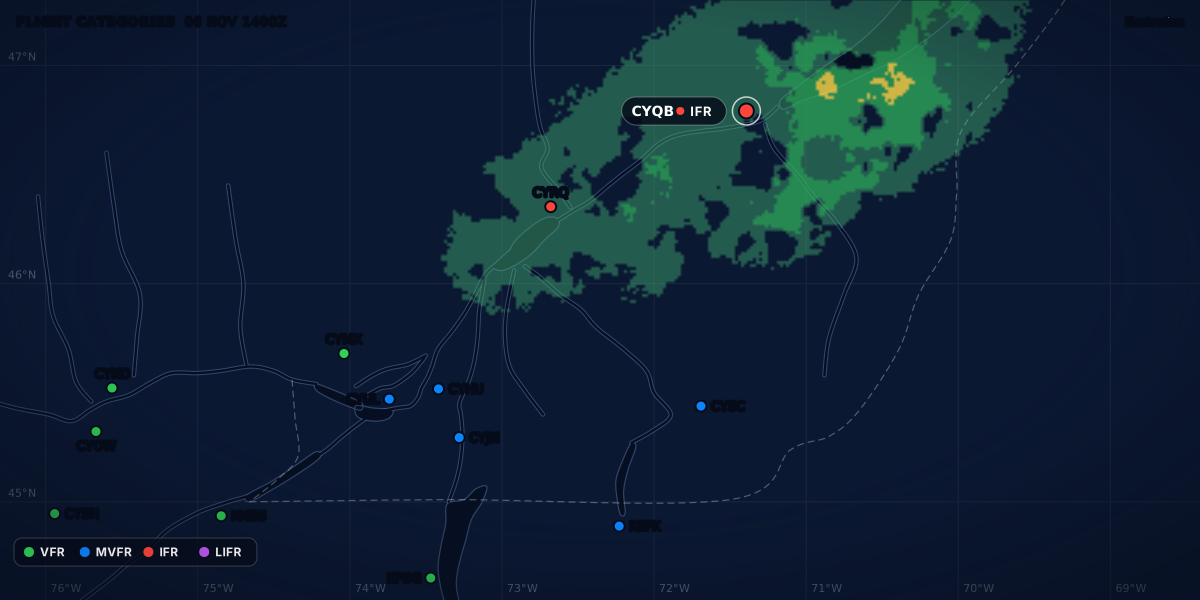
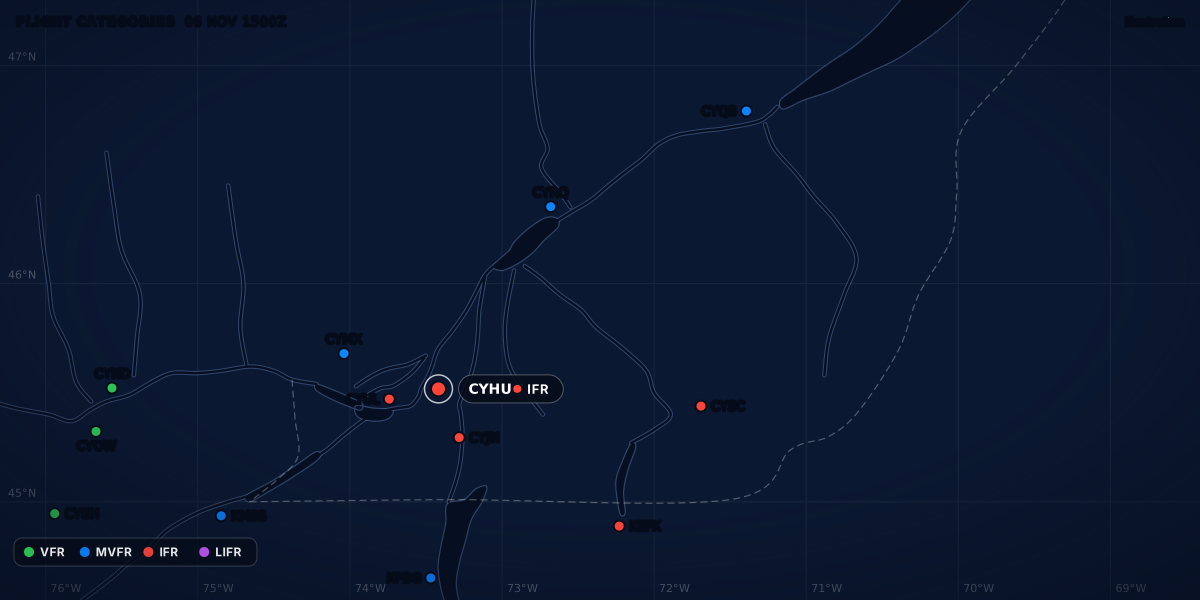
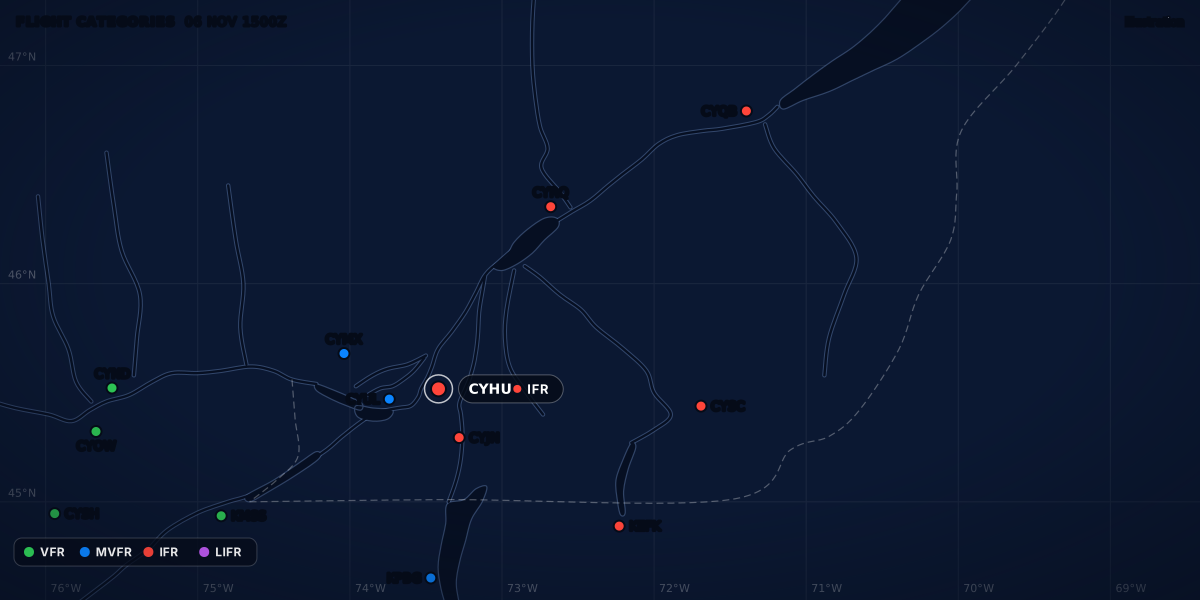
The Aviation Weather Center colors the categories green for VFR, blue for MVFR, red for IFR and purple for LIFR (AWC GFA help). ClearMETAR uses the same four colors and goes one step further: the whole screen takes the color of the category, and a text label always comes with it, so you never rely on color alone.
What the category does not tell you
The category looks only at the ceiling and the visibility. A VFR report can still be a bad day to fly:
- Wind. A 25-knot crosswind with gusts to 35 is VFR. It is also far above the 15 kt demonstrated crosswind of a Cessna 172.
- Thunderstorms.
TSorCBcan appear in a VFR report. - Icing and turbulence. They are not in the METAR at all.
- Density altitude. A hot day at a high field is VFR and still limits your climb.
- What comes next. A METAR describes the weather at one moment in the past. The TAF tells you what is forecast.
The category is also not a rule. The legal VFR weather minimums depend on the airspace, the country and the time of day. In Canada they are in the Canadian Aviation Regulations, CARs 602.114 and 602.115, and in the United States in 14 CFR 91.155. The categories are a summary to help you decide where to look closer.
Personal minimums
Many pilots set their own limits above the legal ones: for example, a ceiling of 3,000 ft, a visibility of 5 SM and a crosswind of 10 knots for a new private pilot. Write them down before you look at the weather, so the report cannot talk you into a flight. The personal minimums checklist starts from the same sample numbers and shows where each limit appears in a report. With ClearMETAR Pro, anything outside your limits shows in amber on every report and forecast.
Sources
- Graphical Forecasts for Aviation (GFA) help: flight category limits and colors, NOAA Aviation Weather Center
- TC AIM (TP 14371) 2026-2, MET 4.9, Table 4.3: IFR outlook criteria, Transport Canada
- CARs 602.114 and 602.115: minimum visual meteorological conditions for VFR flight, Justice Laws Website
- 14 CFR 91.155: Basic VFR weather minimums, eCFR
Rules checked on
Common questions
Is MVFR legal for a VFR flight?
MVFR is a weather category, not a rule: whether a VFR flight is legal depends on the VFR weather minimums for your airspace (CARs 602.114 and 602.115 in Canada, 14 CFR 91.155 in the US) and on your licence. MVFR conditions are often legal and often unwise, so check your personal minimums too.
Which counts, the ceiling or the visibility?
The worse of the two: the Aviation Weather Center gives the MVFR, IFR and LIFR limits as ceiling and/or visibility (AWC GFA help). If the ceiling says VFR and the visibility says IFR, the category is IFR.
Who defines the flight categories?
The US Aviation Weather Center publishes the four categories and their limits (AWC GFA help), and Transport Canada uses the same IFR, MVFR and VFR limits for the IFR outlook of its GFA (TC AIM MET 4.9, Table 4.3). They are a summary, not a group of the METAR itself.

Let the app do the decoding.
ClearMETAR turns every METAR and TAF into one plain sentence. Free on iPhone.