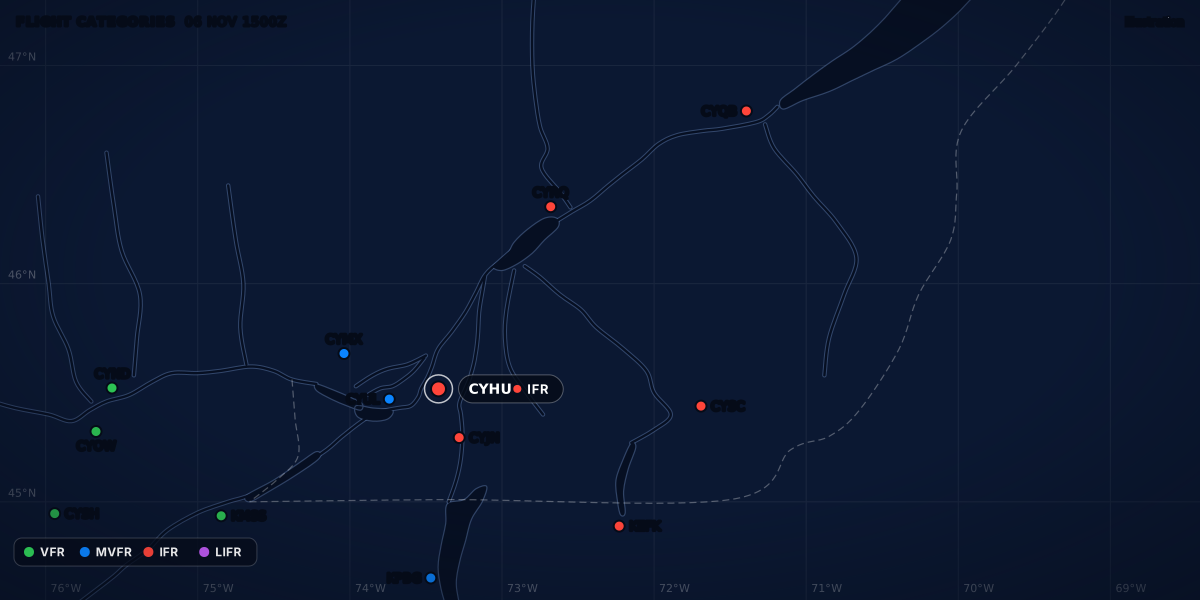
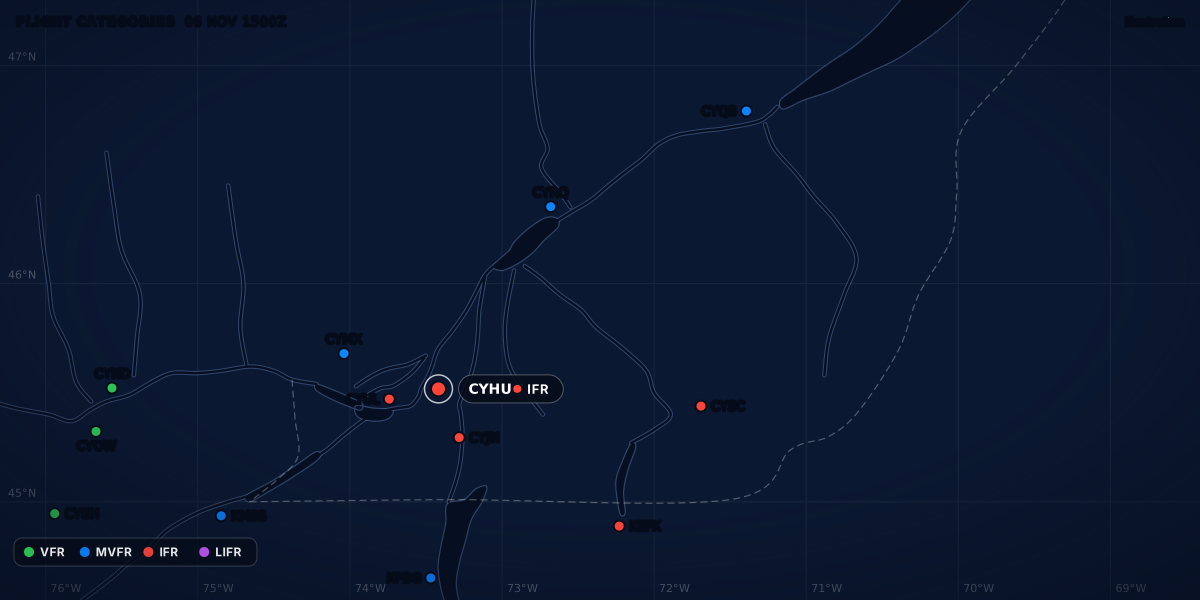
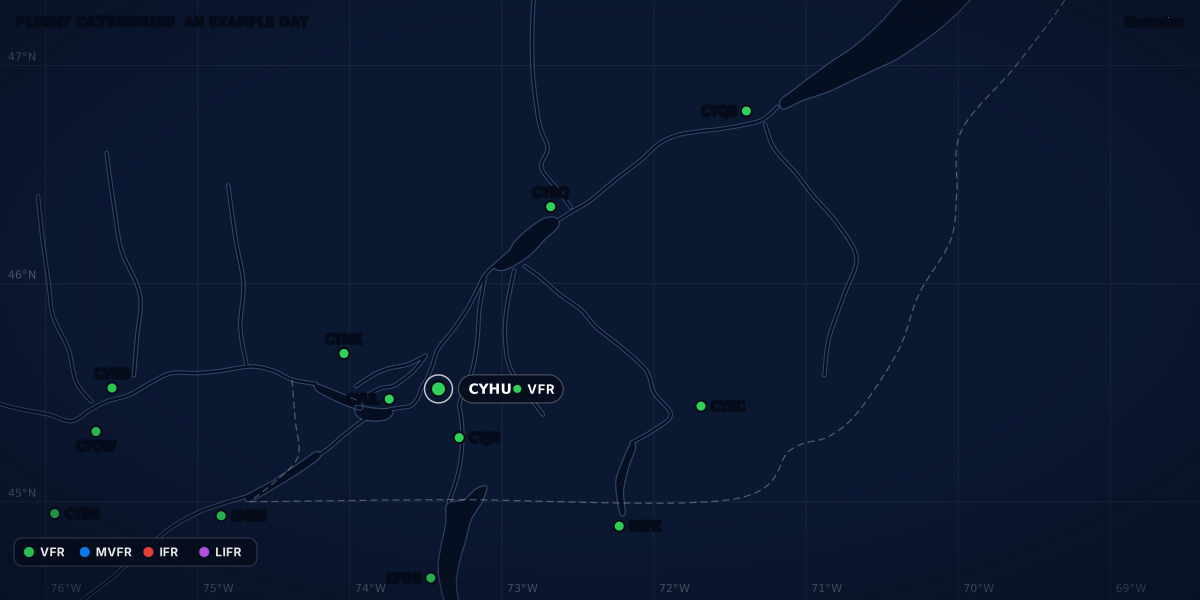
FLIGHT CATEGORIES 06 NOV 1500Z
VFRMVFRIFRLIFR
Illustration
Special VFR in Canada, the US and Europe: minima and night rules
Special VFR lets you fly in a control zone below VFR minima with a clearance. The minimums, how to ask, and the night rules, which differ in each country.
 Jp Valery
11 min read
Special VFR (SVFR) is a VFR flight that air traffic control authorizes inside a control zone when the weather is below the normal VFR minimums. It is one of the types of flight rules, next to plain VFR and IFR. Canada, the US and Europe all have it, and all three ask for a flight visibility of about 1 mile (1,500 m in Europe). They differ on the details that catch pilots: the night rules, a ceiling minimum, a speed limit, and airports where it is not allowed.
What special VFR is, and who asks
Each rule set words it a little differently:
- Canada. “special VFR flight means a VFR flight authorized by an air traffic control unit that is conducted within a control zone under VMC in accordance with Division VI of Subpart 2 of Part VI” (CARs 101.01).
- Europe. “‘special VFR flight’ means a VFR flight cleared by air traffic control to operate within a control zone in meteorological conditions below VMC” (SERA Art. 2, definition 122).
- United States. “Special VFR operations means aircraft operating in accordance with clearances within controlled airspace in meteorological conditions less than the basic VFR weather minima” (14 CFR 1.1). The minimums are in 14 CFR 91.157, and they apply “instead of” the basic VFR minimums of 91.155.
Note the words: Canada says “under VMC”, Europe says “below VMC”, and the US says “less than the basic VFR weather minima”. In all three, the special VFR rule sets its own, lower minimums.
In Canada and the US, you start it. In Canada, “SVFR will not be initiated by ATS”. You request the authorization, normally from the local tower or flight service station (FSS), and you must have it before you fly special VFR in the zone. ATC issues it “traffic and weather conditions permitting” (TC AIM RAC 2.7.3). In the US, special VFR operations “must be requested by the pilot and approved by ATC” (14 CFR 1.1), and 91.157(b)(1) needs “an ATC clearance”. SERA makes special VFR “subject to an ATC clearance” (SERA.5010). The French AIP puts it from the pilot’s side: you need a special VFR clearance to enter or fly in a control zone when you judge that the visual conditions are not met, or soon will not be (AIP France ENR 1.2.4.1).
Special VFR exists only in a control zone (in the US, the surface area of an airport’s controlled airspace). The guide to airspace classes explains these zones.
Canada: CARs 602.117
You may fly special VFR in a control zone when all four conditions of CARs 602.117(1) are true:
- The weather prevents compliance with 602.114(b), the 3-mile flight visibility of VFR in controlled airspace.
- The flight visibility is at least 1 mile (½ mile for a helicopter).
- You fly clear of cloud and with visual reference to the surface at all times.
- You requested and obtained the authorization from the ATC unit.
Under 602.117(2), “where aerodrome traffic permits”, ATC shall authorize special VFR when:
- you request it;
- the ground visibility in the control zone, when reported, is at least 1 mile (½ mile for a helicopter);
- the aircraft has a radio that can keep communication with the ATC unit;
- at night, for an aircraft that is not a helicopter, the authorization is to land at the destination aerodrome.
The TC AIM summary (RAC 2.7.3, Table 2.3) gives the same values. It describes special VFR as flight “in IFR weather conditions” and says you may request it “when weather conditions are below VFR minima”. Its notes add that you must follow every condition in the authorization, and that helicopters should fly slowly enough to see traffic and obstacles in time. Note one difference of wording. Condition (1)(a) of the regulation names only the visibility rule, 602.114(b). The TC AIM speaks of any weather below VFR minima.
Section 602.117 has no ceiling minimum, no speed limit and no instrument rating requirement.
At night. Canadian night runs from the end of evening civil twilight to the beginning of morning civil twilight (CARs 101.01). At night, ATC “will only authorize special VFR where the authorization is for the purpose of allowing the aircraft to land at the destination aerodrome” (TC AIM RAC 2.7.3, note 4). Helicopters are not limited this way.
Student pilots. Under CARs 401.19(1), a student pilot permit holder may act as pilot-in-command only on training flights in Canada, under day VFR (day or night VFR in an integrated course, 401.19(2)), under the direction and supervision of a qualified person, with no passengers. Section 602.117 has no student rule of its own. Ask your supervising instructor before you plan one.
United States: 14 CFR 91.157
Special VFR replaces the basic VFR minimums “below 10,000 feet MSL within the airspace contained by the upward extension of the lateral boundaries of the controlled airspace designated to the surface for an airport” (91.157(a)). You need (91.157(b)):
- an ATC clearance;
- to stay clear of clouds;
- except in a helicopter, a flight visibility of at least 1 SM;
- except in a helicopter, daylight: “between sunrise and sunset” (Alaska uses a sun angle instead), unless you meet “the applicable requirements for instrument flight under part 61” and the aircraft is equipped as 14 CFR 91.205(d) requires for IFR flight.
To take off or land under special VFR in an aircraft other than a helicopter (91.157(c)), the ground visibility must be at least 1 SM. If ground visibility is not reported, the flight visibility must be at least 1 SM. At a satellite airport with no weather reporting, a Part 91 flight may count the visibility from the cockpit in the take-off position as flight visibility. That estimate is not an official weather report (91.157(d)).
Where it is banned. Fixed-wing special VFR is prohibited at the airports listed in Part 91, Appendix D, Section 3, for example Boston Logan, Chicago O’Hare, LaGuardia, JFK and Washington National.
At night. The US special VFR limit uses sunset and sunrise, not civil twilight. So it starts earlier in the evening than US legal night, which begins at the end of evening civil twilight (14 CFR 1.1). The guide to the aviation night definition compares the windows. The recent-experience part of the instrument requirements is in IFR currency.
Student pilots. A student pilot may not act as pilot in command “with a flight or surface visibility of less than 3 statute miles during daylight hours or 5 statute miles at night” (14 CFR 61.89(a)(6)). So special VFR in less than 3 SM is closed to a student flying as pilot in command.
Europe: SERA.5010, and France
Regulation (EU) 2024/404 rewrote parts of SERA.5010, and the new text applies from 1 May 2025. Special VFR needs an ATC clearance, and these conditions apply:
- Day only, “unless otherwise permitted by the competent authority” (SERA.5010(a)).
- The pilot flies clear of cloud and with the surface in sight, with a flight visibility of at least 1,500 m (800 m for helicopters), at 140 kt IAS or less “to give adequate opportunity to observe other traffic and any obstacles in time to avoid a collision” (SERA.5010(b)).
- ATC shall not clear an aircraft to take off, land or enter the traffic circuit at an aerodrome in the control zone when the reported ground visibility is less than 1,500 m (800 m for helicopters) or the ceiling is less than 600 ft (180 m) (SERA.5010(c)).
Guidance material (GM1 SERA.5010(c)) adds that, when the reported ground visibility is below 1,500 m, ATC may still clear “a flight crossing the control zone and not intending to land at an aerodrome within the control zone” if the flight visibility reported by the pilot is at least 1,500 m (800 m for helicopters). The first lines of SERA.5010 also let the competent authority permit other conditions for helicopters in special cases, such as police, medical, search and rescue or firefighting flights.
Night under SERA runs from the end of evening civil twilight to the beginning of morning civil twilight (Art. 2, definition 97). The competent authority of each state decides whether to permit special VFR at night. France permits it for helicopters only, below 140 kt IAS, clear of cloud and in sight of the ground, with a flight visibility of 4,000 m or more and a ceiling of at least 1,000 ft (AIP France ENR 1.2.4.2). An aeroplane gets no special VFR at night in France.
Side by side
For aeroplanes. Helicopters have their own values in each rule.
| Canada | United States | Europe (SERA) | |
|---|---|---|---|
| Rule | CARs 602.117 | 14 CFR 91.157 | SERA.5010 |
| Where | Control zone | Surface area of an airport’s controlled airspace, below 10,000 ft MSL | Control zone |
| Permission | ATC authorization, on your request; ATS never starts it | ATC clearance, on your request | ATC clearance |
| Flight visibility | 1 mile | 1 SM | 1,500 m (0.93 SM) |
| Ground visibility | 1 mile, when reported | 1 SM to take off or land (flight visibility if not reported) | 1,500 m to take off, land or join the circuit |
| Ceiling | None | None | 600 ft to take off, land or join the circuit |
| Cloud | Clear of cloud, visual reference to the surface | Clear of clouds | Clear of cloud, surface in sight |
| Speed limit | None | None | 140 kt IAS |
| Night | Only to land at the destination | Only with the Part 61 instrument requirements and an IFR-equipped aircraft (sunset to sunrise) | Day only unless the state permits it (France: helicopters only) |
| Airports where it is banned | None in 602.117 | Part 91, Appendix D, Section 3 | None in SERA.5010 |
Worked example: one report, three answers
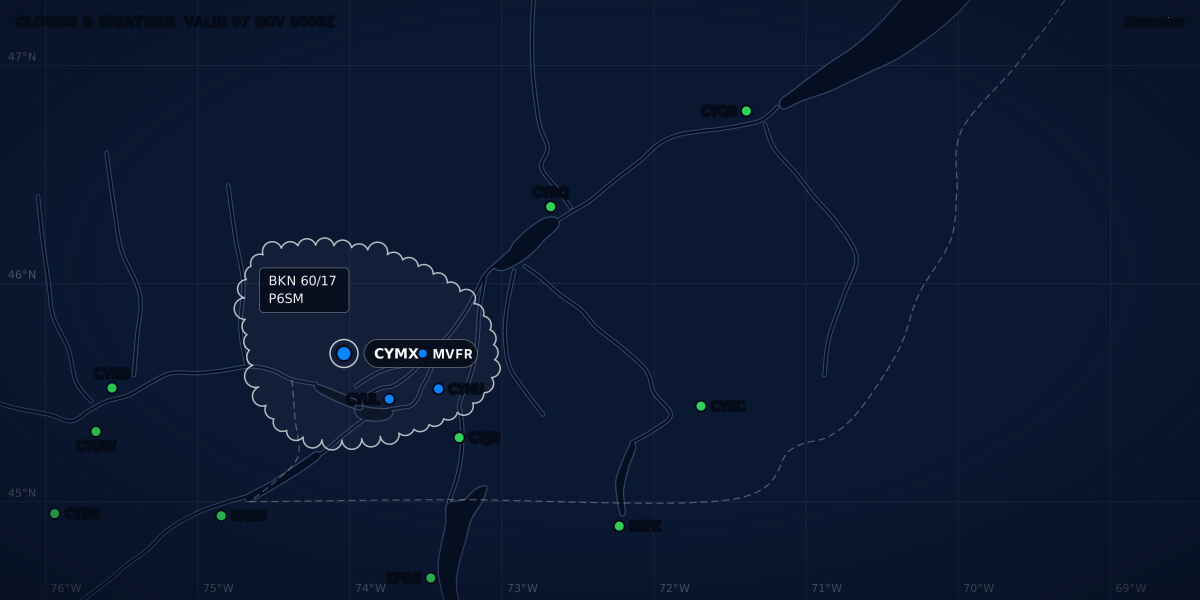
A real-format example (constructed, not a real report) from Montréal / St-Hubert. CYHU is in a Class C control zone up to 2,000 ft ASL (Designated Airspace Handbook, Issue 324, 3.5.4).
The ceiling is 900 ft (the broken layer). The visibility is 4 SM in mist. The flight category is IFR, because the ceiling is below 1,000 ft. The category is a summary; the minimums are the law (flight categories).
Canada (CYHU).
- Plain VFR: no. The 4 SM meets the 3-mile visibility of CARs 602.114(b). But you must stay 500 ft below cloud (602.114(c)) and, except to take off or land, 500 ft above the surface (602.114(d)(ii)). Under a 900 ft base, the highest legal height is 900 − 500 = 400 ft, which is below the 500 ft floor. The guide to VFR weather minimums works through this rule.
- Special VFR: the weather is below VFR minima, which is the case the TC AIM describes. The special VFR values are met: 4 SM is more than 1 mile, and you can stay clear of cloud under a 900 ft base. Here the cloud is the problem, not the visibility. This is the case where the CARs wording and the TC AIM summary differ (see the Canada section above). Ask the tower, and do not enter the zone without the authorization.
- At night: only to land at your destination.
United States (the same weather at an airport in a Class D surface area).
- Plain VFR: no. You may not fly VFR beneath a ceiling of less than 1,000 ft in the surface area (14 CFR 91.155(c)). The 4 SM is enough for the 3 SM of 91.155(d), so the ceiling alone stops you.
- Special VFR: by day, with a clearance. You stay clear of clouds with at least 1 SM flight visibility, and the 4 SM ground visibility is more than the 1 SM needed to take off or land. Not at an Appendix D airport.
- After sunset: only with the Part 61 instrument requirements and an IFR-equipped aircraft.
Europe (the same weather in a control zone; 4 SM is about 6.4 km).
- Plain VFR: no take-off, landing or circuit without an ATC clearance, because the ceiling is below 1,500 ft (SERA.5005(b)). The 6.4 km is above the 5 km of that rule. Near the ground in classes B to E, SERA Table S5-1 also asks for 1,000 ft vertically from cloud, which a 900 ft base does not allow.
- Special VFR: by day, ATC may clear it. The ceiling is above 600 ft and the ground visibility is above 1,500 m (SERA.5010(c)). You fly clear of cloud, with the surface in sight, at 140 kt IAS or less.
- At night: no, unless the state permits it. In France, not in an aeroplane.
By day, the three answers mostly agree: plain VFR is out, and special VFR is possible with a clearance (in Canada, ask the tower because of the wording difference above). After dark they split. The rules for VFR at night in general are in night VFR.
Terrain, obstacles and traffic stay your job
Special VFR lowers the weather minimums. It does not lower anything else.
- In Canada, after the authorization, “the pilot continues to remain responsible for avoiding other aircraft and weather conditions beyond the pilot’s own flight capabilities and the capabilities of the aircraft” (TC AIM RAC 2.7.3).
- The SERA speed limit exists to give you time to see traffic and obstacles (SERA.5010(b)(3)).
- The minimums are a legal floor, not a safe target. Set your own personal minimums before you look at the weather.
- The weather can drop while you are in the zone. An aerodrome issues a SPECI between routine reports when the weather crosses a threshold. ClearMETAR Pro sends an alert when a station changes category, when a SPECI comes out and when the TAF is amended. It does not tell you whether special VFR is legal or available. The rules and ATC decide that.
Sources
- CARs 602.117: Special VFR flight, Justice Laws Website
- CARs 602.114: VFR flight in controlled airspace, Justice Laws Website
- CARs 101.01: definitions (special VFR flight, night), Justice Laws Website
- CARs 401.19: student pilot permit privileges, Justice Laws Website
- TC AIM (TP 14371) 2026-2, RAC 2.7.3 and Table 2.3: special VFR in control zones, Transport Canada
- Designated Airspace Handbook (TP 1820E), Issue 324, 3.5.4: control zones, NAV CANADA
- 14 CFR 91.157: Special VFR weather minimums, eCFR
- 14 CFR 91.155: Basic VFR weather minimums, eCFR
- 14 CFR 91.205(d): instruments and equipment for IFR flight, eCFR
- 14 CFR 1.1: definitions (special VFR operations, night), eCFR
- 14 CFR Part 91, Appendix D, Section 3: locations where fixed-wing special VFR is prohibited, eCFR
- 14 CFR 61.89: General limitations (student pilots), eCFR
- Easy Access Rules for SERA (August 2025): Art. 2, SERA.5001, SERA.5005, SERA.5010, GM1 SERA.5010(c), EASA
- Commission Implementing Regulation (EU) 2024/404 (amends SERA.5010), EUR-Lex
- AIP France ENR 1.2.4: vol VFR spécial, SIA (DGAC)
Rules checked on
Common questions
Can I get special VFR at night?
It depends on the country: in Canada an aircraft other than a helicopter gets night special VFR only to land at its destination (CARs 602.117(2)(d)), and in the US only if the pilot meets the Part 61 instrument requirements and the aircraft is equipped for IFR (14 CFR 91.157(b)(4)). Under SERA it is day only unless the authority permits it (SERA.5010(a)), and France permits night special VFR for helicopters only (AIP France ENR 1.2.4.2).
Does ATC offer special VFR?
Not in Canada or the US: you ask for it. The TC AIM says "SVFR will not be initiated by ATS" (RAC 2.7.3), 14 CFR 1.1 says special VFR operations "must be requested by the pilot and approved by ATC", and SERA makes special VFR "subject to an ATC clearance" (SERA.5010).
Is there a ceiling minimum for special VFR?
Of the three rule sets, only SERA has one: ATC may not clear an aircraft to take off, land or join the circuit at a control-zone aerodrome when the reported ceiling is below 600 ft or the ground visibility below 1,500 m (SERA.5010(c)). CARs 602.117 and 14 CFR 91.157 set no ceiling; you stay clear of cloud.
Let the app do the decoding.
ClearMETAR turns every METAR and TAF into one plain sentence. Free on iPhone.