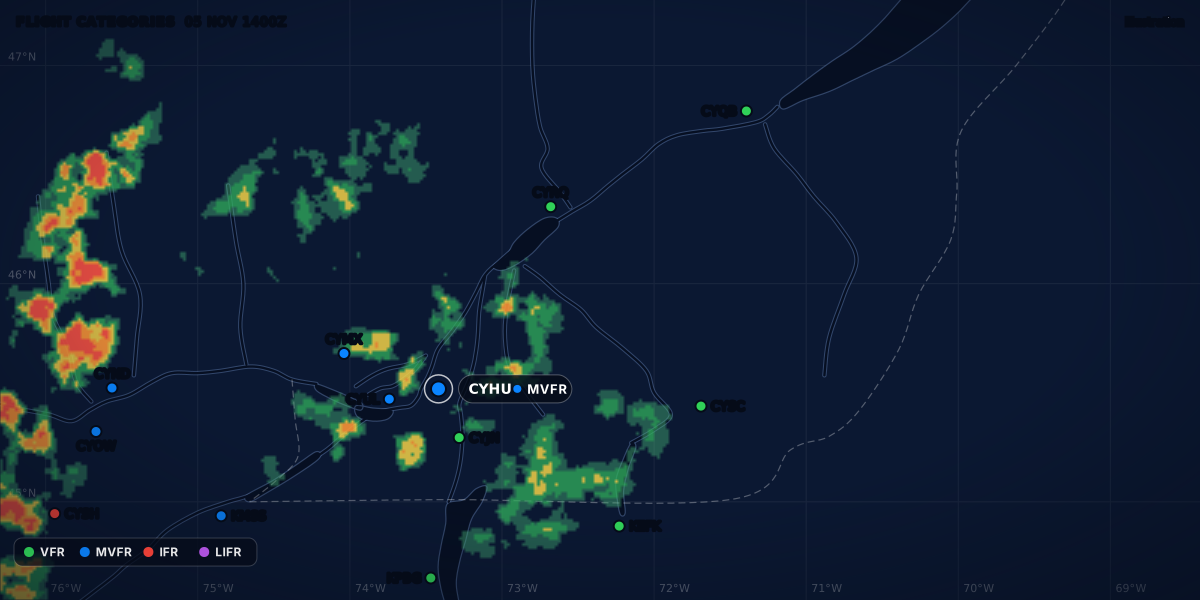
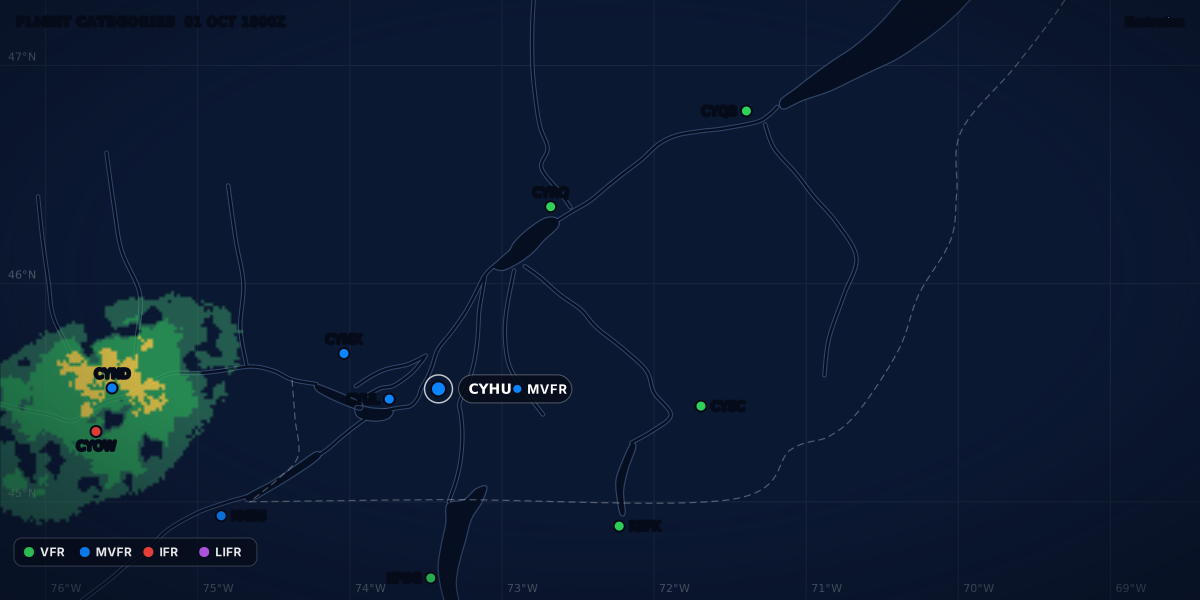
FLIGHT CATEGORIES 06 OCT 1700Z
VFRMVFRIFRLIFR
Illustration
Maximum demonstrated crosswind: a limit or not?
The POH crosswind number is demonstrated, not a limit. Where it comes from, the Cessna 172 and PA-28 values, how to count gusts, the gust factor and tailwind.
 Jp Valery
9 min read
Your POH gives a crosswind number, the maximum demonstrated crosswind. It is the highest crosswind that the manufacturer demonstrated to be safe for takeoff and landing. It is not a promise for today’s gusty wind. Unless your flight manual lists it as a limitation, it is not a limit either. This page explains where the number comes from, which crosswind to compare with it on a gusty day, how much speed the gust factor adds, and what a tailwind changes. To work out the crosswind itself from a report, use the crosswind calculator, or learn the method in the crosswind component guide.
Cessna 172 and Piper Archer: the demonstrated values
Two accident reports and one incident report give the value for the Cessna 172 and the Piper Archer:
| Airplane | Maximum demonstrated crosswind | Source |
|---|---|---|
| Cessna 172N (1977) | 15 kt | NTSB report LAX97LA166, quoting Cessna |
| Cessna FR172G Skyhawk | 15 kt | AAIB Bulletin 8/2003, quoting the POH |
| Piper PA-28-181 Archer III | 17 kt | AAIB Bulletin 7/2008, quoting the POH |
So if you look up a Cessna 172 crosswind limit, these reports give 15 kt, and they call it demonstrated. The NTSB notes that the 1977 172N handbook “contains no information regarding not-to-exceed crosswind velocities” for landing or taxiing. Read the number in the POH of your own airplane, for its model and year.
Where the number comes from
Canada. The TC AIM, AIR 2.2, says that “light aircraft manufactured in the United States are designed to withstand, on landing, 90° crosswinds up to a velocity equal to 0.2 (20%) of their stalling speed”. Its example is an aircraft that stalls at 50 KIAS: 0.2 × 50 = 10 kt straight across the runway. The same section adds: “The aircraft owner’s manual may give higher or limiting crosswinds.” It also says that about 10% of light-aircraft accidents in Canada are attributed to a pilot’s failure to compensate for the crosswind on landing.
United States. The former US rule, 14 CFR 23.233(a), said:
A 90 degree cross-component of wind velocity, demonstrated to be safe for taxiing, takeoff, and landing must be established and must be not less than 0.2 VSO.
VSO (written VS0 in 14 CFR 1.2) is “the stalling speed or the minimum steady flight speed in the landing configuration”. So 0.2 VSO is the least the manufacturer had to demonstrate. The value in the POH can be higher.
The value then went into the flight manual. 14 CFR 23.1585(a)(2) asked for “the maximum demonstrated values of crosswind for takeoff and landing” in the operating procedures. The list of operating limitations, 23.1583, did not mention wind at all. These two sections and 23.233 were removed on August 30, 2017, when the FAA’s rewrite of Part 23 took effect (Amendment 23-64). The new flight-manual section, 23.2620, does not name crosswind.
Europe. CAA Norway, in an article on the EASA Community site (August 2026), puts it in two sentences: “The maximum demonstrated crosswind component is not necessarily an operational limit. Nor is it a guarantee that you will be able to handle the conditions.”
What this means for you. The number tells you what the manufacturer showed. Flight-manual numbers come from a good runway: Transport Canada notes that the landing distance and the crosswind limitations (if applicable) in a flight manual are demonstrated “on runways that are bare, dry, and that have high surface friction characteristics” (TC AIM AIR 1.6.2). Look in the limitations section of your flight manual. If a crosswind is there, it is a limit. If it is not, the number is information, not a limit: use it to set your own. The FAA Airplane Flying Handbook (FAA-H-8083-3C, chapter 9, p. 9-20) lists as the first common crosswind error: “Attempted landing in crosswinds that exceed the airplane’s maximum demonstrated crosswind component.”
Gusts: the gust crosswind and the gust factor
A G in the wind group gives the peak gust. Each country has its own rule for when a report shows it (TC AIM MET 8.2 in Canada, FMH-1 5.4.4 in the US), and the crosswind component guide lists them.
Here is a real gusty afternoon at Montréal / St-Hubert:
Real report, IEM archive, October 6, 2026, 17:00 UTC (13:00 EDT). The wind is 260° true at 16 kt, with gusts to 26 kt. METAR winds are true (TC AIM MET 8.2): before you use a runway number, read true or magnetic.
Put that wind on an example runway (not one of CYHU’s) that points 310° true, 50° off the wind. The table also checks the sample personal limit of 10 kt (see the last section):
| Runway end | Angle | Headwind (steady / gusts) | Crosswind (steady / gusts) |
|---|---|---|---|
| 310° ★ besttrue | 50° left | 10 / 17 kt | 12 / 20 kt from the leftover your 10 kt limit |
| 130°true | 130° right | tailwind 10 / 17 kt | 12 / 20 kt from the rightover your 10 kt limit |
Which crosswind to compare
On the 310° end, the steady crosswind is 12 kt and the gust crosswind is 20 kt. Against the Cessna 172’s 15 kt, the steady number is under it and the gust number is 5 kt over it. Against the Archer’s 17 kt, the gust number is 3 kt over.
None of the sources on this page gives a rule for which of the two numbers to compare with the POH value. Two of them count the gusts:
- In Canada, noise abatement no longer decides the runway when the crosswind, “including gusts”, exceeds 25 KIAS or the tailwind, “including gusts”, exceeds 5 kt (TC AIM RAC 7.7.2).
- In the Chandler, Arizona, accident of April 24, 1997, a Cessna 172N lost directional control in a gust on runway 22L. The wind just before was 280° at 18 kt with gusts to 25 kt. The NTSB computed 16 kt of crosswind steady and 22 kt in the gusts, and wrote that the wind “exceeded the aircraft’s demonstrated crosswind capability by as much as 7 knots, or 46 percent” (LAX97LA166).
Comparing the gust crosswind is the cautious choice.
The mean can drop while the gusts stay
One hour later, the same station reported 26008G26KT (real report, IEM archive, 18:00 UTC). On the same example runway:
| Time | Wind | Steady crosswind | Gust crosswind | Gust factor |
|---|---|---|---|---|
| 17:00 UTC (13:00 EDT) | 26016G26KT |
12 kt | 20 kt | 10 kt |
| 18:00 UTC (14:00 EDT) | 26008G26KT |
6 kt | 20 kt | 18 kt |
The steady crosswind fell by half. The gust crosswind did not change. If you read only the mean speed, the second report looks easier. It is gustier.
The gust factor and your approach speed
The gust factor is the difference between the gust and the mean wind (CAA Norway). In the example, it is 26 − 16 = 10 kt at 17:00 and 26 − 8 = 18 kt at 18:00.
The Airplane Flying Handbook (p. 9-20) describes a common practice:
Pilots often use the normal approach speed plus one-half of the wind gust factors in turbulent conditions. If the normal speed is 70 knots, and the wind gusts are 15 knots, an increase of airspeed to 77 knots is appropriate.
The next sentence matters as much: “In any case, the airspeed and the flap setting should conform to airplane manufacturer’s recommendations in the AFM/POH.” For a short-field approach with no speed from the manufacturer, the handbook uses not more than 1.3 VSO, and “in gusty air, no more than one-half the gust factor is added” (p. 9-21).
With the handbook’s 70 kt and the CYHU reports:
| Time | Gust factor | Half | Approach speed |
|---|---|---|---|
| 17:00 UTC | 10 kt | 5 kt | 70 + 5 = 75 kt |
| 18:00 UTC | 18 kt | 9 kt | 70 + 9 = 79 kt |
More speed is not always safer. CAA Norway writes that half the gust factor “is not a general rule that applies to all aircraft” and that “arbitrarily increasing the landing speed does not necessarily improve safety”. Extra speed also needs extra runway: too much of it “could result in a touchdown too far from the runway threshold or an after-landing roll that exceeds the available landing area” (Airplane Flying Handbook, p. 9-21). In the Rochester accident of March 2, 2008 (AAIB Bulletin 7/2008), the pilot of a PA-28-181 was landing in a gusting crosswind. He knew that the airplane’s increased weight needed a slightly higher approach and touchdown speed, but he “overestimated these”. The airplane touched down at about 75 kt. The POH final approach speed with flap is 66 kt. The airplane bounced and, on its last touchdown, landed nosewheel first.
Flaps matter too. The handbook says to use partial flaps in turbulent air with a gusty crosswind (p. 9-20). The FR172G handbook says: “when landing in a strong crosswind, use the minimum flap setting required for the field length” (AAIB Bulletin 8/2003).
Tailwind
The other end of the example runway, 130°, has the wind behind you: a tailwind of 10 kt, 17 kt in the gusts. A tailwind adds to your ground speed. At the handbook’s 70 kt, you meet the runway at about 80 kt over the ground on the 130° end (70 + 10), and at about 60 kt on the 310° end (70 − 10): about 20 kt apart for the same approach.
Look in your POH for how its takeoff and landing distances change with a tailwind. If it gives no figure for the tailwind you have, you have no data for that takeoff or landing. The landing distances in a flight manual also come from a good runway: bare, dry, with high friction (TC AIM AIR 1.6.2).
In Canada, ATC has its own numbers for choosing a preferential runway at a controlled airport (TC AIM RAC 4.1.3):
The maximum effective crosswind component considered in determining runway selection is 25 kt for arrivals and departures on DRY runways, and 15 kt on WET runways. The maximum effective tailwind component is 5 kt.
For a noise preferential runway, the crosswind and the tailwind count “including gusts” (RAC 7.7.2). On the example runway, the 130° end fails the 5 kt test with or without the gusts. These are criteria for ATC, not limits for your airplane. RAC 7.7.2 adds that “pilots are not obligated to accept the runway for taking off or landing. It remains the pilot’s responsibility to decide if the assigned runway is operationally acceptable.”
Setting your personal limits
The POH number is the manufacturer’s. Your limit is yours. Write it down before you look at the weather, so the report cannot talk you into the flight.
- Pick a crosswind limit at or below the POH value. Our sample for a new private pilot is 10 kt, the same number as in the personal minimums checklist.
- Compare the gust crosswind with it, not only the steady one. In the CYHU example, both numbers are over 10 kt: 12 kt steady and 20 kt in the gusts.
- Add a line for the gusts and a line for the tailwind. Decide how large a gust factor and how much tailwind you accept, and check them against your POH.
- Check the TAF, not only the METAR. In a Canadian TAF, a gust shows only when it is forecast to exceed the mean by 10 kt or more (TC AIM MET 7.3).
A gust group is also a clue to a bumpy ride for your passengers. The guide to turbulence with passengers shows when the wind tends to calm down.
ClearMETAR shows the crosswind and the crosswind in gusts on the best runway end, from the latest METAR. With Pro, the steady or the gust crosswind turns amber when it is over your crosswind limit, and the forecast strip marks in amber the TAF periods where the crosswind would be over it.
Sources
- TC AIM (TP 14371) 2026-2, AIR 1.6.2 and AIR 2.2: runway friction and aircraft performance; crosswind landing limitations, Transport Canada
- TC AIM (TP 14371) 2026-2, RAC 4.1.3 and 7.7.2: preferential and noise preferential runways, Transport Canada
- TC AIM (TP 14371) 2026-2, MET 7.3 and 8.2: gusts in TAFs and METARs, Transport Canada
- 14 CFR 23.233 Directional stability and control (text in force on January 3, 2017; removed on August 30, 2017), eCFR
- 14 CFR 23.1583 Operating limitations and 23.1585 Operating procedures (text in force on January 3, 2017; removed on August 30, 2017), eCFR
- 14 CFR 1.2 Abbreviations and symbols (VS0), eCFR
- Revision of Airworthiness Standards for Normal, Utility, Acrobatic, and Commuter Category Airplanes (81 FR 96572, December 30, 2016; in force August 30, 2017), Federal Register
- Airplane Flying Handbook (FAA-H-8083-3C), chapter 9, pp. 9-20 and 9-21: crosswind errors, turbulent air and short-field approaches, Federal Aviation Administration
- NTSB Aviation Investigation Factual Report LAX97LA166: Cessna 172N, Chandler, Arizona, April 24, 1997, National Transportation Safety Board
- AAIB Bulletin 8/2003: Cessna FR172G Skyhawk, D-EKKO, UK Air Accidents Investigation Branch
- AAIB Bulletin 7/2008: Piper PA-28-181 Cherokee Archer III, G-MPAA, UK Air Accidents Investigation Branch
- Variable Winds and Gusts, by CAA Norway (August 14, 2026), EASA Community
- Federal Meteorological Handbook No. 1 (FCM-H1-2019), 5.4.4: wind gust, Office of the Federal Coordinator for Meteorology
- ASOS/METAR archive: CYHU, October 6, 2026, Iowa Environmental Mesonet
Rules checked on
Common questions
Is the maximum demonstrated crosswind a limitation?
Not unless your flight manual lists it as a limitation. The former US rule put the value in the manual's operating procedures, 14 CFR 23.1585(a)(2), not in its operating limitations (23.1583), and TC AIM AIR 2.2 notes that an owner's manual may give a limiting crosswind.
How much should I add to my approach speed for gusts?
What your POH says comes first. The FAA Airplane Flying Handbook (chapter 9, p. 9-20) says pilots often add half the gust factor, the gust minus the mean wind: 5 kt for a 26016G26KT wind.
How much tailwind is acceptable?
Only as much as your POH takeoff and landing data cover, on the runway you have. At controlled airports in Canada, ATC uses a maximum tailwind of 5 kt when it selects a preferential runway (TC AIM RAC 4.1.3), with gusts counted for a noise preferential runway (RAC 7.7.2).

Let the app do the decoding.
ClearMETAR turns every METAR and TAF into one plain sentence. Free on iPhone.