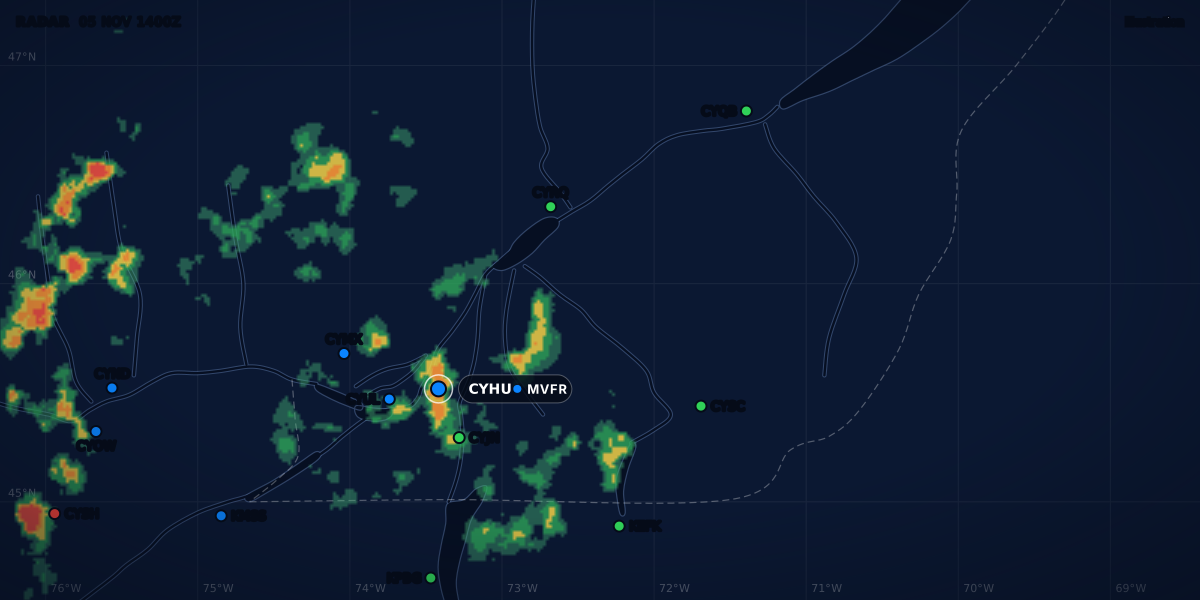
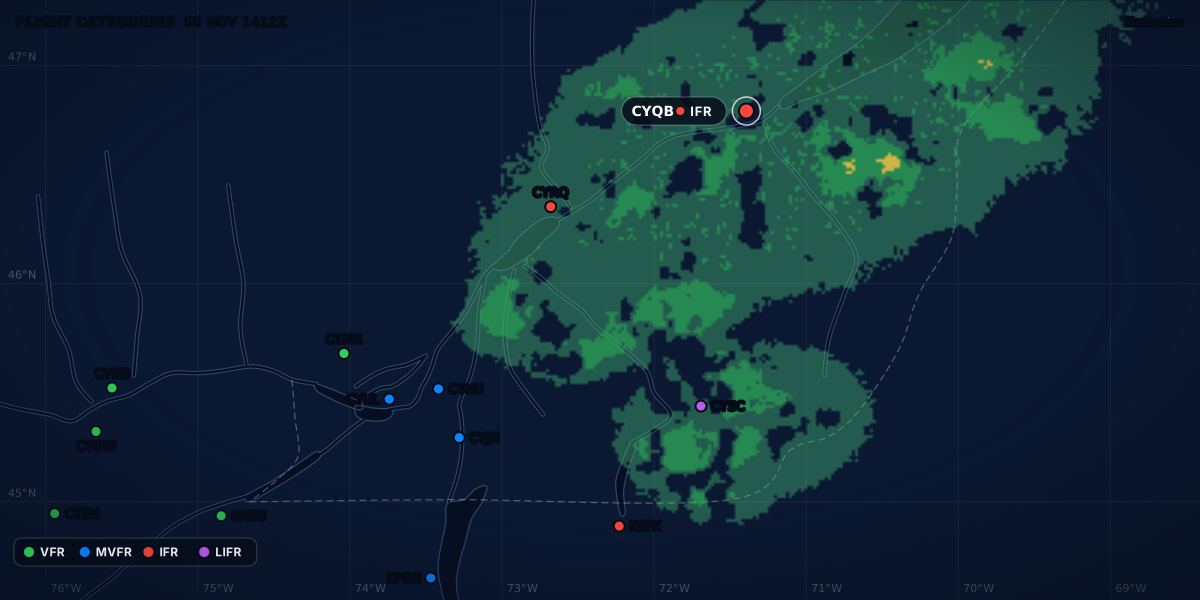
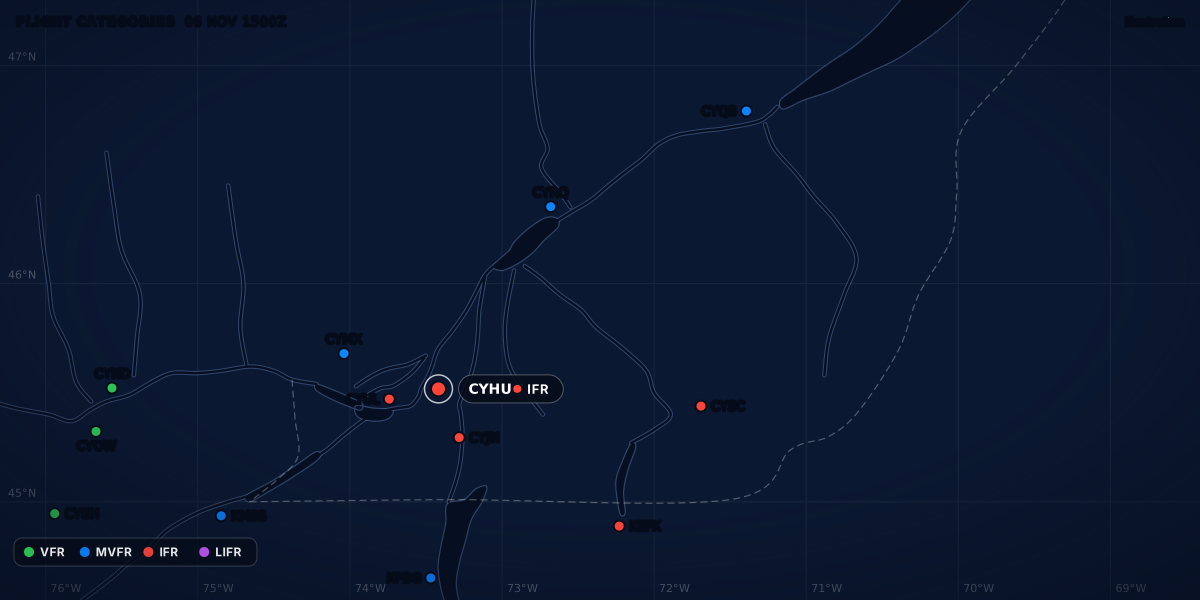
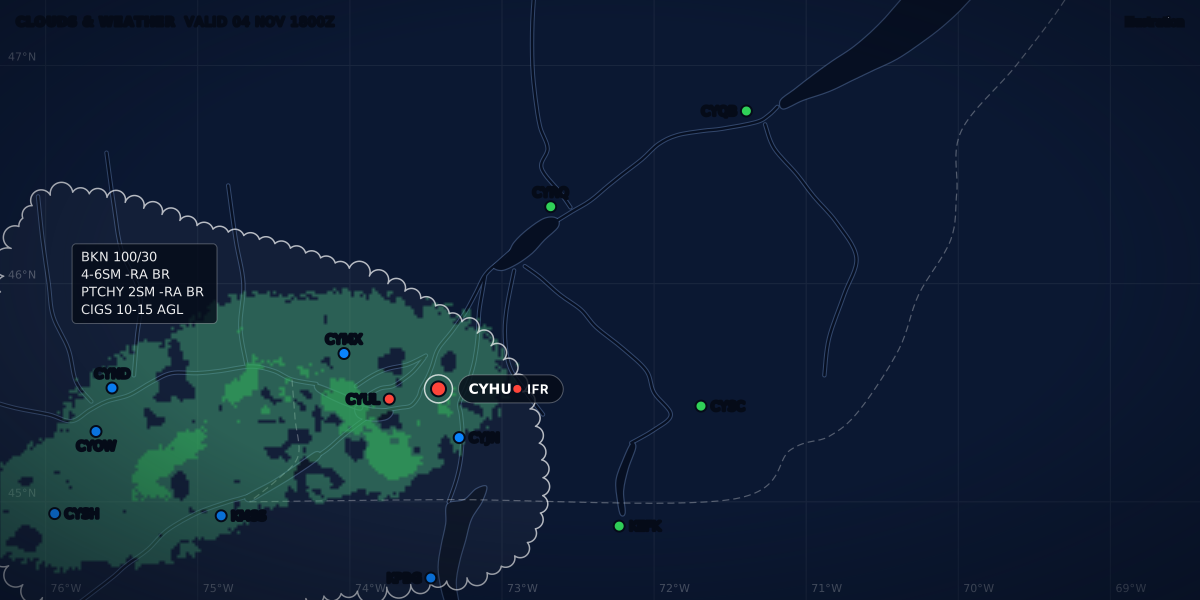
FLIGHT CATEGORIES 06 NOV 1400Z
VFRMVFRIFRLIFR
Illustration
What is a ceiling in aviation? Canada, US and EU definitions
The cloud ceiling is the lowest broken or overcast layer, or a vertical visibility. Canada, US and EU definitions side by side, and the SCT, VV and CLR cases.
 Jp Valery
9 min read
Short answer
The ceiling, or cloud ceiling, is the height above the ground of the lowest cloud layer that covers more than half the sky. In a METAR or a TAF, it is the lowest layer coded broken (BKN) or overcast (OVC). When fog or snow hides the whole sky, it is the vertical visibility (VV). Few (FEW) and scattered (SCT) layers are never the ceiling. If no layer qualifies, there is no ceiling.
Here is a real-format example (constructed, not a real report) from Québec / Jean Lesage (CYQB):
The scattered layer at 400 ft is the lowest cloud, but it is not the ceiling. The ceiling is the overcast layer at 800 ft. The remark SF3NS5 gives the amount of each layer: stratus fractus covers 3/8 of the sky at 400 ft, and nimbostratus adds 5/8 at 800 ft. Together they cover 8/8, so the higher layer is coded OVC.
The definitions side by side
This table compares four texts: two from the United States, one from Canada and one from the European Union. They agree on the core and differ at the edges.
| Where | Source | Definition |
|---|---|---|
| United States, rule | 14 CFR 1.1 | “the height above the earth’s surface of the lowest layer of clouds or obscuring phenomena that is reported as “broken”, “overcast”, or “obscuration”, and not classified as “thin” or “partial”” |
| United States, observing | FMH-1 9.4.5 | “The ceiling shall be the lowest layer aloft reported as broken or overcast. If the sky is totally obscured, the vertical visibility shall be the ceiling.” |
| Canada | TC AIM MET 8.2 | “the lesser of the following: the height above ground or water of the base of the lowest layer of cloud covering more than half of the sky, or the vertical visibility in a surface-based layer which completely obscures the whole sky” |
| European Union | SERA, Article 2(50) | “the height above the ground or water of the base of the lowest layer of cloud below 6 000 m (20 000 ft) covering more than half the sky” |
“More than half the sky” and “broken or overcast” are the same thing in the code. BKN is 5/8 to less than 8/8 of the sky, and OVC is 8/8 (TC AIM MET Table 8.2, FMH-1 Table 12-3).
- Canada. The Canadian Aviation Regulations do not define the word in their definitions section, 101.01. The definition is in the TC AIM, which adds: “a ceiling exists at the height of the first layer for which a coverage symbol of BKN or OVC is reported. The existence of a vertical visibility constitutes an obscured ceiling.”
- United States. 14 CFR 1.1 is the rule. FMH-1 is the standard that weather stations follow to observe and code the sky. In its code,
VVmarks an “indefinite ceiling” (FMH-1 12.6.9(b)): the vertical visibility up into an obscuration at the surface (FMH-1 Appendix A). - Europe. SERA holds the EU rules of the air. Regulation (EU) No 923/2012, which sets out SERA, says these rules are based on ICAO standards and recommended practices (recital 1, in EASA’s Easy Access Rules for SERA). Its text has a height limit, 6,000 m (20,000 ft), and it does not mention vertical visibility. Météo-France puts the same idea in METAR terms: the ceiling (plafond) is the base of the lowest layer that covers 5 oktas or more (Guide aviation 2024, p. 30), so a
BKNorOVClayer (p. 17).
Above what, and in what steps
Report heights are above the station, not above sea level. Canada reports them “as a height above the station elevation” (TC AIM MET 8.2). The US measures them “in feet above the surface”, and the surface is the field elevation of the station (FMH-1 9.5.3 and 9.4.1(b)). Météo-France gives cloud bases relative to the aerodrome elevation (Guide aviation 2024, p. 17).
The steps differ:
| Height | Canada (TC AIM MET 8.2) | United States (FMH-1 Table 12-4) |
|---|---|---|
| 5,000 ft or less | Steps of 100 ft | Nearest 100 ft |
| Above 5,000 ft, up to 10,000 ft | Steps of 100 ft | Nearest 500 ft |
| Above 10,000 ft | Steps of 1,000 ft | Nearest 1,000 ft |
So a broken layer measured at 5,300 ft is BKN053 in a Canadian METAR and BKN055 in a US one.
Is a scattered layer a ceiling?
No. And you do not add scattered layers yourself: the report has already done it.
Each cloud group gives the summation amount: the sky covered by that layer plus every layer below it (TC AIM MET 8.2, FMH-1 9.4.2(c)). No layer can show more than 8/8.
| Code | Summation amount | Ceiling? |
|---|---|---|
FEW |
Up to 2/8 | No |
SCT |
3/8 to 4/8 | No |
BKN |
5/8 to less than 8/8 | Yes |
OVC |
8/8 | Yes |
VV |
8/8: the sky is hidden | Yes |
Sources: TC AIM MET Table 8.2 and FMH-1 Table 12-3 (the VV row is from FMH-1).
Take two layers that each cover 3/8 of the sky. They are coded SCT015 BKN030 (real-format example): the higher layer is broken, because 3/8 + 3/8 = 6/8 at and below it. The ceiling is 3,000 ft. So when every layer of a report says SCT or FEW, the sky is at most half covered, and there is no ceiling.
TC AIM MET 8.2 shows the rule with its own sample report from Saskatoon (CYXE):
The TC AIM decodes the sky as “broken clouds at 800 ft AGL, and combined with the lower layer, overcast clouds at 4 000 ft”. The remark SF5NS3 shows why. The nimbostratus at 4,000 ft covers only 3/8 of the sky by itself, but with the 5/8 of stratus fractus below it, the total is 8/8. The ceiling is the broken layer at 800 ft. The chip says LIFR because of the 3/4 SM visibility, not because of the ceiling. The METAR remarks guide explains these cloud remarks.
Now a sky with no ceiling (real-format example, constructed):
The remark CU1SC2CI1 gives 1/8, 2/8 and 1/8. The summation reaches 4/8 at the highest layer, so it stays SCT. No layer is broken or overcast, so there is no ceiling.
Vertical visibility and obscured ceilings
When fog, snow or another phenomenon at the surface hides the whole sky, there is no cloud base to measure. The report gives the vertical visibility instead: VV, then how far up the observer or the sensor can see, in hundreds of feet (TC AIM MET 8.2, FMH-1 9.4.4 and 12.6.9(b)). Both countries count it as the ceiling. The TC AIM calls it an “obscured ceiling”, and FMH-1 an “indefinite ceiling”.
This is a real-format example (constructed). VV002 is a vertical visibility of 200 ft, so the ceiling is 200 ft. It is not the base of a cloud. It is where the view up into the fog ends. The remark FG8 says that fog hides 8/8 of the sky.
In the code, VV counts as a full sky: its summation amount is 8/8 (FMH-1 Table 12-3). The SERA text does not mention vertical visibility. It speaks only of “the base of the lowest layer of cloud”.
Thin, partial and CLR
Thin and partial. 14 CFR 1.1 leaves out any layer “classified as “thin” or “partial””. FMH-1 Table 12-3, the US list of sky cover codes, has no thin or partial code: it lists only VV, SKC or CLR, FEW, SCT, BKN and OVC.
FMH-1 has a separate case for fog or smoke at the surface that hides part of the sky. It is reported as a layer at a height of 000, and the remarks repeat it (FMH-1 9.5.6): fog that hides 3/8 to 4/8 of the sky is “FG SCT000” (12.7.1(r)). At the surface, the amount can only be FEW, SCT or BKN. FMH-1 takes the ceiling from the lowest layer “aloft” (9.4.5). The fog still counts in the summation of the layers above it (9.4.2(c)), so look at those layers for the ceiling.
CLR is not a clear sky. It means that an automated sensor found no cloud up to its limit:
| Code | Meaning | Source |
|---|---|---|
CLR, United States |
Automated station: no layers detected at or below 12,000 ft | FMH-1 12.6.9(c) |
CLR, Canada |
AWOS: clear below 25,000 ft. Some private AWOS detect cloud bases only up to 10,000 ft. | TC AIM MET 8.2 |
NCD |
No cloud detected: some Canadian AWOS use it | TC AIM MET 8.4.3(f) |
SKC |
Sky clear: no cloud. In the US, only stations with an observer use it. | TC AIM MET Table 8.2, FMH-1 12.6.9(c) |
So CLR means no ceiling below the sensor’s limit. It says nothing about cloud above that height.
In France, NSC and CAVOK mean no cloud below 5,000 ft above the aerodrome, or below the minimum sector altitude if that is higher, and no CB or TCU (Météo-France Guide aviation 2024, p. 17). The METAR codes guide explains each of these codes.
Ceilings in a TAF and on the GFA
TAF. A TAF uses the same cloud groups. TC AIM MET 7.3 says: “Sky condition is decoded as in a METAR. Heights are AGL.” You find the ceiling the same way, in the main forecast and in each change group. Here is the sample TAF of TC AIM MET 7.3, for Saskatoon:
TAF CYXE 281139Z 2812/2912 24010G25KT WS011/27050KT 3SM -SN BKN010 OVC040
     TEMPO 2818/2901 1 1/2SM -SN BLSN BKN008
     PROB30 2820/2822 1/2SM SN VV005
     FM290130Z 28010KT 5SM -SN BKN020
     BECMG 2906/2908 00000KT P6SM SKC
RMK NXT FCST BY 281800Z| Part | Sky | Ceiling |
|---|---|---|
| Main forecast | BKN010 OVC040 |
1,000 ft |
TEMPO 2818/2901 |
BKN008 |
800 ft |
PROB30 2820/2822 |
VV005 |
500 ft (vertical visibility) |
FM290130Z |
BKN020 |
2,000 ft |
BECMG 2906/2908 |
SKC |
None |
In a Canadian TAF, a BECMG or TEMPO group with a significant cloud change repeats the whole cloud group, with the layers that do not change (TC AIM MET 7.3). The TAF guide reads the rest of the forecast.
GFA. On NAV CANADA’s graphic area forecast, “all heights are measured ASL unless otherwise noted” (TC AIM MET 4.4). Heights above ground carry CIG and AGL: LCA CIGS 3–5 AGL means local obscured ceilings with a vertical visibility of 300 to 500 ft above ground (MET 4.11). The GFA guide explains the rest of the chart.
Where the ceiling matters
| Use | What the ceiling does | Read next |
|---|---|---|
| Flight category | With the visibility, it gives VFR, MVFR, IFR or LIFR. The category is a summary. The minimums are the law. | Flight categories |
| VFR weather minimums | The legal minimums depend on the country and the airspace. Some name a ceiling: within the lateral boundaries of US controlled airspace designated to the surface for an airport, you may not fly VFR beneath a ceiling of less than 1,000 ft, except as 14 CFR 91.157 allows (91.155(c)). | VFR weather minimums |
| Special reports | A ceiling that crosses a threshold triggers a SPECI. The Canadian list starts at 1,500 ft (TC AIM MET 8.3.1(a)), the US list at 3,000 ft (FMH-1 2.5.2(a)(8)). | SPECI reports |
ClearMETAR shows the ceiling on its Clouds panel: “Ceiling 800 ft” or “No ceiling”, above a drawing of each layer at its height. With Pro, the ceiling minimum you set is a dashed amber line on the same drawing.
Cloud ceiling vs service ceiling
Search for “ceiling” in aviation, and some pages are about the aircraft, for example its service ceiling. That is aircraft performance, not weather. On this page, “ceiling” always means the cloud ceiling in weather reports and forecasts.
Sources
- 14 CFR 1.1 General definitions (Ceiling), eCFR
- 14 CFR 91.155 Basic VFR weather minimums, paragraph (c), eCFR
- Federal Meteorological Handbook No. 1 (FCM-H1-2019), 2.5.2, 9.3-9.5, 12.6.9, 12.7.1(r), Tables 12-3 and 12-4, Appendix A, Office of the Federal Coordinator for Meteorological Services and Supporting Research
- TC AIM (TP 14371) 2026-2, MET 4.4, 4.11, 7.3, 8.2, 8.3.1 and 8.4.3, Transport Canada
- Canadian Aviation Regulations, 101.01 Interpretation, Justice Laws Website
- Easy Access Rules for SERA, Regulation (EU) No 923/2012 (August 2025): recital 1 and Article 2(50), EASA
- Guide aviation 2024, pp. 17 and 30, Météo-France
Rules checked on
Common questions
Is a scattered layer a ceiling?
No. Only a layer reported as broken (BKN) or overcast (OVC), or a vertical visibility (VV), makes a ceiling (14 CFR 1.1, TC AIM MET 8.2). Layer amounts are summed from the surface up, so layers that together cover more than half the sky are already coded BKN or OVC.
Does vertical visibility count as a ceiling?
Yes. When the whole sky is hidden, the vertical visibility is the ceiling: an obscured ceiling in TC AIM MET 8.2, and the ceiling of a totally obscured sky in FMH-1 9.4.5.
Is the ceiling above ground or sea level?
Above ground in a METAR and a TAF (TC AIM MET 8.2 and 7.3, FMH-1 9.5.3). On NAV CANADA's GFA, heights are above sea level unless they are marked CIG and AGL (TC AIM MET 4.4 and 4.11).

Let the app do the decoding.
ClearMETAR turns every METAR and TAF into one plain sentence. Free on iPhone.