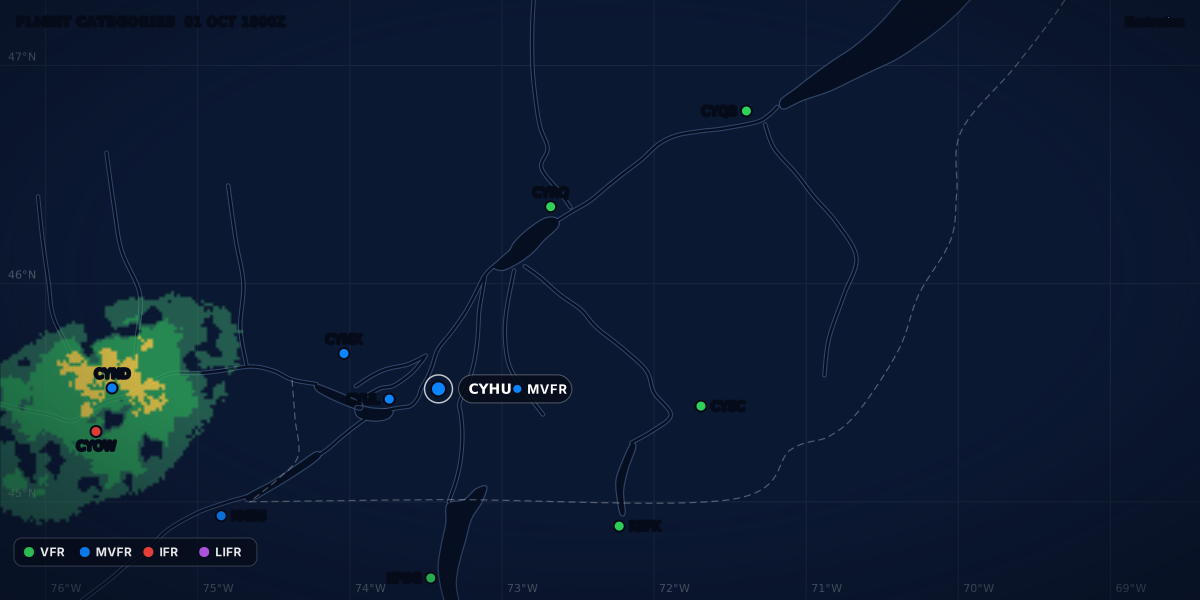
FLIGHT CATEGORIES 06 NOV 1500Z
VFRMVFRIFRLIFR
Illustration
VFR weather minimums: Canada, US and Europe side by side
Legal visibility and distance from cloud for VFR in Canada (CARs 602.114 and 602.115), the US (14 CFR 91.155) and Europe (SERA.5001), with METAR examples.
 Jp Valery
13 min read
VFR weather minimums are the lowest visibility and the smallest distance from cloud (the cloud clearance) that the law allows for a flight under visual flight rules. Canada, the United States and Europe set different numbers. Each set also changes with the airspace, the height and the time of day. This guide is part of the types of flight rules series, which separates the rules, the conditions and the weather categories.
Here are the day values for an aeroplane, side by side. The sections below quote each rule with its section number.
| By day, aeroplane | Canada | United States | Europe (SERA) |
|---|---|---|---|
| Controlled airspace, below 10,000 ft | 3 miles; 500 ft vertically and 1 mile horizontally from cloud (the same at every altitude) | 3 SM; 500 ft below, 1,000 ft above and 2,000 ft horizontally from clouds (Class C, D and E) | 5 km; 300 m (1,000 ft) vertically and 1,500 m horizontally from cloud |
| Class G, low level | Below 1,000 ft AGL: 2 miles, clear of cloud | 1,200 ft AGL or less: 1 SM, clear of clouds | At or below 3,000 ft AMSL or 1,000 ft above terrain: 5 km, clear of cloud, surface in sight |
| In a control zone (US: surface area) | Ground visibility 3 miles when reported; 500 ft above the surface except to take off or land | No VFR beneath a ceiling of less than 1,000 ft; ground visibility 3 SM to take off, land or enter the pattern | Ceiling 1,500 ft and ground visibility 5 km to take off, land or join the circuit, unless ATC clears you |
SM is statute miles. AGL is above ground level and AMSL above mean sea level. Helicopters have their own lines in most of these rules; this guide gives the values for aeroplanes.
What the minimums measure
The minimums use three kinds of numbers.
- Flight visibility. The visibility forward from the cockpit of an aircraft in flight (CARs 101.01; the US definition in 14 CFR 1.1 is close). It is what you see, where you are. Most lines of the rules use it.
- Ground visibility. The visibility at an aerodrome, as reported (CARs 101.01). A METAR gives the visibility at its station. Some control-zone lines use the reported ground visibility.
- Distance from cloud. How far you stay below, above and beside a cloud. A few rules also use the ceiling, the lowest broken or overcast layer or vertical visibility; the guide what is a ceiling gives the exact definitions.
These numbers define visual meteorological conditions (VMC) in Canada: conditions equal to or better than the minima, “expressed in terms of visibility and distance from cloud” (CARs 101.01). The hub explains VMC and IMC next to VFR and IFR.
The flight category is the Aviation Weather Center’s summary of the ceiling and the visibility. It is not one of these rules. A report coded IFR can be legal VFR in some airspace, and a VFR-category report can be illegal where you fly. The category is a summary; the minimums are the law (flight categories).
The airspace decides which line applies. Canada sets minima for controlled or uncontrolled airspace, not for each class (TC AIM RAC 2.8), while the US sets them by class and Europe by class and height band; the guide to airspace classes explains the letters.
Canada: controlled airspace (CARs 602.114)
Under CARs 602.114, a VFR flight in controlled airspace needs all of these:
- Visual reference to the surface.
- A flight visibility of at least 3 miles.
- At least 500 ft vertically and 1 mile horizontally from cloud.
- In a control zone, also: a ground visibility of at least 3 miles, when one is reported, and at least 500 ft above the surface, except when you take off or land.
Three points stand out next to the US and Europe:
- One set of numbers at every altitude. Canada has no 10,000-ft step.
- One vertical distance. It is 500 ft, above or below the cloud.
- No written ceiling. But in a control zone, 500 ft below the cloud and 500 ft above the surface add up to 1,000 ft. Under a lower ceiling, no height meets both rules (example A below). This “1,000-ft ceiling” is derived from the rule, not written in it.
A control zone is controlled airspace from the surface up to 3,000 ft AGL, unless the Designated Airspace Handbook gives other limits (CARs 101.01). The CARs write “miles”. Transport Canada measures visibility in statute miles (TC AIM GEN 1.4.1, Table 1.1); the CARs give no unit for the 1-mile distance from cloud.
Canada requires visual reference to the surface in controlled and uncontrolled airspace (602.114(a) and 602.115(a)). VFR over the top is an exception: CARs 602.116 opens with “Despite paragraphs 602.114(a) and 602.115(a)”, and it has its own guide.
Canada: uncontrolled airspace (CARs 602.115)
Class G is, in effect, all uncontrolled domestic airspace (TC AIM RAC 2.8.7). By day, CARs 602.115 sets these minimums for an aeroplane, with visual reference to the surface:
| Height | Flight visibility | Distance from cloud |
|---|---|---|
| At or above 1,000 ft AGL | 1 mile | 500 ft vertically, 2,000 ft horizontally |
| Below 1,000 ft AGL | 2 miles | Clear of cloud |
The order looks backwards. Low down, you need more visibility but no buffer from cloud. Higher up, you need less visibility but a buffer.
Two traps:
- An old note. TC AIM Table 2.2 (RAC 2.7.3) still says that a private operator certificate can allow less than 2 miles. The current 602.115(c)(i) names only an air operator certificate. Follow the CARs text.
- Controlled airspace above you. A transition area is based at 700 ft AGL unless otherwise specified, and a control area extension never goes lower than 700 ft AGL (TC AIM RAC 2.7.5 and 2.7.2). Above that floor, the controlled-airspace minima apply. Check the VFR chart.
United States (14 CFR 91.155)
14 CFR 91.155(a) sets the minimums by class. By day, for aircraft other than helicopters:
| Airspace | Flight visibility | Distance from clouds |
|---|---|---|
| Class A | Not applicable | Not applicable |
| Class B | 3 SM | Clear of clouds |
| Class C, D, and E below 10,000 ft MSL | 3 SM | 500 ft below, 1,000 ft above, 2,000 ft horizontal |
| Class E at or above 10,000 ft MSL | 5 SM | 1,000 ft below, 1,000 ft above, 1 SM horizontal |
| Class G, 1,200 ft or less above the surface | 1 SM | Clear of clouds |
| Class G, more than 1,200 ft above the surface, below 10,000 ft MSL | 1 SM | 500 ft below, 1,000 ft above, 2,000 ft horizontal |
| Class G, more than 1,200 ft above the surface, at or above 10,000 ft MSL | 5 SM | 1,000 ft below, 1,000 ft above, 1 SM horizontal |
Two more paragraphs apply at an airport with controlled airspace down to the surface:
- 91.155(c), the ceiling. No VFR flight beneath the ceiling, within the lateral boundaries of controlled airspace designated to the surface for an airport, when the ceiling is less than 1,000 ft.
- 91.155(d), the ground visibility. To take off, land or enter the traffic pattern within the surface area of Class B, C, D or E airspace, the ground visibility must be at least 3 SM. If the airport reports none, the flight visibility must be at least 3 SM.
A common memory aid for the most used row is “3-152”: 3 SM, 1,000 ft above, 500 ft below and 2,000 ft horizontally from clouds. Section 91.155 has no general line on visual reference to the surface.
Europe (SERA.5001 and SERA.5005)
The EU Standardised European Rules of the Air (SERA, Regulation (EU) No 923/2012) give one table, Table S5-1 in SERA.5001:
| Height band | Classes | Flight visibility | Distance from cloud |
|---|---|---|---|
| At and above 3,050 m (10,000 ft) AMSL | A to G | 8 km | 1,500 m horizontally, 300 m (1,000 ft) vertically |
| Below 10,000 ft AMSL and above 900 m (3,000 ft) AMSL or 300 m (1,000 ft) above terrain, whichever is higher | A to G | 5 km | 1,500 m horizontally, 300 m (1,000 ft) vertically |
| At and below 3,000 ft AMSL or 1,000 ft above terrain, whichever is higher | A to E | 5 km | 1,500 m horizontally, 300 m (1,000 ft) vertically |
| Same band | F and G | 5 km | Clear of cloud and with the surface in sight |
The notes under the table matter:
- When the transition altitude is lower than 10,000 ft AMSL, FL 100 replaces 10,000 ft.
- The Class A values are guidance for pilots only.
- In Class F and G at low level, the competent authority may allow a flight visibility down to 1,500 m, for example for flights at 140 kt IAS or less. France does: an aeroplane may fly with 1,500 m at 140 kt IAS or less (AIP France ENR 1.2.2).
SERA.5005(b) adds a rule at controlled aerodromes. Unless ATC clears you, a VFR flight may not take off or land at an aerodrome in a control zone, or enter its traffic zone or circuit, when the reported ceiling is less than 450 m (1,500 ft) or the ground visibility is less than 5 km. Its numbers are the highest of the three systems.
Same question, three answers
| Question | Canada | United States | Europe (SERA) |
|---|---|---|---|
| Do the minimums change at 10,000 ft? | No (602.114) | Yes: 5 SM; 1,000 ft below and above clouds, 1 SM horizontally (Class E and G) | Yes: 8 km (FL 100 when the transition altitude is lower) |
| Is there a ceiling minimum? | Not written; about 1,000 ft in a control zone in practice, derived from 602.114(c) and (d)(ii) | 1,000 ft, beneath the ceiling in controlled airspace designated to the surface (91.155(c)) | 1,500 ft, to take off, land or join the circuit in a control zone without an ATC clearance (SERA.5005(b)) |
| Lowest Class G visibility by day | 1 mile at or above 1,000 ft AGL; 2 miles below | 1 SM | 5 km; 1,500 m at 140 kt or less where the state allows it (France does) |
| Must you see the surface? | Yes (602.114(a), 602.115(a)); VFR over the top is an exception | No general line in 91.155 | In Class F and G at low level (Table S5-1) |
| Unit of visibility | Statute miles | Statute miles | Kilometres and metres |
At night
At night, the visibility minimum in Canadian uncontrolled airspace rises to 3 miles at every height (CARs 602.115(b)(ii) and (c)(ii)) and the US Class G rows change too (91.155(a)); the night VFR guide gives the full night table.
Worked examples
All the reports below are real-format examples, not real observations. Each example is for an aeroplane, by day.
A. Ceiling 900 ft at a control-zone airport
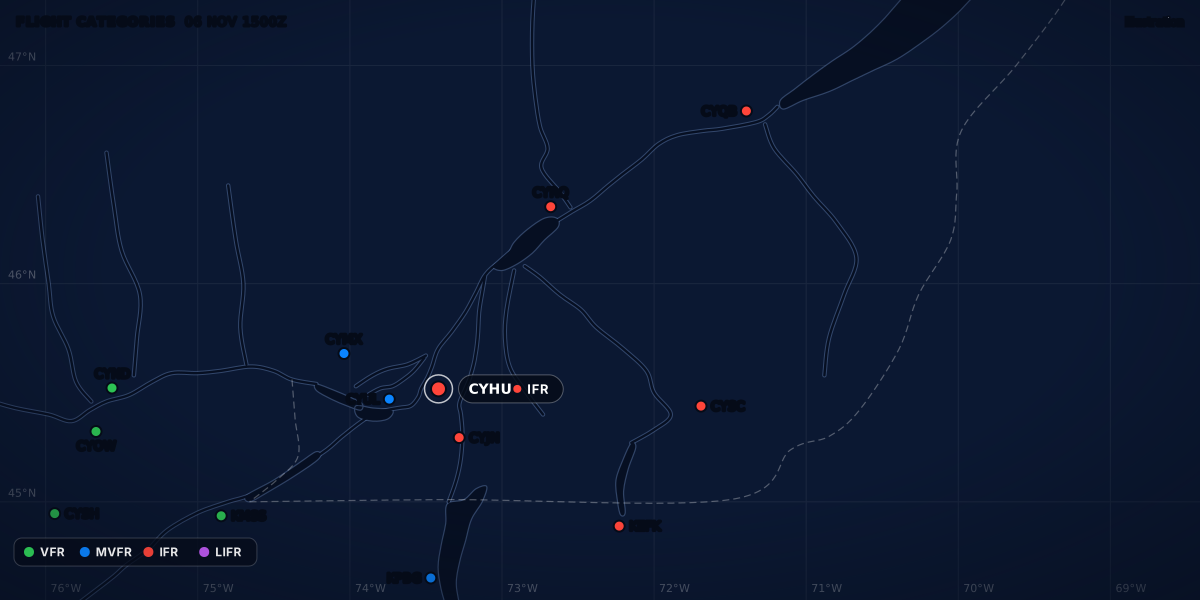
CYHU sits in a Class C control zone that goes up to 2,000 ft ASL (Designated Airspace Handbook, Issue 324, 3.5.4). The category is IFR, because the 900-ft ceiling is below 1,000 ft.
- Visibility. The reported 4 SM meets the 3 miles of ground visibility in 602.114(d)(i). Your flight visibility must also be at least 3 miles (602.114(b)).
- Cloud. You must stay 500 ft below the broken layer: 900 − 500 = 400 ft AGL at most.
- Surface. In the control zone, you must stay at least 500 ft above the surface, except to take off or land.
- Result. 400 ft is 100 ft lower than 500 ft. No height meets both rules, so VFR flight in the zone is not legal.
Under the same weather, a US airport with controlled airspace down to the surface fails 91.155(c): the ceiling is less than 1,000 ft. In Europe, a VFR flight in controlled airspace must stay 300 m (1,000 ft) below cloud (Table S5-1), so a 900-ft ceiling leaves no legal height at all. The ceiling is also below the 1,500 ft of SERA.5005(b).
In all three systems, the way out is special VFR, which you ask ATC for. In Canada it needs 1 mile and clear of cloud (CARs 602.117); the special VFR guide compares it with 14 CFR 91.157 and SERA.5010.
B. Ceiling 1,200 ft: legal on paper
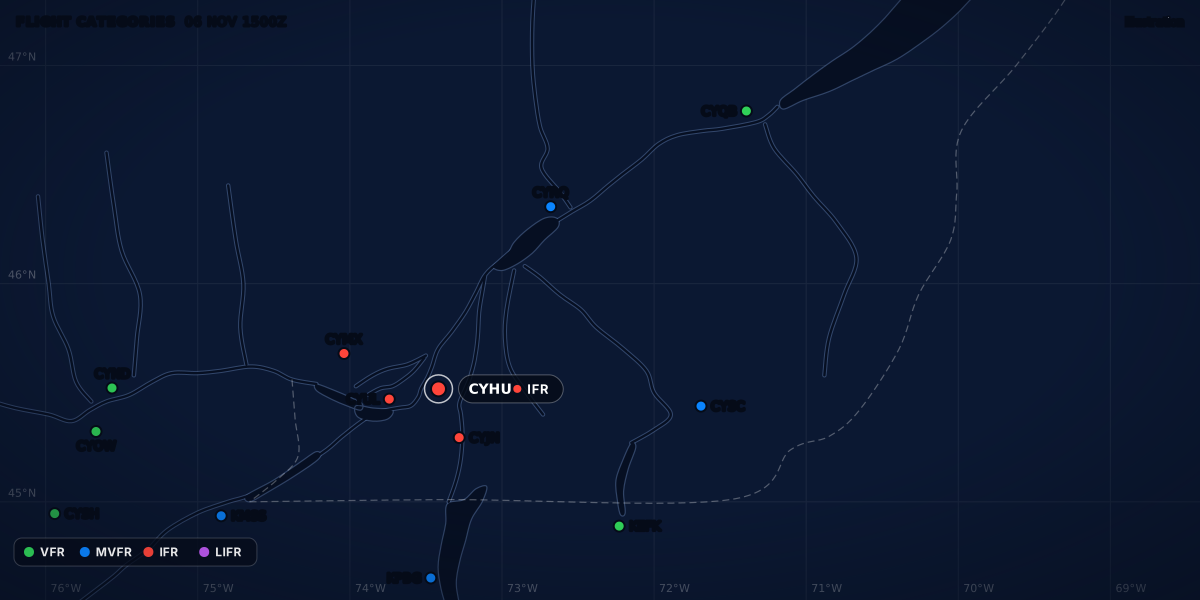
Three hours later, the category is MVFR. In the control zone, the legal band starts at 500 ft AGL (the surface rule) and ends at 700 ft AGL (1,200 − 500). It is 200 ft deep.
That band is legal for the VFR minimums. The minimum altitudes still apply, though. Over a built-up area, an aeroplane must stay 1,000 ft above the highest obstacle within 2,000 ft (CARs 602.14(2)(a)(i)). A band that ends at 700 ft cannot give that.
In the US, a 1,200-ft ceiling passes 91.155(c), and 500 ft below the clouds puts you at 700 ft AGL or lower. In Europe, 300 m (1,000 ft) below the cloud puts you at about 200 ft AGL or lower (Table S5-1). That is below the 150 m (500 ft) minimum height of SERA.5005(f), and the 1,200-ft ceiling is also below the 1,500 ft of SERA.5005(b). Europe is the strictest here.
C. 4 SM at 10,500 ft
This example has no report: flight visibility is what you see from the cockpit. You cruise at 10,500 ft in controlled airspace, and haze limits the view to about 4 SM.
- Canada: legal. 602.114(b) asks for 3 miles at every altitude.
- United States: not legal. Class E at or above 10,000 ft MSL needs 5 SM (91.155(a)).
- Europe: not legal. At and above 10,000 ft AMSL, SERA asks for 8 km, and 4 SM is about 6.4 km.
D. An IFR report that is legal VFR in Class G
The category is IFR, because 2 SM is below 3 SM. Sherbrooke has no control zone: the Montréal FIR list in the Designated Airspace Handbook does not name it (Issue 324, 3.5.4). Say you fly near it, in uncontrolled airspace, with a flight visibility of 2 miles under this overcast.
- Below 1,000 ft AGL. You need 2 miles and must stay clear of cloud (602.115(c)). The flight is legal.
- At or above 1,000 ft AGL. You need 1 mile, but 500 ft below cloud (602.115(b)). Under an overcast at 1,500 ft, 1,000 ft AGL is the top.
- In a control zone. You would need 3 miles (602.114(b)). Not legal.
In US Class G, 1,200 ft or less above the surface, 1 SM and clear of clouds is enough (91.155(a)): legal. Under SERA, Class G at low level needs 5 km, and 2 SM is about 3,200 m: not legal. In France, the 1,500-m option applies at 140 kt IAS or less: legal, clear of cloud and with the surface in sight.
Check the VFR chart before you count on Class G: a transition area based at 700 ft AGL would bring the controlled-airspace minima down to that height. Legal is also not the same as wise; the last section comes back to that.
Minimum altitudes still apply
VFR minimums tell you how far to stay from cloud. Other rules tell you how far to stay from the ground, people and buildings. Both apply at the same time. Each altitude rule below makes an exception for take-off and landing.
| Over a built-up (congested) area or an open-air assembly of persons | Elsewhere | |
|---|---|---|
| Canada (CARs 602.14(2)) | Aeroplanes: 1,000 ft above the highest obstacle within 2,000 ft | 500 ft from any person, vessel, vehicle or structure |
| US (14 CFR 91.119) | 1,000 ft above the highest obstacle within 2,000 ft | 500 ft above the surface; over open water or sparsely populated areas, 500 ft from any person, vessel, vehicle or structure |
| Europe (SERA.5005(f)) | 300 m (1,000 ft) above the highest obstacle within 600 m | 150 m (500 ft) above the ground or water, or above the highest obstacle within 150 m |
Legal minimums and personal minimums
The numbers on this page are a legal floor, not a safe day. Many pilots set their own limits well above them, and the personal minimums checklist shows how. The VFR flight category asks for no ceiling or a ceiling above 3,000 ft, and a visibility above 5 SM; VFR days per year counts how many days a year meet it.
The minimums apply to the conditions where you fly, not at the station that reports them. I fly from CSE4 and CSB3, two fields with no weather report. For a field like that, ClearMETAR shows the report of the nearest reporting station, with its distance, and you can pick another station. That report is a clue about your sky, not a measure of it; the guide to weather without a METAR covers the other clues.
Sources
- CARs 602.114: minimum visual meteorological conditions for VFR flight in controlled airspace, Justice Laws Website
- CARs 602.115: minimum visual meteorological conditions for VFR flight in uncontrolled airspace, Justice Laws Website
- CARs 602.116: VFR over-the-top, Justice Laws Website
- CARs 602.117: special VFR flight, Justice Laws Website
- CARs 602.14: minimum altitudes and distances, Justice Laws Website
- CARs 101.01: interpretation (flight visibility, ground visibility, control zone, VMC), Justice Laws Website
- TC AIM (TP 14371) 2026-2, RAC 2.7.2, 2.7.3 (Table 2.2), 2.7.5, 2.8 and 2.8.7, Transport Canada
- TC AIM (TP 14371) 2026-2, GEN 1.4.1, Table 1.1: units of measurement, Transport Canada
- Designated Airspace Handbook (TP 1820E), Issue 324, 3.5.4: Montréal FIR control zones, NAV CANADA
- 14 CFR 91.155: Basic VFR weather minimums, eCFR
- 14 CFR 91.157: Special VFR weather minimums, eCFR
- 14 CFR 91.119: Minimum safe altitudes, eCFR
- 14 CFR 1.1: General definitions (flight visibility, ground visibility), eCFR
- Regulation (EU) No 923/2012 (SERA), consolidated text of 1 May 2025: SERA.5001 (Table S5-1), SERA.5005(b) and (f), SERA.5010, EUR-Lex
- AIP France ENR 1.2.2: VMC minima (eAIP AIRAC 2026-10-29), SIA (DGAC)
- Graphical Forecasts for Aviation (GFA) help: flight category limits, NOAA Aviation Weather Center
Rules checked on
Common questions
What are the VFR minimums in Canadian uncontrolled airspace?
By day, an aeroplane needs 2 miles flight visibility and must stay clear of cloud below 1,000 ft AGL, and needs 1 mile with 500 ft vertically and 2,000 ft horizontally from cloud at or above 1,000 ft AGL (CARs 602.115). At night, the visibility minimum is 3 miles at every height (602.115(b)(ii) and (c)(ii)).
What is the 3-152 rule?
It is a memory aid, not a rule: the US minimums in Class C, D and E airspace below 10,000 ft MSL are 3 statute miles of visibility, and 1,000 ft above, 500 ft below and 2,000 ft horizontally from clouds (14 CFR 91.155(a)). Canada (CARs 602.114) and Europe (SERA.5001) use other numbers.
Can I fly VFR under a 900 ft ceiling in a control zone?
Not in Canada: you must stay 500 ft below cloud (CARs 602.114(c)) and 500 ft above the surface except to take off or land (602.114(d)(ii)), and a 900 ft ceiling leaves no height that meets both. In the US, 14 CFR 91.155(c) forbids VFR beneath a ceiling of less than 1,000 ft in controlled airspace designated to the surface, so in both countries the option is special VFR with ATC (CARs 602.117, 14 CFR 91.157).

Let the app do the decoding.
ClearMETAR turns every METAR and TAF into one plain sentence. Free on iPhone.