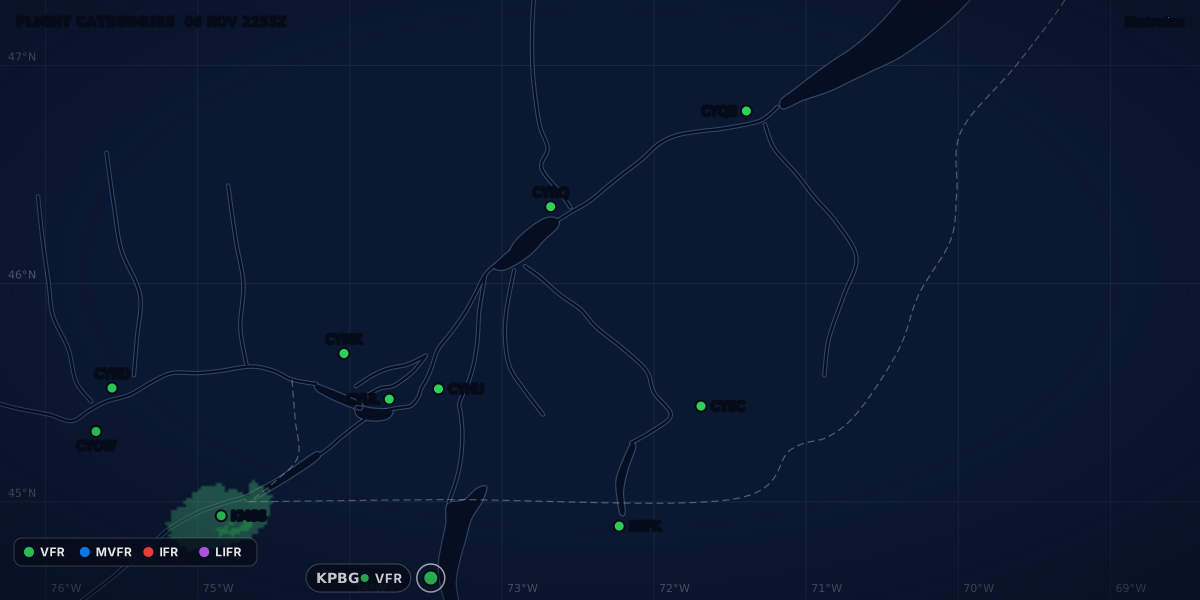
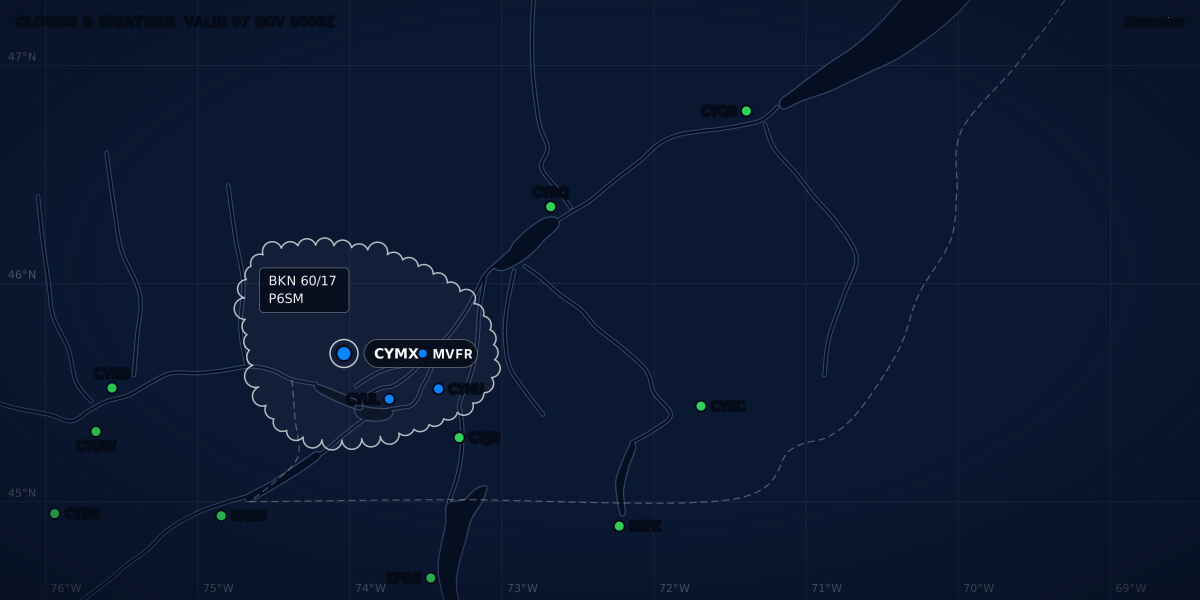
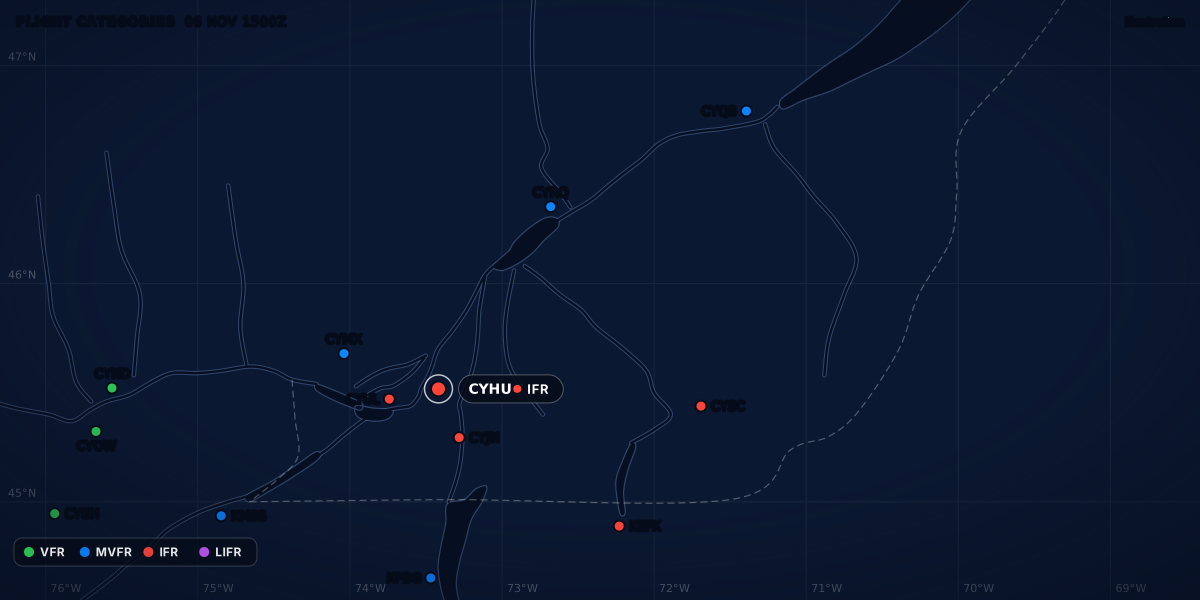
FLIGHT CATEGORIES 06 NOV 2200Z
VFRMVFRIFRLIFR
Illustration
FAA night definition vs Canada and EASA: when night starts
When does night start for a pilot? At the end of civil twilight in Canada, the US and the EU, but the US has three nights and the UK two.
 Jp Valery
13 min read
For a pilot, night is a time you look up, not the moment it gets dark. The FAA definition of night, in 14 CFR 1.1, is the time between the end of evening civil twilight and the beginning of morning civil twilight. Canada and the EU define it the same way. But some rules count from sunset instead. The US has three nights, the UK has two, and Canada adds a sunset rule for aircraft on water.
To check one airport on one date, use the civil twilight calculator. It gives every night that applies there, with its rule.
In this series: night currency, the landings you need before you carry people at night, and night VFR, what changes for a VFR flight after dark.
The calculator knows seven airports for now: CSB3, CSE4, CYHU, KBTV, KPBG, EGLL and CYZF. For another place, enter the coordinates and pick the country’s rules. It has the rules of Canada, the United States, the EU (with the EEA and Switzerland) and the United Kingdom. In other countries it gives the sun times only. It uses the same sun equations as the Day and night panel of the ClearMETAR app, and its times are computed to the nearest minute (see official times).
The definitions side by side
| Canada | United States | EU | United Kingdom | |
|---|---|---|---|---|
| Night | Civil twilight (CARs 101.01) | Civil twilight (14 CFR 1.1) | Civil twilight (SERA Art. 2(97)) | Rules of the air: civil twilight (UK SERA Art. 2(97)) |
| Other windows | Lights on water: sunset to sunrise (CARs 605.17) | Position lights: sunset to sunrise (14 CFR 91.209(a)). Night landings to carry persons: 1 h after sunset to 1 h before sunrise (14 CFR 61.57(b)) | Licensing: an authority may set another period between sunset and sunrise (FCL.010) | Licensing night: 30 min after sunset to 30 min before sunrise (ANO 2016 Sch. 1, UK FCL.010) |
| Nights to know | 1, plus the water rule | 3 | 1, unless your authority sets another | 2 |
“Civil twilight” in this table means: from the end of evening civil twilight to the beginning of morning civil twilight.
What civil twilight is
Civil twilight is the part of twilight when the sun is just below the horizon. In the evening, it starts at sunset. It ends when the centre of the sun’s disc is 6° below the horizon. In the morning, it runs the other way: it starts at 6° below the horizon and ends at sunrise (TC AIM GEN glossary, “evening civil twilight” and “morning civil twilight”).
Sunrise and sunset are the moments when the top edge of the sun meets a flat sea-level horizon, with average refraction (NRC). Hills, your altitude and the clouds change what you see. They do not change the legal time. A dark overcast evening is still legal day until civil twilight ends.
Why “30 minutes after sunset” is wrong. Civil twilight has no fixed length. It gets longer as you go farther from the equator, and it changes with the season. TC AIM GEN 1.5.2 says that it lasts “approximately 25 min”. At CSB3, near Montréal, the evening civil twilight lasts 29 to 38 minutes through 2026 (computed). Among the rules in this guide, only two use 30 minutes after sunset: the UK licensing night and a French note (both below). The other rules use the end of civil twilight, sunset itself, or 1 hour after sunset (US).
Canada: civil twilight, and sunset on water
CARs 101.01(1) defines night as “the time between the end of evening civil twilight and the beginning of morning civil twilight”. Day, or daylight, is the rest: from the beginning of morning civil twilight to the end of evening civil twilight.
The definitions of 101.01(1) apply “In these Regulations”, so every CARs rule that says “night” uses this one. For example, a VFR aeroplane at night must carry fuel to the destination plus 45 minutes at normal cruising speed, against 30 minutes by day (CARs 602.88(3)). The night VFR rules themselves are in the night VFR guide.
One rule uses sunset instead. CARs 605.17(1) asks for the position lights and the anti-collision lights “in the air or on the ground at night, or on water between sunset and sunrise”. I have a float rating. On a lake, this rule puts the lights on at sunset, about half an hour before the legal night. At CSB3 on November 6, 2026, that is 16:34 EST instead of 17:05 EST (computed). The pilot may turn the anti-collision lights off when that is safer (605.17(2)).
United States: three nights
The US uses three different windows. Outside Alaska, they open in this order in the evening and close in the reverse order in the morning. In Alaska, civil twilight can last more than 1 hour, so the 61.57(b) window can open before the 14 CFR 1.1 night (at Anchorage in 2026: around the winter solstice, and in the weeks before and after the summer days with no night; computed).
- Position lights, from sunset to sunrise. 14 CFR 91.209(a) applies “During the period from sunset to sunrise”. In Alaska, the period is different: “a prominent unlighted object cannot be seen from a distance of 3 statute miles or the sun is more than 6 degrees below the horizon”.
- Night, from the end of civil twilight. 14 CFR 1.1 says: “Night means the time between the end of evening civil twilight and the beginning of morning civil twilight, as published in the Air Almanac, converted to local time.” Its definitions apply “as used in this chapter”, and that chapter holds parts 61 and 91. So this is the night for the logbook and for the night VFR fuel reserve: 45 minutes, against 30 by day (14 CFR 91.151(a)).
- Night landings to carry persons, from 1 hour after sunset. 14 CFR 61.57(b)(1) covers a pilot in command “carrying persons during the period beginning 1 hour after sunset and ending 1 hour before sunrise”. It asks for three takeoffs and three landings to a full stop in that same period within the preceding 90 days; the night currency guide has the details.
At Plattsburgh (KPBG) on November 6, 2026 (computed, EST):
| Window | Rule | Starts | Ends (November 7) |
|---|---|---|---|
| Position lights | 14 CFR 91.209(a) | 16:37 (sunset) | 06:39 (sunrise) |
| Night | 14 CFR 1.1 | 17:08 | 06:09 |
| Night landings, carrying persons | 14 CFR 61.57(b) | 17:37 | 05:39 |
In the ClearMETAR app, the Day and night panel of a US airport shows the 14 CFR 1.1 night and also the time from which night landings count for 61.57(b).
Logging night time
14 CFR 61.51(b)(3)(i) asks you to log the conditions of each flight: “Day or night.” Section 61.51 does not define night, so the 14 CFR 1.1 definition applies. Log night time from the end of evening civil twilight to the beginning of morning civil twilight. On a flight that takes off in daylight and lands at KPBG at 17:20 EST on November 6, the last 12 minutes are night time. But the landing does not count for 61.57(b): that window opens at 17:37.
EU and France
In the EU, the rules of the air are SERA, Regulation (EU) No 923/2012. Article 2(97) says that “‘night’ means the hours between the end of evening civil twilight and the beginning of morning civil twilight”. It defines civil twilight with the same 6° below the horizon.
Licences and ratings follow Part-FCL. Its definition in FCL.010 is the same civil twilight “or such other period between sunset and sunrise as may be prescribed by the appropriate authority” (EASA Easy Access Rules for Aircrew). So a national authority can set its own night for licensing.
France publishes SERA in French with its national supplements, in one document (SERA complet, version 2.3, January 17, 2026). Under Article 2(97), that document adds a note marked “Complément (FR)”. It says that “il est admis que” (it is accepted that) between 30° and 60° of latitude, night starts 30 minutes after sunset and ends 30 minutes before sunrise. At 30° or less, the figure is 15 minutes. At Paris-Charles de Gaulle (LFPG), the evening civil twilight lasts 31 to 43 minutes through 2026 (computed), so the 30-minute night starts 1 to 13 minutes before the SERA night. If you fly in France, ask your school which time it uses for you.
United Kingdom: two nights
The UK kept SERA’s civil twilight for its rules of the air: UK SERA Article 2(97) has the same words, with no UK amendment. But the Air Navigation Order 2016, Schedule 1, defines night as “the time from half an hour after sunset until half an hour before sunrise (both times inclusive), sunset and sunrise being determined at surface level”. The UK put the same words into its FCL.010 (SI 2019/645, regulation 310(3)). So UK licences and ratings use the half-hour night.
At London Heathrow (EGLL) on December 21, 2026 (computed): sunset at 15:55 GMT, licensing night at 16:25, end of civil twilight at 16:35. The evening civil twilight at Heathrow lasts 33 to 48 minutes through 2026, so there the licensing night always starts first: 10 minutes earlier on December 21, 17 minutes earlier on June 21 (21:53 against 22:10 BST).
Worked example: CSB3 and KPBG, November 6, 2026
CSB3 (St-Mathieu-de-Beloeil, Québec) is one of the two fields I fly from. It has no weather report. Plattsburgh (KPBG) is 106 km to the south, across the border. The sun times are almost the same. The rules are not.
- Civil dawn
- 06:08 EST11:08Z
- Sunrise
- 06:39 EST11:39Z
- Sunset
- 16:34 EST21:34Z
- Civil dusk
- 17:05 EST22:05Z
| Rule | From | Until |
|---|---|---|
| NightCARs 101.01 | 17:05 EST22:05Z | 06:09 EST11:09Z |
| Lights on waterCARs 605.17 | 16:34 EST21:34Z | 06:41 EST11:41Z |
- Civil dawn
- 06:07 EST11:07Z
- Sunrise
- 06:38 EST11:38Z
- Sunset
- 16:37 EST21:37Z
- Civil dusk
- 17:08 EST22:08Z
| Rule | From | Until |
|---|---|---|
| Night14 CFR 1.1 | 17:08 EST22:08Z | 06:09 EST11:09Z |
| Position lights14 CFR 91.209(a) | 16:37 EST21:37Z | 06:39 EST11:39Z |
| Night currency, carrying persons14 CFR 61.57(b) | 17:37 EST22:37Z | 05:39 EST10:39Z |
Read the evening in order (EST, computed):
- 16:34: sunset at CSB3. On water, lights on (CARs 605.17).
- 16:37: sunset at KPBG. Position lights on (14 CFR 91.209(a)).
- 17:05: night at CSB3 (CARs 101.01). In Canada, this one time does almost everything.
- 17:08: night at KPBG (14 CFR 1.1). Night time in the logbook starts.
- 17:37: night landings at KPBG start to count for carrying persons (14 CFR 61.57(b)).
Weather reports give the time in UTC. On November 6, Québec and New York are on EST, which is UTC − 5 hours.
This is a real report from Montréal / St-Hubert (CYHU), 16 km from CSB3 (AWC and the IEM archive, November 6, 2026, 22:00 UTC). 062200Z is 17:00 EST: five minutes before night at CSB3. The report is VFR, and it says nothing about the light. You get that time from the sun, not from the METAR. At Plattsburgh, the report of 062153Z (16:53 EST) came 16 minutes after sunset and 15 minutes before night: lights on, but not night yet. The next one, 062253Z (17:53 EST), came after all three US times (real reports, AWC and the IEM archive).
Why the time changes with latitude and season
Evening civil twilight, from sunset to the start of night, in minutes (computed for 2026):
| Airport | Latitude | March 20 | June 21 | September 22 | December 21 |
|---|---|---|---|---|---|
| Miami (KMIA) | 25.8° N | 23 | 26 | 23 | 25 |
| Plattsburgh (KPBG) | 44.7° N | 30 | 37 | 29 | 34 |
| St-Mathieu-de-Beloeil (CSB3) | 45.6° N | 29 | 38 | 30 | 34 |
| Paris-Charles de Gaulle (LFPG) | 49.0° N | 32 | 43 | 31 | 38 |
| London Heathrow (EGLL) | 51.5° N | 33 | 47 | 34 | 40 |
| Whitehorse (CYXY) | 60.7° N | 42 | no night | 42 | 60 |
| Yellowknife (CYZF) | 62.5° N | 45 | no night | 45 | 69 |
The farther you are from the equator, the longer the twilight. It is longest in June, with a second peak in December, and shortest between the two. So no fixed number of minutes after sunset works everywhere, or all year. The same civil twilight also sets how many daylight hours you get: the VFR days per year guide counts VFR weather in daylight only.
Where there is no legal night
Near the summer solstice, the sun does not go 6° below the horizon in the far north. The NRC puts the limit at 60.6° of latitude on the solstice: above it, civil twilight “will not end”. With no end of civil twilight, there is no night under CARs 101.01, 14 CFR 1.1 or SERA.
Evenings in 2026 with no end of civil twilight (computed; the first and last dates can move by a day):
| Airport | Latitude | No legal night | Evenings |
|---|---|---|---|
| London Heathrow (EGLL) | 51.5° N | never | 0 |
| Whitehorse (CYXY) | 60.7° N | June 15 to June 27 | 13 |
| Anchorage (PANC) | 61.2° N | June 8 to July 4 | 27 |
| Yellowknife (CYZF) | 62.5° N | May 29 to July 14 | 47 |
| Iqaluit (CYFB) | 63.8° N | May 22 to July 22 | 62 |
| Fairbanks (PAFA) | 64.8° N | May 17 to July 26 | 71 |
| Inuvik (CYEV) | 68.3° N | May 4 to August 9 | 98 |
- Civil dawn
- None
- Sunrise
- 03:40 MDT09:40Z
- Sunset
- 23:39 MDT05:39Z
- Civil dusk
- None
| Rule | From | Until |
|---|---|---|
| NightCARs 101.01 | None tonight: the sun stays less than 6° below the horizon. | |
Three cases worth knowing (computed):
- Yellowknife, June 21: no night, but the sun sets at 23:39 and rises at 03:40 MDT. A floatplane on a lake still needs its lights on between the two (CARs 605.17).
- Anchorage, June 21: no 14 CFR 1.1 night, so no night time to log. But the 61.57(b) window still exists, from 00:42 to 03:22 AKDT, because it counts from sunset and sunrise.
- Inuvik, December 21: the sun does not rise (from December 7, 2026 to January 5, 2027). Yet the legal day runs from 11:18 to 16:26 MST, because the sun comes within 6° of the horizon.
Official times
The tool computes the sun with the NOAA equations. NOAA says they are “theoretically accurate to within a minute” between 72° N and 72° S, and “within 10 minutes” outside (NOAA). The NRC says that observed times “may deviate from the computed values by 1 or 2 minutes”, and that terrain changes them too. For a legal question at the edge of a window, use the official source.
- Canada. The TC AIM glossary ends evening civil twilight at the time that the National Research Council (NRC) specifies. The NRC sunrise/sunset calculator gives a full year of sunrise, sunset and civil twilight times for a city or for a latitude and longitude, in the time zone you choose. TC AIM GEN 1.5.2 also has charts for the start of morning and the end of evening civil twilight. They give the time on the standard meridian of the time zone (75° W for EST): “ADD 4 minutes for each degree west of the standard meridian, or SUBTRACT 4 minutes for each degree east”. CSB3, at 73.24° W, is 1.76° east of 75° W: subtract 7 minutes.
- United States. 14 CFR 1.1 names the Air Almanac, on the site of the US Naval Observatory (USNO). It has sunrise, sunset and twilight tables, and it is a free PDF from the 2015 edition. The USNO’s sun data for one day gives sunrise, sunset and the beginning and end of civil twilight for one place.
- United Kingdom. The ANO determines sunset and sunrise “at surface level”.
Watch the time zone. A table in UTC, a chart in standard time and a phone in daylight time can all show the same moment with different numbers.
What changes at night
Each of these has its own guide or rule. This page only tells you when they start.
- VFR weather minimums and the night VFR rules. The day minimums are in VFR weather minimums. What changes after dark, country by country, is in night VFR.
- Fuel. 45 minutes of reserve at night instead of 30 by day, for a VFR aeroplane in Canada (CARs 602.88(3)) and in the US (14 CFR 91.151(a)).
- Lights. At night in Canada, and from sunset on water (CARs 605.17). From sunset in the US (14 CFR 91.209(a)).
- Carrying people. The landings you need are in night currency.
- The night rating. The Canadian night rating, with its hours, is on trimcarbon.com’s night rating page. trimcarbon.com is made by the same team as ClearMETAR.
- Fog. “Radiation fog develops on clear nights” when the air near the ground cools to its dew point (NAV CANADA). The fog guide follows a real fog night at CYHU, report by report.
Sources
- CARs 101.01(1): definitions of day and night, Justice Laws Website
- CARs 605.17: position and anti-collision lights, Justice Laws Website
- CARs 602.88: fuel requirements (VFR by day and at night), Justice Laws Website
- TC AIM (TP 14371) 2026-2, GEN 1.5.2 (morning and evening twilight charts) and GEN glossary, Transport Canada
- Sunrise/sunset calculator, National Research Council Canada
- Interpreting the results of the sunrise/sunset calculator, National Research Council Canada
- 14 CFR 1.1: General definitions (night), eCFR
- 14 CFR 91.209: Aircraft lights, eCFR
- 14 CFR 61.57: Recent flight experience, pilot in command, eCFR
- 14 CFR 61.51: Pilot logbooks, eCFR
- 14 CFR 91.151: Fuel requirements for flight in VFR conditions, eCFR
- The Air Almanac, US Naval Observatory
- Sun and Moon data for one day, US Naval Observatory
- Regulation (EU) No 923/2012 (SERA), Article 2(97): night, EUR-Lex
- Easy Access Rules for Aircrew (Regulation (EU) No 1178/2011), Part-FCL, FCL.010 Definitions, EASA
- SERA et suppléments nationaux (SERA complet), version 2.3, 17 January 2026, French government (ecologie.gouv.fr)
- Air Navigation Order 2016, Schedule 1: interpretation (night), legislation.gov.uk
- SI 2019/645, regulation 310: amendment of FCL.010 (night), legislation.gov.uk
- UK SERA (retained Regulation (EU) No 923/2012), Article 2(97), legislation.gov.uk
- Solar calculation details, NOAA Global Monitoring Laboratory
- Aviation Meteorology Reference: radiation fog, NAV CANADA
Rules checked on
Common questions
Is night 30 minutes after sunset?
Not in Canada, the US or the EU: night starts at the end of evening civil twilight, when the centre of the sun is 6° below the horizon (CARs 101.01, 14 CFR 1.1, SERA Art. 2(97)), and near Montréal that is 29 to 38 minutes after sunset. The UK licensing night does start 30 minutes after sunset (ANO 2016 Sch. 1), and a French note in the national SERA document accepts 30 minutes between 30° and 60° of latitude.
When can I log night time in the US?
From the end of evening civil twilight to the beginning of morning civil twilight: 14 CFR 61.51(b)(3)(i) asks you to log day or night, and 14 CFR 1.1 defines night. Night landings count for carrying persons only from 1 hour after sunset to 1 hour before sunrise (14 CFR 61.57(b)).
Let the app do the decoding.
ClearMETAR turns every METAR and TAF into one plain sentence. Free on iPhone.