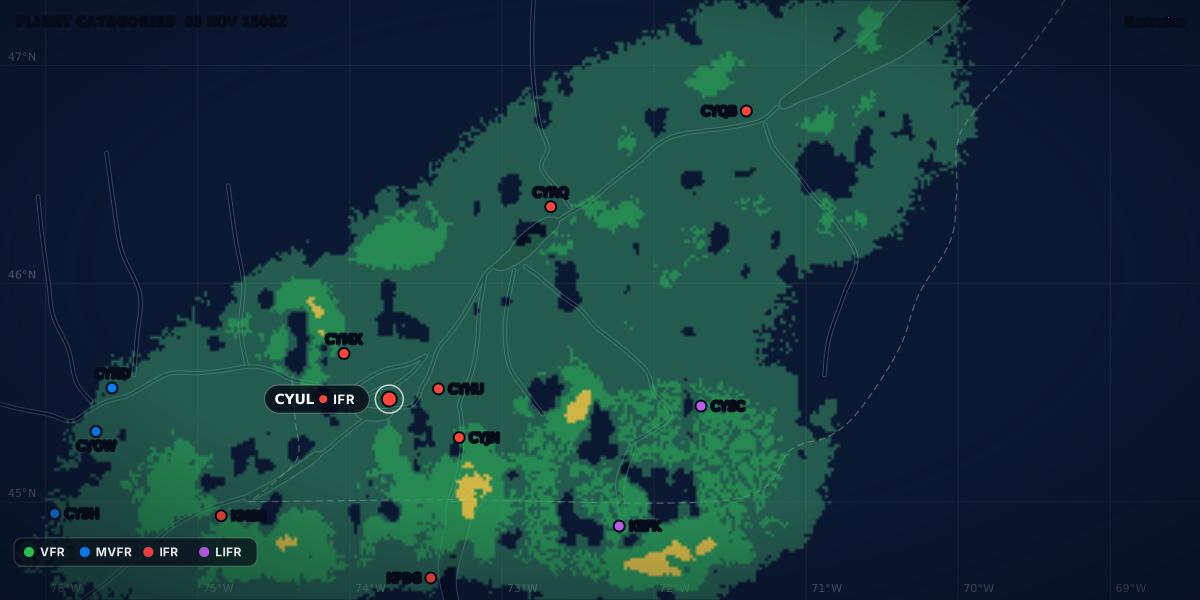
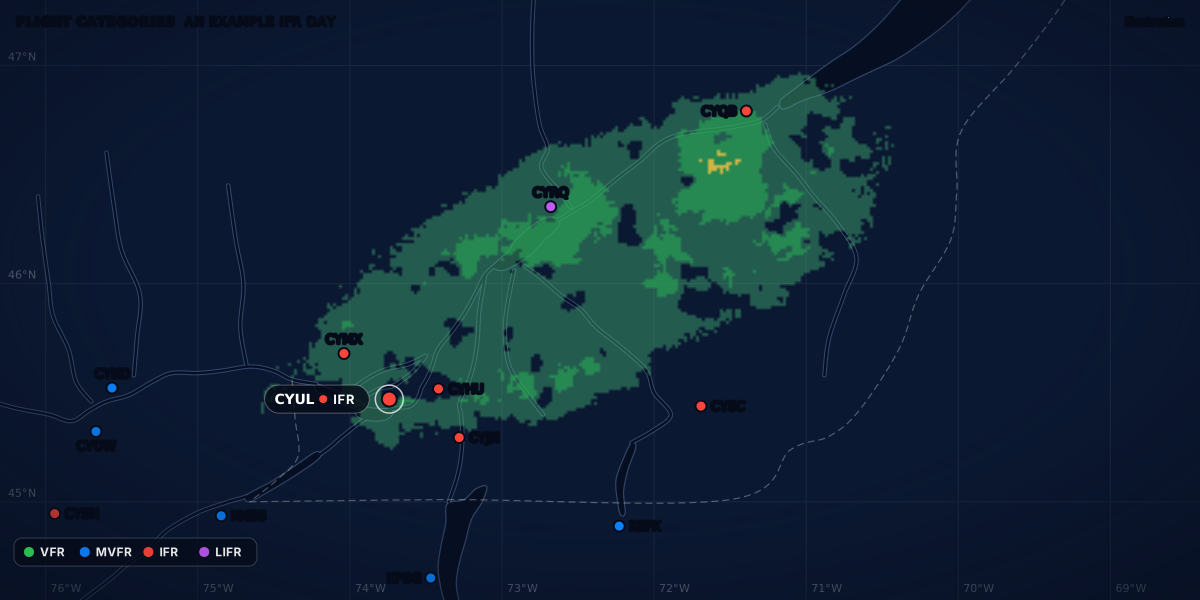
FLIGHT CATEGORIES 15 OCT 1100Z
VFRMVFRIFRLIFR
Illustration
IFR alternate requirements: the 1-2-3 rule, Canada and EASA
When IFR needs an alternate and what weather it needs: the US 1-2-3 rule and 600-2/800-2, Canada's CAP GEN minima and TAF rules, and EASA Part-NCO.
 Jp Valery
19 min read
An IFR flight plan names a destination and, most of the time, an alternate: the airport you plan to go to if you cannot land at the destination. Two questions follow. Do you need an alternate on this flight? And does the airport you picked qualify? The United States, Canada and Europe answer both questions in different ways. This guide sets the three rulebooks side by side, each with its source, then works one example per country.
It belongs to the instrument rating guides, which compare the paths to the rating in each country.
I am a private pilot, not an instrument pilot or instructor. This guide summarizes the regulations; your school, examiner and authority have the final word.
Short answer
“600-2” means a ceiling of 600 ft and a visibility of 2 statute miles.
| United States | Canada | Europe (EASA Part-NCO) | |
|---|---|---|---|
| Do you need an alternate? | Yes, unless the destination has an instrument approach and passes the 1-2-3 test | Yes, always, unless an air operator certificate or a special authorization says otherwise | Yes, unless the destination forecast shows a ceiling of DH/MDH + 1,000 ft and 5,000 m |
| Window for that destination test | 1 h before to 1 h after the ETA | No such test | 1 h before to 1 h after the ETA, or departure to ETA + 1 h if that is shorter |
| What the alternate needs | Its published alternate minimums, else 600-2 (precision) or 800-2 (non-precision) | The CAP GEN table, for example 600-2 (one precision approach) or 300-1 above its minima, whichever is greater | DH/MDH + 200 ft and 1,500 m (DH below 250 ft), or DH/MDH + 400 ft and 3,000 m |
| When the alternate’s weather counts | At your ETA there | At your ETA there | Over the same window |
| TEMPO and PROB | Not in 91.169 | TEMPO not below the alternate minima; PROB not below the landing minima | Not in NCO.OP.140 or NCO.OP.143 |
| Rule | 14 CFR 91.169 | CARs 602.122 and 602.123; TC AIM RAC 3.13 | NCO.OP.140 and NCO.OP.143 |
Each column has its details, numbers and exceptions in the sections below.
A real morning: why the alternate matters
On 15 October 2022, fog covered much of southern Québec at dawn. Here are two real reports from the same minute, 11:00Z, from the IEM archive. The archive stores them without the word METAR. Both are routine reports, so the word is added back here.
St-Hubert had a visibility of 0 SM in fog, with a vertical visibility of 200 ft: LIFR. Ottawa had 15 SM and a broken layer at 7,000 ft: VFR. Between 10:53Z and 11:00Z, six more stations on the map at the top of this page were LIFR in fog: Mirabel, Montréal-Trudeau, Trois-Rivières, Sherbrooke, Québec City and Newport, Vermont. Gatineau, Massena and Plattsburgh were VFR.
An alternate inside the same fog would not have helped. That is the job of the rules below: they make you name a second airport, and they ask its forecast to be good enough when you would get there. These reports are observations. The rules look at the weather expected at your ETA, so you plan the alternate with forecasts, before you leave. How fog forms and when it lifts is the subject of fog types for pilots.
United States: when you need an alternate
“Unless otherwise authorized by ATC”, an IFR flight plan must include “an alternate airport” (14 CFR 91.169(a)(2)). Paragraph (b) removes the alternate when both conditions are true:
- An approach exists. Part 97 “prescribes a standard instrument approach procedure to”, or the FAA has issued a special one to the operator for, “the first airport of intended landing” (91.169(b)(1)).
- The forecast passes. Weather reports or forecasts show that, “For at least 1 hour before and for 1 hour after the estimated time of arrival”, “the ceiling will be at least 2,000 feet above the airport elevation” and the visibility at least 3 statute miles (91.169(b)(2)(i)).
Pilots call it the 1-2-3 rule: 1 hour, 2,000 ft, 3 miles. The rule text does not use that name. Helicopters have their own numbers in 91.169(b)(2)(ii).
The flight category is not the test. Both lines below are MVFR, and only one of them needs an alternate:
| Destination forecast, all through the window | Category | Alternate under 91.169(b) |
|---|---|---|
| Ceiling 2,500 ft, visibility 4 SM | MVFR | Not required |
| Ceiling 1,900 ft, visibility 6 SM | MVFR | Required: the ceiling is below 2,000 ft |
The category is a summary; the rule is the test. The guide to VFR, MVFR, IFR and LIFR explains where the categories come from.
TEMPO and PROB30. Section 91.169 does not say how a TEMPO or PROB30 group inside the window counts. This guide does not answer that question. Ask your instructor or examiner before you rely on a TAF with such a group in the window.
If you are working toward the FAA rating, the guide to instrument rating requirements covers the hours and the tests.
United States: what weather the alternate needs
You may not list an alternate “unless appropriate weather reports or weather forecasts, or a combination of them, indicate that, at the estimated time of arrival at the alternate airport, the ceiling and visibility at that airport” are at or above its minima (91.169(c)). The test is at your ETA there, not over a window.
- The airport has an instrument approach. For aircraft other than helicopters: “The alternate airport minima specified in that procedure, or if none are specified the following standard approach minima” (91.169(c)(1)(i)): “Ceiling 600 feet and visibility 2 statute miles” for a precision approach, and “Ceiling 800 feet and visibility 2 statute miles” for a nonprecision approach.
- The airport has no instrument approach. The minima “are those allowing descent from the MEA, approach, and landing under basic VFR” (91.169(c)(2)).
- Helicopters have their own numbers in 91.169(c)(1)(ii).
Where the alternate minimums are published
The FAA lists them in the IFR Alternate Airport Minimums pages of the Terminal Procedures Publication. The legend of cycle 2611 (29 October to 26 November 2026) says:
- “A” in a triangle on an approach chart: the procedure has non-standard alternate minimums, or restrictions, and the pages list them.
- “A NA”: you “may not use that approach as an alternate due to unmonitored facility, absence of weather reporting service, or lack of adequate navigation coverage”. These approaches are not listed.
- “A procedure is not authorized for alternate flight planning purposes when local weather is not available.”
- For alternate planning, the precision approaches are “ILS, PAR, and GLS”. The non-precision ones are “NDB, VOR, LOC, TACAN, LDA, ASR, RNAV (GPS) and RNAV (RNP)”.
The entries give minimums by aircraft approach category. Category A is a speed “less than 91 knots”, and Category B is “91 knots or more but less than 121 knots” (14 CFR 97.3). Three real entries from cycle 2611:
| Airport and approach | Entry (cycle 2611) | For a Category A or B airplane |
|---|---|---|
| Newport, Vermont (KEFK), RNAV (GPS) Rwy 36 | “NA when local weather not available.” “Cat C 1100-3.” | The standard for a non-precision approach, 800-2, and only when local weather is available |
| Burlington, Vermont (KBTV), ILS or LOC Rwy 15 | “LOC Cat C 900-2¾, Cat D, E 1100-3.” “NA when control tower closed.” “NA when local weather not available.” | ILS: 600-2. LOC: 800-2. Neither when the tower is closed or local weather is not available |
| Burlington, Vermont (KBTV), RNAV (GPS) Z Rwy 33 | “Cat A, B, C, D, E 1700-5.” | 1700-5 |
The entry for KEFK gives no number for Categories A and B. For them, the standard line of the legend applies. Read the entry for your approach in the cycle of your flight date.
Canada: an alternate on every IFR flight plan
“Except as otherwise authorized by the Minister in an air operator certificate or in a special authorization” issued under subsection 604.05(2), “no pilot-in-command shall operate an aircraft in IFR flight unless the IFR flight plan or IFR flight itinerary” filed for the flight “includes an alternate aerodrome having a landing area suitable for use by that aircraft” (CARs 602.122).
No weather test removes the alternate. On a private IFR flight in Canada, a clear day at the destination still needs one.
The TC AIM summary of this rule (RAC 3.13, October 1, 2026) names an air operator certificate or “a private operator certificate” as the exceptions. The CARs text names an air operator certificate or a special authorization under 604.05(2). Plan with the CARs.
The weather test for the alternate is in CARs 602.123: the alternate qualifies only if “available weather information indicates” that its ceiling and visibility will be, “at the expected time of arrival”, “at or above the alternate aerodrome weather minima specified in the Canada Air Pilot”. Like the US test for the alternate, it is at your ETA there.
If you are working toward the Canadian rating, the guide to the instrument rating in Canada covers the exam and the flight test.
Canada: the alternate minima and the rounding rule
The CAP GEN table “applies to all approach charts, except where use as an alternate is not authorized on the chart” (TC AIM RAC 3.13.1, which reproduces it as Table 3.7). HAT is the height above touchdown and HAA the height above aerodrome (TC AIM GEN, abbreviations).
| Facilities at the alternate | Weather requirement (Table 3.7) |
|---|---|
| Two or more usable precision approaches, each with straight-in minima to separate suitable runways | 400-1, or 200-½ above the lowest usable HAT and visibility, whichever is greater |
| One usable precision approach | 600-2, or 300-1 above the lowest usable HAT and visibility, whichever is greater |
| Non-precision only | 800-2, or 300-1 above the lowest usable HAT/HAA and visibility, whichever is greater |
| No IFR approach | Forecast weather no lower than 500 ft above a minimum IFR altitude that will permit a VFR approach and landing |
| Helicopters, with instrument approaches | Ceiling 200 ft above the minima for the approach to be flown, and visibility at least 1 SM, never less than the minimum visibility for that approach |
600-2 and 800-2 are the “STANDARD ALTERNATE MINIMA”. When your requirement is the standard, Table 3.8 also authorizes two other pairs:
| Standard alternate minima | Also authorized (Table 3.8) |
|---|---|
| 600-2 | 700-1½ or 800-1 |
| 800-2 | 900-1½ or 1000-1 |
The rounding rule (RAC 3.13.1, note 4). Forecast ceilings come in 100-ft steps, so round the HAT or HAA first: “Up to 20 ft, use the lower 100-ft increment; above 20 ft, use the next higher 100-ft increment”. The TC AIM examples: HAA 620 ft gives 600 ft, HAA 621 ft gives 700 ft, HAT 420 ft gives 400 ft, HAT 421 ft gives 500 ft. “Calculated visibilities should not exceed 3 mi” (note 5).
Two computed examples. The approach numbers are illustrations, not a real chart:
| Alternate | Lowest usable minima | Rounded | 300-1 above | Standard | Requirement |
|---|---|---|---|---|---|
| One precision approach | HAT 200 ft, ½ SM | 200 ft | 500-1½ | 600-2 | 600-2, so 700-1½ or 800-1 also work |
| Non-precision only | HAA 621 ft, 1 SM | 700 ft | 1000-2 | 800-2 | 1000-2, and Table 3.8 does not apply |
In both rows, one pair is at least as high as the other on both numbers. When one pair has the higher ceiling and the other the higher visibility, the TC AIM text does not say how to compare them. This guide avoids that case; ask your instructor or Transport Canada.
RAC 3.13.1 also lists what to weigh when you find the lowest usable HAT/HAA and visibility:
- NOTAMs on the ground navigation equipment;
- whether your aircraft equipment works with that ground equipment;
- the forecast wind, which “could dictate the landing runway and associated approach minima”;
- the BECMG, TEMPO and PROB groups in the forecast;
- GFA heights, which are above sea level unless marked otherwise;
- “alternate minima values determined from a previous flight operation may not be applicable to a subsequent flight operation”.
Canada: TAFs with BECMG, TEMPO and PROB
The Canadian text says how TAF change groups count. A TAF with BECMG, TEMPO or PROB may be used to judge an alternate, provided that (TC AIM RAC 3.13):
| Group in force at your ETA | How it counts |
|---|---|
| BECMG, conditions improving | The new conditions apply “as of the end of the BECMG time period”, and must not be below the alternate minima |
| BECMG, conditions getting worse | The new conditions apply “as of the start of the BECMG time period”, and must not be below the alternate minima |
| TEMPO | “the forecast TEMPO condition shall not be below the published alternate minima requirements” |
| PROB | “the forecast PROB condition shall not be below the appropriate landing minima for that aerodrome” |
What each group means is in TAF change groups. The worked example below applies all four lines.
Canadian VFR over the top uses a different forecast test, with its own window: see VFR on top vs VFR over the top. Do not mix the two.
No TAF: aerodrome advisory and GFA
Table 3.7 assumes “the aerodrome having a TAF available” (RAC 3.13.1, note 1). Two other cases can qualify:
- An AERODROME ADVISORY forecast (note 2): the forecast weather is no lower than 500 ft above the lowest usable HAT/HAA, and the visibility is not less than 3 mi.
- The GFA only (note 3): the forecast shows no cloud lower than 1,000 ft above the lowest usable HAT/HAA, no cumulonimbus, and a visibility of not less than 3 mi.
“All heights specified in a GFA are ASL, unless otherwise indicated” (RAC 3.13.1), so apply the terrain elevation before you compare. The guide on how to read a GFA shows where the heights are on the chart.
Europe (EASA Part-NCO): NCO.OP.140 and NCO.OP.143
Part-NCO holds the EASA rules for “non-commercial operations with other-than complex motor-powered aircraft” (recital 9 of the regulation below). Its alternate rules come from Regulation (EU) 2021/2237, which applies “from 30 October 2022” (Article 2).
When you need an alternate (NCO.OP.140, aeroplanes). “For IFR flights, the pilot-in-command shall specify at least one destination alternate aerodrome in the flight plan,” “unless the available current meteorological information for the destination indicates” two things, over the window below:
- “a ceiling of at least 1 000 ft above the DH/MDH for an available instrument approach procedure (IAP)”;
- “a visibility of at least 5 000 m”.
The window. “for the period from 1 hour before until 1 hour after the estimated time of arrival, or from the actual time of departure to 1 hour after the estimated time of arrival, whichever is the shorter period”. On a flight shorter than one hour, the window starts at your departure.
What the alternate needs (NCO.OP.143, planning minima, aeroplanes). “An aerodrome shall not be specified as a destination alternate aerodrome unless the available current meteorological information indicates”, over a window with the same wording:
| The alternate has | Ceiling at least | Visibility at least |
|---|---|---|
| An instrument approach operation with a DH below 250 ft | 200 ft above the DH or MDH | 1,500 m |
| An instrument approach operation with a DH or MDH of 250 ft or more | 400 ft above the DH or MDH | 3,000 m |
| No IAP | The higher of 2,000 ft and the minimum safe IFR height | 5,000 m |
The minimum safe IFR height is “the height above the aerodrome of the lowest level compatible with SERA.5015(b) for en-route flight at a point from which visual flight to the aerodrome could reasonably be commenced” (GM1 NCO.OP.143). Helicopters have their own planning minima in NCO.OP.144.
In flight (NCO.OP.160(b)). You “shall only commence or continue an IFR flight towards the planned destination aerodrome” if the latest information shows, at the ETA, the destination or at least one destination alternate “at or above the applicable aerodrome operating minima”.
TEMPO and PROB. NCO.OP.140 and NCO.OP.143 do not say how TAF change groups count in the window. EASA’s guidance material has a section titled “Application of aerodrome forecasts (TAF & TREND)” under NCO.OP.160 (AMC1 NCO.OP.160). This guide does not say whether or how it applies to the alternate test. Ask your training organization how to apply TEMPO and PROB groups. If you fly with the EASA basic instrument rating (BIR), also read the guide to EASA instrument ratings.
GPS approaches at the alternate
- United States. The FAA legend counts “RNAV (GPS)” and “RNAV (RNP)” as non-precision for alternate planning. It makes no exception for an RNAV (GPS) approach with an LPV line. So plan with the non-precision standard, 800-2, unless the entry for that approach gives other numbers. Some entries add “NA when local weather not available”, as at KEFK.
- Canada. “Pilots may take credit for RNAV approaches at alternate aerodromes in accordance with the criteria outlined in” the alternate section of the CAP GEN (TC AIM RAC 3.13.1). This guide does not reproduce those criteria. Read them in the current CAP GEN.
- Europe. You may select an alternate only if “an IAP that does not rely on GNSS is available” at the destination or at a destination alternate, or if all five conditions of NCO.OP.142(b) are met: SBAS-capable equipment, the destination, alternates and route inside the SBAS service area, ABAS predicted if SBAS fails, an IAP selected that does not rely on SBAS, and a contingency action if GNSS is lost. That IAP “can be an RNP APCH to LNAV minima” (GM1 NCO.OP.142(b)(4)). Equipment to (E)TSO-C145() or C146() is SBAS-capable (AMC1 NCO.OP.142(b)(1)). The planning minima of NCO.OP.143 depend on the DH or MDH of the approach, not on its name.
Worked examples
United States: the 1-2-3 test at Burlington
You plan an IFR flight to Burlington, Vermont (KBTV), with an ETA of 15:00Z. Here is the destination TAF. It is a real-format example, written for this guide, not a real forecast.
- The window runs from 14:00Z to 16:00Z (91.169(b)(2)(i)).
- The group in force for the whole window is
FM061400: 4 SM in light rain, broken at 2,500 ft. - The test. 2,500 ft is at least 2,000 ft, and 4 SM is at least 3 SM. KBTV has instrument approaches, so no alternate is required at this ETA. The category is MVFR all the same.
Now arrive at 20:00Z instead. The window runs from 19:00Z to 21:00Z, and FM061900 gives 6 SM and a broken layer at 1,900 ft. The ceiling is below 2,000 ft, so you need an alternate. The visibility is better than before, and the category is still MVFR.
The alternate then needs its own minimums at your ETA there. At KEFK, RNAV (GPS) Rwy 36, a Category A airplane needs 800-2, and only when local weather is available (cycle 2611).
Canada: an alternate’s TAF at four ETAs
Your alternate has one usable precision approach with landing minima of 200 ft HAT and ½ SM: the first row of the computed examples above. Its alternate minima are 600-2, so 700-1½ and 800-1 also work. These approach numbers are illustrations, not the published minima for Ottawa. The TAF is a real-format example, written for this guide.
The test is at your ETA at the alternate. Read every group in force at that moment:
| ETA at the alternate | Groups in force | Check | Result |
|---|---|---|---|
| 15:00Z on the 6th | Main forecast, more than 6 SM, broken at 4,000 ft; TEMPO 1½ SM, overcast at 600 ft |
The TEMPO is below 600-2 (visibility), 700-1½ and 800-1 (ceiling) | Does not qualify |
| 21:00Z on the 6th | FM061800 5 SM, overcast at 1,200 ft; PROB30 1 SM, overcast at 400 ft |
The FM group meets 600-2. The PROB30 is above the landing minima of 200 ft and ½ SM | Qualifies |
| 01:00Z on the 7th | BECMG 0700/0702 to 2 SM, overcast at 500 ft |
The weather gets worse, so the new conditions count from the start, 00:00Z. 500 ft is below 600-2, 700-1½ and 800-1 | Does not qualify |
| 06:00Z on the 7th | The BECMG conditions; PROB30 ¼ SM in fog, vertical visibility 100 ft |
The BECMG conditions fail as above. The PROB30 is below the landing minima | Does not qualify |
Two lessons from this TAF:
- At 01:00Z, the BECMG period has not ended. It does not matter: when the weather gets worse, the new conditions count from the start of the period.
- The colours are not the test. On the timeline, the 21:00Z PROB30 group is LIFR and it passes. The 15:00Z TEMPO group is only IFR and it fails. The two groups are checked against different minima.
Europe: the window and the planning minima
An illustration, with no TAF. You depart at 09:20Z, and your ETA is 10:00Z.
- The window. 1 hour before to 1 hour after the ETA is 09:00Z to 11:00Z, 2 hours. Departure to 1 hour after the ETA is 09:20Z to 11:00Z, 1 hour 40 minutes. The shorter one applies: 09:20Z to 11:00Z. On a flight that departs at 07:30Z for the same ETA, the second window would be 3 hours 30 minutes, so 09:00Z to 11:00Z applies.
- The destination test. The destination has an ILS with a DH of 200 ft. To file with no alternate, the forecast must show a ceiling of at least 1,200 ft and a visibility of at least 5,000 m all through the window (NCO.OP.140).
- Alternate A has an ILS with a DH of 200 ft, below 250 ft: it needs a ceiling of 400 ft and 1,500 m (NCO.OP.143).
- Alternate B has only an RNP approach to LNAV minima, with an MDH of 450 ft: it needs a ceiling of 850 ft and 3,000 m (NCO.OP.143). Its approach relies on GNSS, but the destination’s ILS does not, so NCO.OP.142(a) is met.
Fuel to the alternate
In the US, you need fuel to “Complete the flight to the first airport of intended landing;”, then to fly to the alternate, then to “Fly after that for 45 minutes at normal cruising speed” (30 minutes for helicopters) (14 CFR 91.167(a)). The alternate leg drops out under the same 1-2-3 test (91.167(b)). In Canada, a propeller-driven aeroplane with an alternate in its flight plan carries fuel “to fly to and execute an approach and a missed approach at the destination aerodrome”, then “to fly to and land at the alternate aerodrome”, and then to fly for 45 minutes (CARs 602.88(4)(a)(i); TC AIM RAC 3.12.2). This guide does not cover the EASA fuel rules.
Reading TAFs for the alternate in the app
ClearMETAR draws each TAF as a strip of flight categories, from now to the end of the forecast, with the TEMPO and PROB groups on their own hatched rows. You can drag along it to put a cursor on any whole hour, such as the hour of your ETA, and tap a TEMPO or PROB group. For a Canadian alternate, read the TEMPO row against the alternate minima and the PROB row against the landing minima, at your ETA. For EASA, read the whole window. The app does not check alternates and has no approach charts, and its colours are the US flight categories, not an alternate test. The minima come from your approach chart, the CAP or the TPP.
To decode a whole TAF, group by group, read how to read a TAF.
Sources
- 14 CFR 91.169: IFR flight plan, information required (the alternate airport and its weather minima), eCFR
- 14 CFR 91.167: fuel requirements for flight in IFR conditions, eCFR
- 14 CFR 97.3: definitions (aircraft approach category), eCFR
- IFR Alternate Airport Minimums, Northeast volume NE-1, d-TPP cycle 2611 (29 October to 26 November 2026), FAA
- CARs 602.122: alternate aerodrome requirements, Justice Laws Website
- CARs 602.123: alternate aerodrome weather minima, Justice Laws Website
- CARs 602.88: fuel requirements, Justice Laws Website
- TC AIM (TP 14371) 2026-2, RAC 3.12.2, 3.13 and 3.13.1 (Tables 3.7 and 3.8): IFR fuel and alternate aerodrome requirements, Transport Canada
- TC AIM (TP 14371) 2026-2, GEN: abbreviations (HAT, HAA), Transport Canada
- Commission Implementing Regulation (EU) 2021/2237: Part-NCO NCO.OP.140, NCO.OP.142, NCO.OP.143 and NCO.OP.160, EUR-Lex
- AMC and GM to Part-NCO, Issue 2, Amendment 13 (ED Decision 2022/012/R): AMC1 NCO.OP.142(b)(1), GM1 NCO.OP.142(b)(4), GM1 NCO.OP.143, EASA
- AMC and GM to Part-NCO, Issue 2, Amendment 17 (ED Decision 2025/023/R): AMC1 NCO.OP.160, application of aerodrome forecasts (TAF & TREND), EASA
- ASOS/METAR archive: CYHU, CYOW and nine nearby stations, 15 October 2022, 10:45Z to 11:05Z (data), Iowa Environmental Mesonet
Rules checked on
Common questions
What is the 1-2-3 rule?
It is the informal name of the US test in 14 CFR 91.169(b): you need no alternate when the destination has an instrument approach and the forecast shows, from 1 hour before to 1 hour after your ETA, a ceiling of at least 2,000 ft above the airport elevation and a visibility of at least 3 SM. The rule text itself does not use the name.
Do I always need an alternate in Canada?
Yes: every IFR flight plan or IFR flight itinerary must include an alternate aerodrome, unless an air operator certificate or a special authorization under 604.05(2) says otherwise (CARs 602.122). Canada has no weather test that removes the alternate.
Can I count an LPV approach as precision for alternate minimums?
Not in the US: the FAA's IFR Alternate Minimums legend counts RNAV (GPS) approaches as non-precision for alternate planning, so the standard is 800-2 unless the entry for that approach gives other numbers (14 CFR 91.169(c)). In Canada, the CAP GEN sets the credit for RNAV approaches (TC AIM RAC 3.13.1), and in Europe NCO.OP.143 sets the minima by the approach's DH or MDH, while NCO.OP.142 adds conditions when the approaches rely on GNSS.

Let the app do the decoding.
ClearMETAR turns every METAR and TAF into one plain sentence. Free on iPhone.