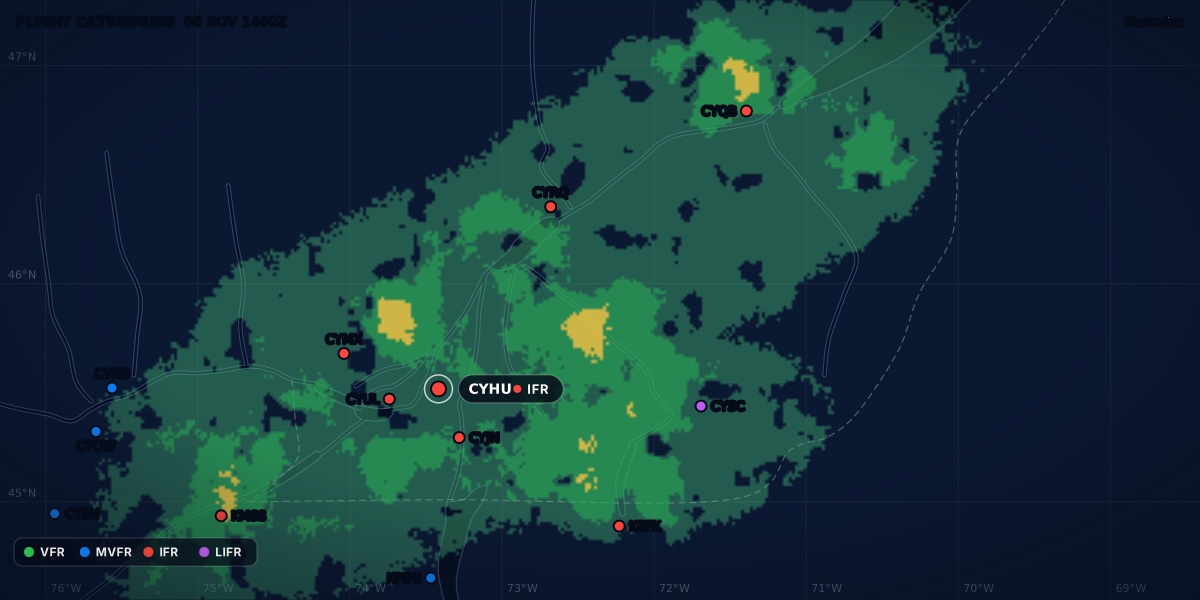
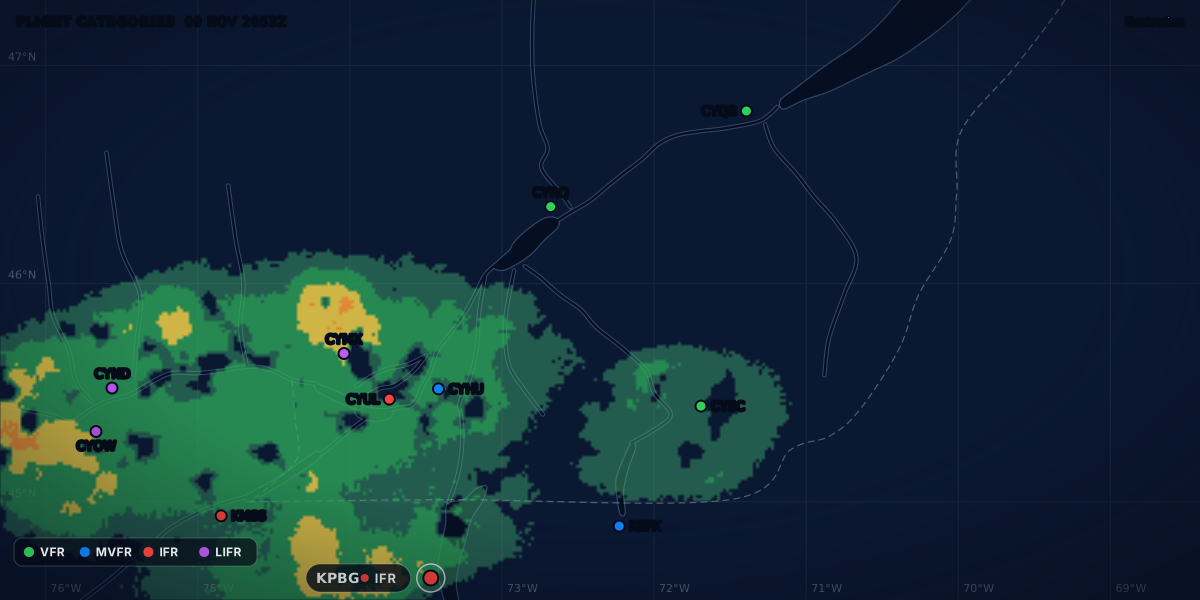
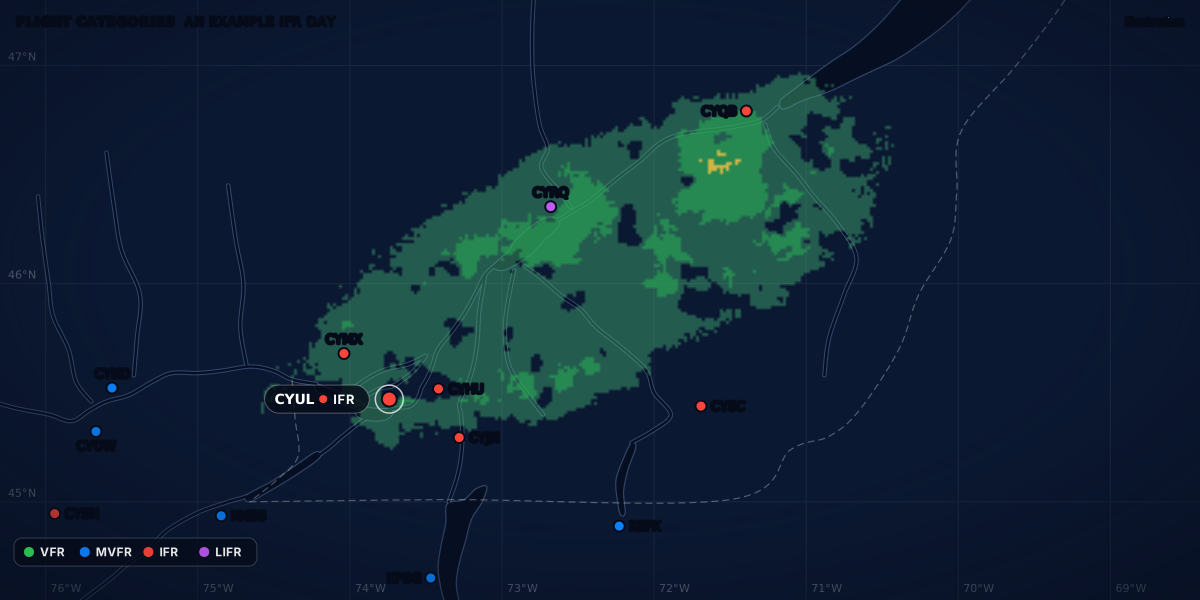
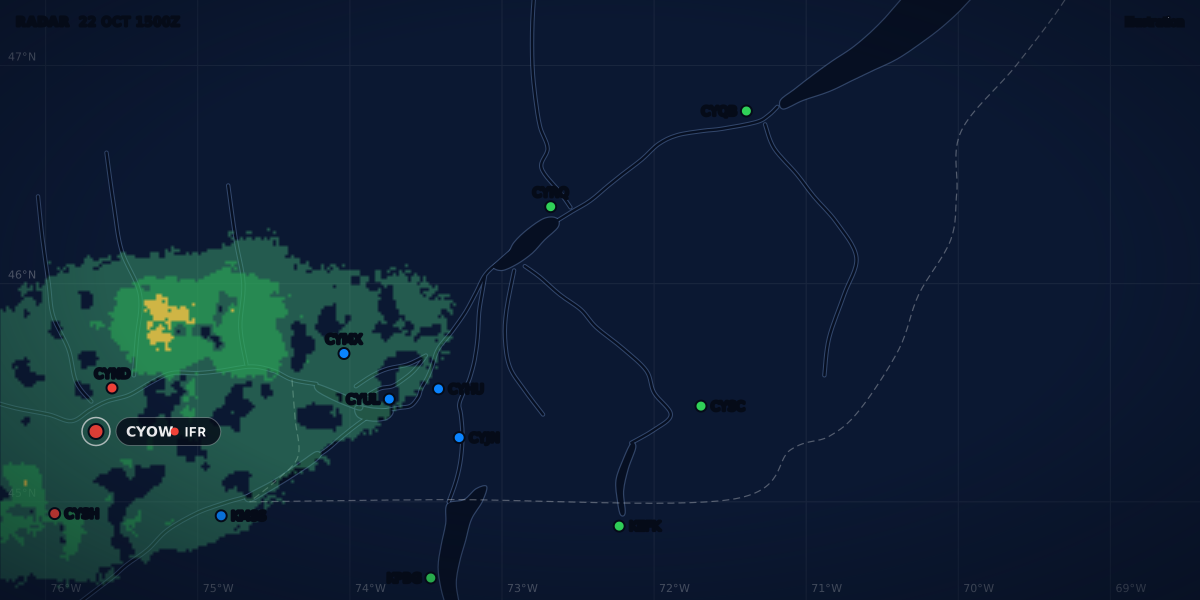
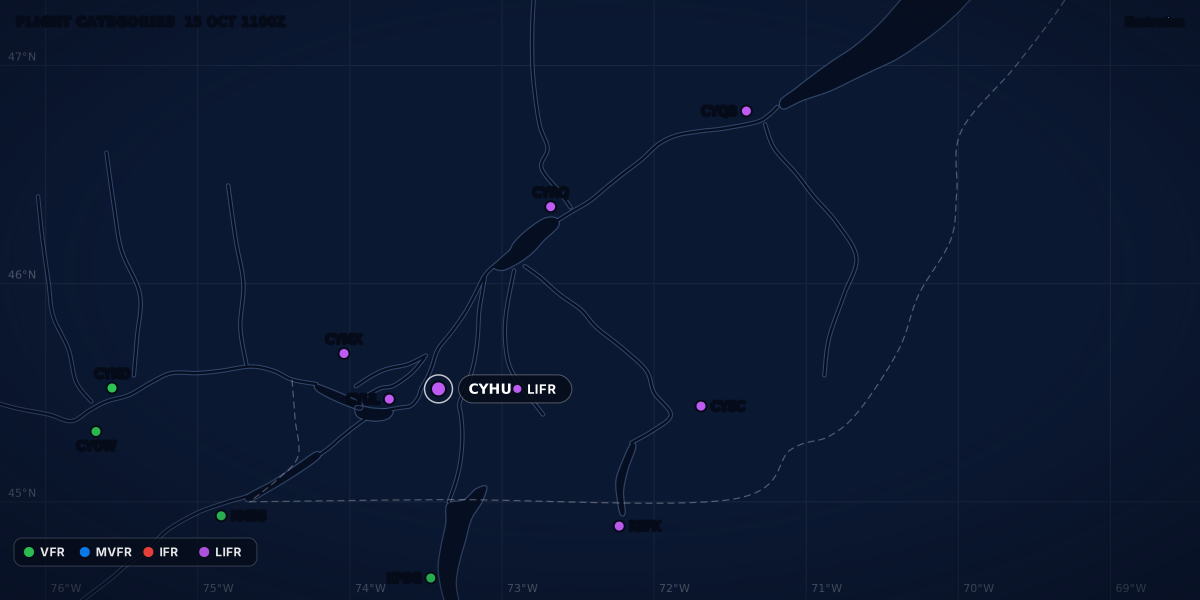
FLIGHT CATEGORIES 03 NOV 1500Z
VFRMVFRIFRLIFR
Illustration
IFR rating: how to get an instrument rating in Canada, US, Europe
There is no IFR licence: there is an instrument rating. Paths, hours and exams in Canada, the US and Europe side by side, with costs and how to choose a route.
 Jp Valery
13 min read
A grey morning at Montréal-Trudeau (CYUL). This is a real-format example, not a real observation:
METAR CYUL 031500Z 05010KT 2SM -RA BR OVC006 07/06 A2984The visibility is 2 SM in light rain and mist. The sky is overcast at 600 ft. Both numbers put the report in the IFR flight category. The category is a summary, the minimums are the law. Still, a morning like this is the reason pilots get an instrument rating. With it, you may fly under the instrument flight rules (IFR), in weather below the VFR minimums, when the rules for your flight allow it.
This guide starts the instrument rating series. It explains what the rating is, the path that every country shares, and the numbers side by side. The other guides in the series go deeper:
- Instrument rating in Canada: the experience rules clause by clause, the groups and the INRAT exam.
- FAA instrument rating requirements: the hours, the tests, and Part 61 vs Part 141.
- EASA and France instrument ratings: the modular IR, the CB-IR and the basic instrument rating (BIR).
- IFR currency and the IPC: how you keep your IFR privileges in Canada and the US.
- IFR alternate requirements: when you need an alternate aerodrome, and what weather it needs.
I am a private pilot, not an instrument pilot or instructor. This guide summarizes the regulations; your school, examiner and authority have the final word.
There is no IFR licence
Pilots often say “IFR licence” or “IFR license”. None of the authorities in this guide issues one. You get an instrument rating, and it goes on the pilot licence that you already hold:
- Canada. The Minister endorses a pilot licence (aeroplane or helicopter) with an instrument rating, and with “the group of aircraft in respect of which the privileges may be exercised” (CARs 401.46). The holder may then use “the privileges of the licence under IFR” in that group, and also has the privileges of a VFR over-the-top rating (CARs 401.47).
- United States. Instrument ratings go “on private and commercial pilot certificates only”: Instrument—Airplane, Instrument—Helicopter and Instrument—Powered-lift (14 CFR 61.5(b)(8)). Without one, you may not act as pilot in command “under IFR or in weather conditions less than the minimums prescribed for VFR flight” (14 CFR 61.3(e)).
- Europe (EASA). IFR operations are for holders of a PPL, CPL, MPL or ATPL “with an IR appropriate to the category of aircraft” (Part-FCL FCL.600). The rule makes an exception for the basic instrument rating (FCL.835). It also allows skill tests and dual instruction “if an IR appropriate to the category of aircraft is not available”.
So “how do I get an IFR licence?” really asks two things: which licence do you hold, and which authority issued it? The guide VFR vs IFR explains the two sets of flight rules themselves.
The same seven steps everywhere
The order of the steps is the same in Canada, the US and Europe. The numbers differ, and the next section sets them side by side.
- Hold a pilot licence. In the US and under EASA, a private licence is the minimum (14 CFR 61.65(a)(1), FCL.610(a)). In Canada, the rating goes on your pilot licence, aeroplane or helicopter (CARs 401.46).
- Log cross-country time as pilot-in-command. Canada and EASA ask for 50 hours, and so does the FAA for Part 61 training. The FAA guide explains the Part 141 route. Check your logbook first: each country defines a cross-country flight in its own way.
- Learn the theory and pass the written exam.
- Fly instrument time with an instructor. Part of it can be in a simulator or a training device.
- Fly a long cross-country flight under IFR. Canada and the US each name one in the rules.
- Pass the flight test.
- Keep the rating current. Each country has its own recency rule.
Canada, the US and EASA side by side
The numbers are minimums for a single-engine aeroplane. The rule for each cell is in parentheses.
| Canada (Transport Canada) | United States (FAA) | EASA (EU, France included) | |
|---|---|---|---|
| The rating | An instrument rating for a group of aircraft, on your pilot licence (CARs 401.46) | Instrument—Airplane, on a private or commercial certificate (61.5(b)(8)) | An IR on a PPL, CPL, MPL or ATPL (FCL.600); or a BIR (FCL.835) |
| Licence first | Pilot licence, aeroplane or helicopter (CARs 401.46) | Private pilot certificate, or apply for it at the same time (61.65(a)(1)) | A PPL, with night privileges to use the IR at night (or an ATPL in another category); or a CPL (FCL.610(a)) |
| Cross-country as pilot-in-command | 50 h, 10 of them in the category (Standard 421.46(2)(b)(i)) | 50 h, 10 of them in an airplane (61.65(d)(1)) | 50 h, 10 of them in the category (FCL.610(b)) |
| What a cross-country flight is | A flight along a pre-planned route to a destination at least 25 NM from the departure point (CARs 400.01) | A flight with a landing more than 50 NM in a straight line from the departure point (61.1) | A flight from a departure point to an arrival point on a pre-planned route; no distance (FCL.010) |
| Instrument time | 40 h, of which at most 20 h of instrument ground time (421.46(2)(b)(ii)) | 40 h, actual or simulated; at most 20 h in simulators and training devices, 30 h in a Part 142 course (61.65(d)(2), (h), (j)) | Courses: at least 50 h of instrument time under instruction (modular IR) or 40 h (CB-IR) (Appendix 6) |
| Dual instruction | 15 h from a person qualified under Standard 425.21(9); 5 h from a flight instructor rating holder; 5 h in aeroplanes (421.46(2)(b)(ii)) | 15 h from an authorized instructor with an instrument-airplane rating; 3 h in an airplane in the 2 calendar months before the test (61.65(d)(2)) | A course at an approved training organization, ATO (FCL.615(a)); the CB-IR also counts instruction outside it (Appendix 6) |
| Written exam | INRAT, at least 70 %, six subjects with meteorology (421.46(2)(a)) | Knowledge test, after an instructor’s endorsement (61.65(a)(4), (7)) | Theory exams in seven subjects with meteorology (FCL.615(b)) |
| Flight test | Flight test under Schedule 8 of Standard 428 (421.46(2)(c)) | Practical test (61.65(a)(8)) | Skill test under Appendix 7 (FCL.620) |
| Keeping it | A flight test or IPC in the 24 months before the flight; following the first day of the 7th month after it, 6 approaches in the 6 months before the flight (CARs 401.05(3), (3.1)) | 6 approaches, holding, and intercepting and tracking courses in the 6 calendar months before the month of the flight (61.57(c)) | Valid 1 year; revalidate in the 3 months before it expires (FCL.625(a), (b)) |
| More detail | Instrument rating in Canada | FAA requirements | EASA and France |
Sources: Standard 421.46, Standard 425.21(9), CARs 400.01, CARs 401.05, 14 CFR 61.65, 61.1, 61.57, and Part-FCL with its Appendix 6 (Section A, paragraph 7; Section Aa, paragraph 6(a)).
Where the rules differ most
- The cross-country definition. Canada counts a flight to a destination at least 25 NM away (CARs 400.01). For the FAA rating, the landing point must be more than 50 NM away in a straight line (61.1). So a 30 NM flight is cross-country time in Canada, but it does not count toward the 50 hours of 61.65(d)(1).
- The long IFR flight. Canada asks for one dual cross-country flight of at least 100 NM in actual or simulated IMC, on an IFR flight plan, with an approach to minima at two different locations (Standard 421.46(2)(b)(ii)(D)). The US flight is 250 NM along airways or by ATC routing, with an instrument approach at each airport and “three different kinds of approaches” (61.65(d)(2)(ii)). The US flight is 2.5 times the Canadian minimum.
- Who may teach you. In Canada, the 15 hours of dual instrument flight time can come from a commercial or airline transport pilot with an instrument rating and at least 500 hours as pilot-in-command, 100 of them on the aircraft group (and, for Group 1, 10 on the type of multi-engine aeroplane used for the training), with no instructor rating (Standard 425.21(9)). Standard 421.46(2)(b)(ii)(A) still asks for 5 hours of dual instrument flight time from a flight instructor rating holder. In the US, the 15 hours come from an authorized instructor with an instrument-airplane rating (61.65(d)(2)).
- Groups or category. Canada rates you by group, and the aircraft of your flight test sets the group. A test in a single-engine aeroplane gives Group 3 (single-engine aeroplanes). A test in a multi-engine aeroplane gives Group 1 (all aeroplanes) (Standard 421.46(1)). The FAA rating is Instrument—Airplane (61.5(b)(8)).
- A lighter rating in the EU. The basic instrument rating (BIR) allows IFR flights in single-pilot aeroplanes for which you hold class ratings, with some exceptions (FCL.835(a)(1)). It adds weather limits of its own, such as a visibility of at least 1,500 m and a ceiling of at least 600 ft at departure and around your arrival time (FCL.835(a)(5)), and the EASA guide works through the full rule.
Which guide is yours
Start with the authority that issued your pilot licence.
You hold a Canadian licence. Your rules are in Standard 421.46: the INRAT exam, the experience clauses, and a flight test that sets your group. Instrument rating in Canada reads them clause by clause.
You hold an FAA certificate. Your rules are in 14 CFR 61.65. FAA instrument rating requirements explains the hours, the knowledge and practical tests, and the difference between Part 61 and Part 141 training.
You hold an EASA licence, France included. You choose a route: the modular IR, the competency-based IR (CB-IR) or the BIR. EASA and France instrument ratings compares the three and gives the steps with the DGAC in France.
The UK and Australia in brief
United Kingdom. The Civil Aviation Authority (CAA) sets its own rules. For the instrument rating (aeroplanes), it asks for a PPL(A) with a radiotelephony licence (FRTOL), or a CPL(A); 50 hours of cross-country flight time as pilot-in-command; a Class 1 medical, or a Class 2 medical with a valid audiogram; at least 150 hours of theory; and, for a single-engine course, at least 50 hours of instrument time under instruction (CAA IR(A) page). The UK also has a national rating, the IMC rating. It was called the IR(R) until 1 October 2025. It may not be used in the airspace of another country unless that country gives permission (CAA IMC page).
Australia. You need a private, commercial or air transport pilot licence, the requirements of at least one instrument endorsement from each part of table 61.890, the IR knowledge exam, flight training and a flight test. The experience is at least 50 hours of cross-country flight time as pilot in command and 40 hours of instrument time. The 40 hours include at least 10 hours of dual instrument time and at least 20 hours of instrument flight time, or 10 hours when the ground time was in an approved flight simulator, supervised by an instructor with an instrument rating training endorsement (CASR 61.885(1), (2), (5) and (6)). The Australian rating also lets you fly at night under VFR (61.855(b)). A second rating, the private instrument rating, is limited to private operations in Australian territory, in single-pilot aircraft of 5,700 kg or less (61.910).
Moving between Canada and the US
Canada and the US convert each other’s aeroplane instrument ratings under a licence agreement, the Implementation Procedures for Licensing (IPL). The IPL asks for no further flight test in either direction (IPL, Revision 1). From the FAA to Transport Canada, you need an FAA instrument proficiency check in the 24 months before you apply, a pass on the FAAIA exam (air law and communications procedures) and a Canadian Category 1 or Category 3 medical, but no more experience (AC 401-001, 6.4). Instrument rating in Canada lists every condition. From Transport Canada to the FAA, the IPL asks for a Canadian instrument rating (aeroplane) and a pass on an FAA examination in air law and communications. In both directions, you must meet the recency and operational rules of the new country before you use the privileges (IPL, footnote 1). A licence or certificate that was itself issued on the basis of a foreign licence cannot be converted (IPL 2.1(c)). Europe has other rules: see EASA and France instrument ratings.
After the rating: currency and alternates
Each system asks for recent practice: in Canada, a test or IPC in the 24 months before the flight plus recent approaches (CARs 401.05(3) and (3.1)); in the US, six approaches with holding and course tracking in the 6 calendar months before the month of the flight, and no periodic check while you keep that experience (61.57(c), (d)); under EASA, a yearly revalidation (FCL.625). IFR currency and the IPC works through the Canadian and US rules with dates.
Each IFR flight also raises a planning question: do you need an alternate aerodrome, and what weather must it have? The answer differs by country, and IFR alternate requirements sets the three rulebooks side by side.
Weather is on every test
Each of the three authorities checks your weather knowledge before it gives you the rating.
- Canada. Meteorology is one of the six INRAT subjects (Standard 421.46(2)(a)). On the flight test, item 1.A, “Obtaining Weather Information”, is a ground item. The examiner assesses your competency to “retrieve and interpret” items such as weather reports and forecasts, graphic area forecasts, SIGMETs, PIREPs and NOTAMs (TP 9939E, item 1.A).
- United States. Your ground training covers the “procurement and use of aviation weather reports and forecasts” and the “recognition of critical weather situations and windshear avoidance” (61.65(b)(6) and (8)). “Preflight preparation” is the first area of operation of your flight training (61.65(c)(1)).
- EASA. Meteorology is one of the seven theory subjects of the IR exams (FCL.615(b)).
Reports like the METAR at the top of this page are part of it. Start with how to read a METAR and how to read a TAF. The Canadian list goes further, with the graphic area forecast, SIGMETs and PIREPs. To practise, ClearMETAR decodes METARs and TAFs group by group in plain words, and draws each TAF as a timeline. It is a reading aid, not a weather briefing.
Cost and time
The rules set minimum hours, not prices. The figures below come from schools and a survey: they are secondary sources, read on 6 November 2026.
| Where | What it covers | Cost | Time | Source |
|---|---|---|---|---|
| Ontario, Canada | Single-engine: ground school, 20 h dual in a Cessna 172, 20 h simulator, 8 h briefing, flight test | C$12,722, taxes excluded | not given | Brampton Flight Centre price sheet, rates effective 1 September 2026 |
| Ontario, Canada | Multi-engine: the same, with 10 h in a Piper PA-44 and 10 h in a Cessna 172 | C$15,014, taxes excluded | not given | same sheet |
| Québec, Canada | 20 h simulator and 20 h flight, multi-engine training included | “Estimate $30,000”, taxes included | 4 to 6 months | Collège Air Richelieu course page (no date on the page) |
| United States | Instrument rating flight training, median of survey answers | about US$11,500 | about 15 weeks | Redbird Flight, 2026 State of Flight Training Survey (1,180 responses, about 89 % in the US), reported by AVweb on 6 March 2026 |
Three notes:
- The Brampton sheet says that “the amount of flight training necessary fluctuates with each student”. It prices the instrument training only, not the 50 hours of cross-country time as pilot-in-command.
- The Air Richelieu page gives one estimate for the whole course, with multi-engine training and taxes.
- This guide has no dated price for Europe. Ask two or three ATOs for a written quote, and compare them hour by hour. For US costs in more detail, see FAA instrument rating requirements.
Sources
- CARs 401.46 and 401.47: instrument rating and its privileges, Justice Laws Website
- CARs 400.01: definition of cross-country flight time, Justice Laws Website
- CARs 401.05(3) and (3.1): instrument rating recency, Justice Laws Website
- CARs Standard 421.46: instrument rating (groups, knowledge, experience, skill), Transport Canada
- CARs Standard 425.21(9): who may conduct instrument rating flight training, Transport Canada
- TP 9939E, Flight Test Guide, Instrument Rating, Groups 1, 2 and 3 Aeroplane (12th edition, January 2021): item 1.A, Transport Canada
- AC 401-001 (Issue 03): Application Guidelines for Aeroplane FAA to TCCA Licence Conversion Agreement, section 6.4, Transport Canada
- Implementation Procedures for Licensing (FAA and TCCA), Revision 1: section 2.1 and the instrument rating conditions, Transport Canada
- 14 CFR 61.1: definition of cross-country time, eCFR
- 14 CFR 61.3(e): instrument rating required, eCFR
- 14 CFR 61.5(b)(8): instrument ratings, eCFR
- 14 CFR 61.57(c) and (d): instrument experience and the instrument proficiency check, eCFR
- 14 CFR 61.65: instrument rating requirements, eCFR
- Regulation (EU) No 1178/2011, Part-FCL: FCL.010, FCL.600 to FCL.625, FCL.835 and Appendix 6 (modular and competency-based IR courses), consolidated text of 30 April 2026, EUR-Lex
- Instrument rating for aeroplanes (IR(A)), UK Civil Aviation Authority
- Instrument meteorological conditions (IMC) rating, UK Civil Aviation Authority
- Civil Aviation Safety Regulations 1998, Compilation No. 103 (29 September 2026), Volume 2: regulations 61.855, 61.885 and 61.910, Federal Register of Legislation (Australia)
Rules checked on
Common questions
Is there an "IFR licence"?
No. You fly IFR with an instrument rating added to a pilot licence: Transport Canada endorses it on your licence (CARs 401.46), the FAA places it on a private or commercial certificate (14 CFR 61.5(b)(8)), and in the EU it goes on a PPL, CPL, MPL or ATPL (Part-FCL FCL.600).
Which country's rating should I get?
Usually the rating of the authority that issued your pilot licence, because each rating goes on a licence of its own system (CARs 401.46, 14 CFR 61.65(a)(1), Part-FCL FCL.610(a)). If you will fly mostly in another country, read its conversion rules first, for example AC 401-001 section 6.4 to convert an FAA rating to a Canadian one.
Let the app do the decoding.
ClearMETAR turns every METAR and TAF into one plain sentence. Free on iPhone.