FLIGHT CATEGORIES AN EXAMPLE IFR DAY
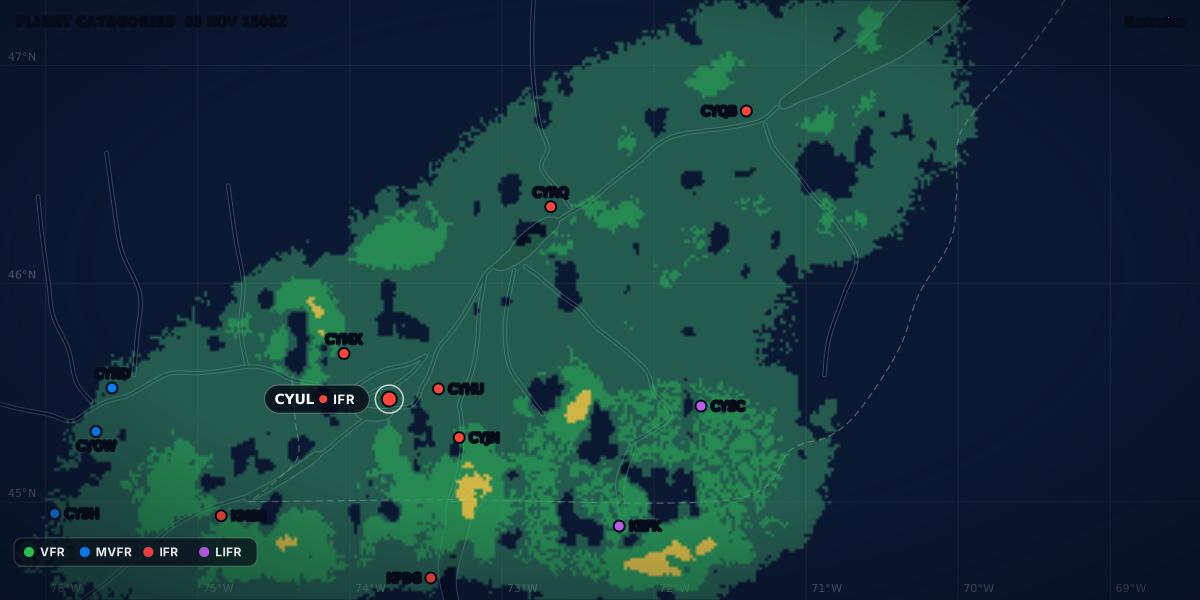
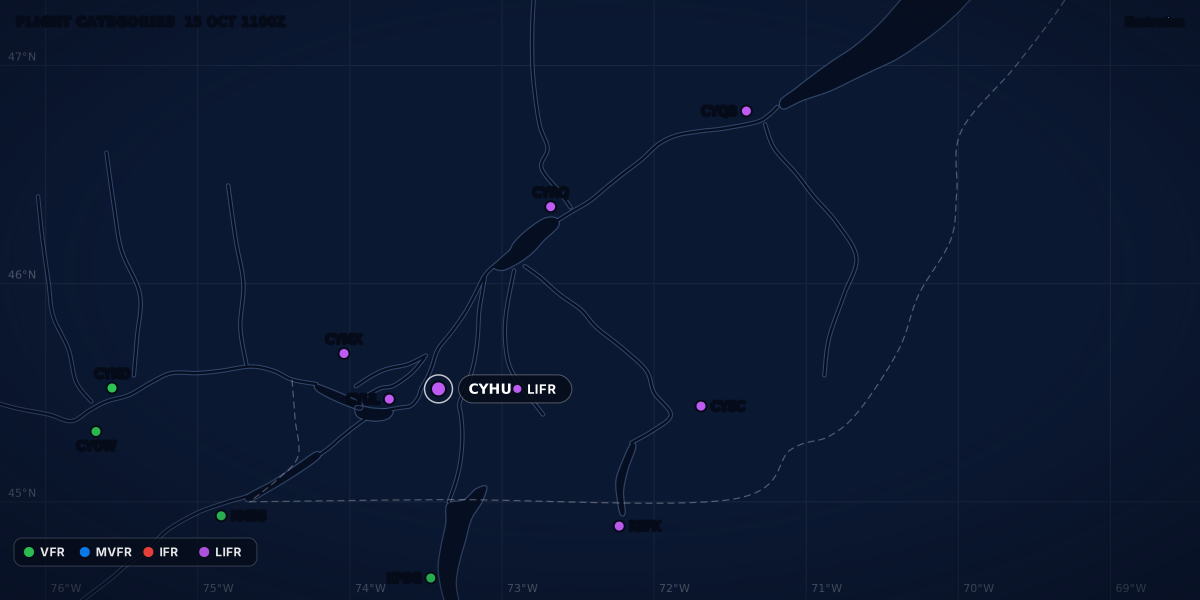
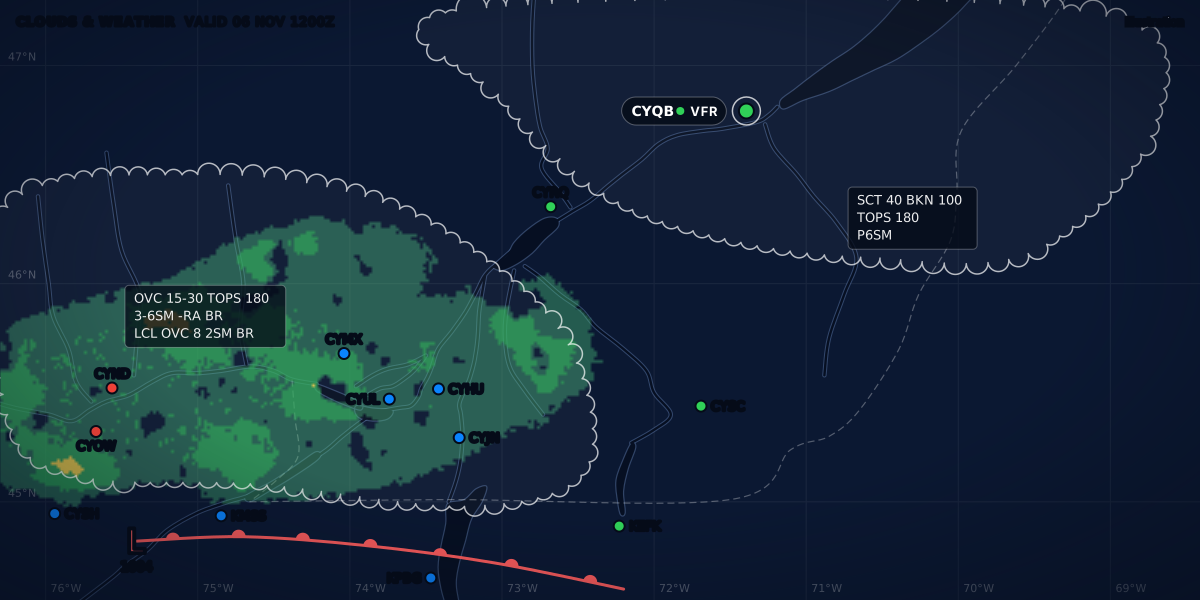
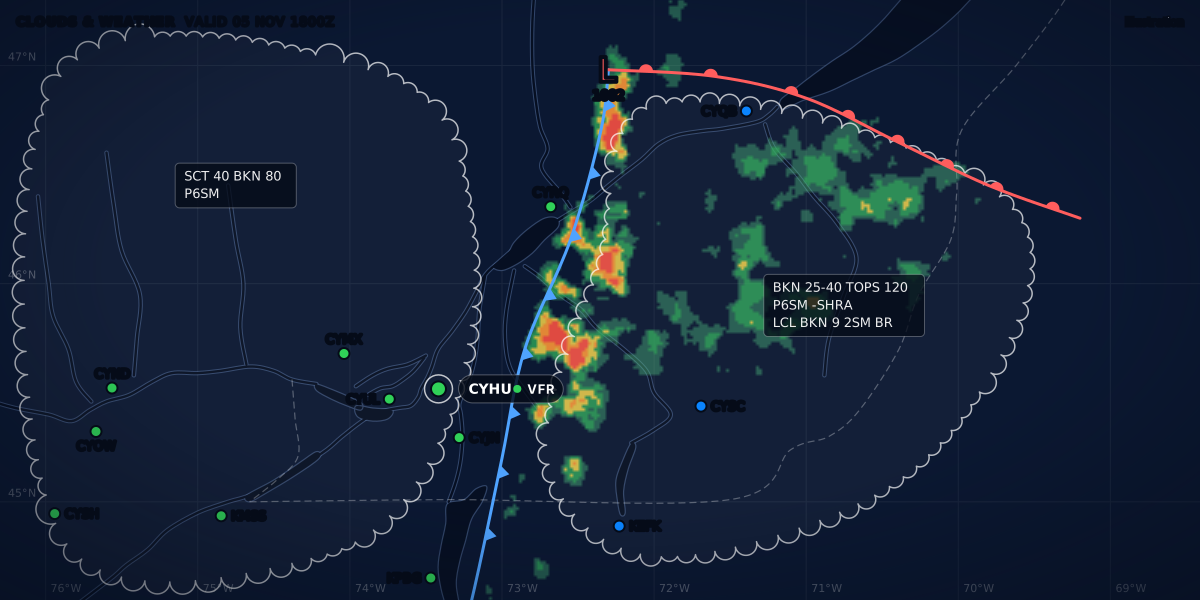
VFRMVFRIFRLIFR
Illustration
EASA instrument rating: CB-IR, modular IR, BIR and France
Three EASA routes to IFR: the modular IR, the competency-based IR (CB-IR) and the basic instrument rating (BIR). Hours, exams, English, revalidation, France.
 Jp Valery
20 min read
An EASA private pilot has three ways to fly IFR in an aeroplane. Two of them lead to the same rating, the instrument rating (IR): the modular course and the competency-based course (CB-IR). The third is a separate, smaller rating with weather limits: the basic instrument rating (BIR).
This guide sets the three side by side, with the rule behind each fact. It then turns the BIR weather limits into a TAF check, and ends with the French paperwork. The rules come from Part-FCL, Annex I to Regulation (EU) No 1178/2011 (consolidated text of 30 April 2026). For Canada and the US, start with how to get an instrument rating.
I am a private pilot, not an instrument pilot or instructor. This guide summarizes the regulations; your school, examiner and authority have the final word.
What an IR allows, and the three routes
With an IR, you may fly under IFR, “including PBN operations”, with a decision height of no less than 200 ft (FCL.605(a)). A lower decision height needs an authorisation under Part-SPA. Under IFR in an aeroplane, the pilot needs an IR, “Except as provided in point FCL.835”: that exception is the BIR (FCL.600).
- Modular IR (Part-FCL Appendix 6, Section A). A course at an approved training organisation (ATO), in two modules: Basic Instrument Flight and Procedural Instrument Flight.
- Competency-based IR, or CB-IR (Appendix 6, Section Aa). A shorter course for PPL and CPL holders that counts earlier instrument training and experience. Part of it can be flown with an instructor outside an ATO.
- BIR (FCL.835). A different rating, for single-pilot aeroplanes, with higher minima and a weather test before every IFR flight.
The modular IR and the CB-IR give the same rating, IR(A), after the same skill test (FCL.620, Appendix 7). The old en-route instrument rating (EIR) is gone in the EU. EIR holders kept their privileges “Up to and including 8 September 2022”, and EIR courses in progress on 8 September 2021 continued as BIR courses (Regulation 1178/2011, Article 4c).
The three routes compared
Single-engine numbers. The multi-engine minimums are in the flight-training section below.
| Modular IR | CB-IR | BIR | |
|---|---|---|---|
| Rating you get | IR(A) | IR(A), the same rating | BIR, a separate rating |
| Rule | FCL.600 to FCL.625, Appendix 6 A | FCL.600 to FCL.625, Appendix 6 Aa | FCL.835 |
| Licence first | PPL(A) or CPL(A) | PPL(A) or CPL(A) | At least a PPL(A) |
| Cross-country time as PIC | 50 h, at least 10 h in aeroplanes (FCL.610(b)) | 50 h, at least 10 h in aeroplanes | Not in FCL.835 |
| Theory instruction | At least 150 h | At least 80 h | At an ATO; FCL.835 sets no hours |
| Instrument flight training | At least 50 h, up to 35 h in an FFS or FNPT II | At least 40 h, up to 25 h in an FFS or FNPT II | Modules 1 to 3; FCL.835 sets no hours |
| Training outside an ATO | No (FCL.615(a)) | Up to 30 h with an IRI(A) or FI(A), or earlier IFR time as PIC | Modules 1 and 2 may start outside; module 3 may be done outside |
| English (FCL.055(d)) | Yes | Yes | No |
| Audiogram with a class 2 medical | Yes | Yes | Yes |
| Skill test | Appendix 7 | Appendix 7 | Appendix 7, in an aeroplane |
| Validity | 1 year | 1 year | 1 year |
| Revalidation | Proficiency check in the last 3 months | Proficiency check in the last 3 months | Check in the last 3 months, or 6 h IFR as PIC with 3 approaches and a 1 h training flight; a check in an aeroplane every second time |
| Lowest decision height | 200 ft (FCL.605(a)) | 200 ft | DH or MDH plus 200 ft, visibility at least 1,500 m |
| ICAO-compliant | Yes | Yes | Not fully: “valid only in EASA Member States” |
FFS is a full flight simulator, FNPT a flight and navigation procedures trainer. An IRI(A) is an instrument rating instructor; an FI(A) counts only if it holds “the privilege to provide training for the IR” (Appendix 6 Aa, paragraph 1). The ICAO line is EASA’s own reading (Comment-Response Document 2016-14, page 5). Each row is explained below.
Prerequisites for any IR
- A licence. At least a PPL in the aircraft category, or a CPL (FCL.610(a)).
- Night privileges, to use the IR at night. A PPL holder needs night privileges under FCL.810 “if the IR privileges will be used at night” (FCL.610(a)(1)(i)).
- 50 hours of cross-country time as PIC. They can be “in aeroplanes, TMGs, helicopters or airships”, with at least 10 hours in aeroplanes (FCL.610(b)). This is a prerequisite, not part of the course.
- An audiogram. For a class 2 medical “when an instrument rating or a basic instrument rating is to be added to the licence”, hearing is tested with pure-tone audiometry at the initial examination, then every 5 years until 40, every 2 years until 60, and every year after that (Part-MED, MED.B.080(a)(1)(i)).
- English. See English for the IR below.
- An ATO. The course is “a course of theoretical knowledge and flight instruction at an ATO” (FCL.615(a)). A declared training organisation (DTO) cannot give it: for aeroplanes, its list stops at the LAPL and PPL, the SEP and TMG class ratings, and the night, aerobatic, mountain, sailplane-towing and banner-towing ratings (Part-DTO, DTO.GEN.110(a)(1)).
Theory exams (FCL.025)
The IR theory covers seven subjects: air law; aircraft general knowledge, instrumentation; flight planning and monitoring; human performance; meteorology; radio navigation; and communications (FCL.615(b)). The BIR uses the same subjects, with one exam paper for each of modules 1, 2 and 3 (FCL.835(d)).
| Rule | IR (modular or CB-IR) | BIR |
|---|---|---|
| Pass mark | 75 % of the marks of each paper, no penalty marking (FCL.025(b)(1)) | Same |
| Time to pass every paper | 18 months from the end of the month of your first attempt (FCL.025(b)(2)) | Same |
| When you must start again | One paper failed 4 times, or not all passed within 6 sittings or 18 months (FCL.025(b)(3)) | One paper failed 4 times, or not all passed within 18 months (FCL.025(b)(4)) |
| Before you start again | Further training at a DTO or ATO (FCL.025(b)(5)) | Same |
| How long the pass counts | 36 months (FCL.025(c)(1)(ii)) | “for an unlimited duration” (FCL.025(c)(1)(iii)) |
The course of theory must be finished within 18 months. The skill test, and the instrument flight training (for the modular course, the Procedural module), must be done while your theory pass is valid (Appendix 6 A, paragraph 4; Appendix 6 Aa, paragraph 3).
Flight training: modular IR vs CB-IR
| Minimum | Modular IR (Appendix 6 A) | CB-IR (Appendix 6 Aa) |
|---|---|---|
| Theory instruction | 150 h (paragraph 6) | 80 h, some of it may be e-learning (paragraph 5) |
| Instrument time under instruction, single-engine | 50 h; up to 20 h in an FNPT I, or up to 35 h in an FFS or FNPT II (paragraph 7) | 40 h; up to 10 h in an FNPT I, or up to 25 h in an FFS or FNPT II (paragraph 6(a)) |
| Instrument time under instruction, multi-engine | 55 h, at least 15 h in multi-engine aeroplanes (paragraph 8) | 45 h; at least 10 h in a multi-engine aeroplane at an ATO (paragraph 6(b)) |
| Least time in an aeroplane, single-engine (computed, before credit) | 15 h | 15 h, of which at least 10 h at an ATO |
| Credit for earlier training | Up to 10 h for a CPL(A), a BIR or the Basic module certificate (paragraph 10.1) | Up to 30 h for instruction by an IRI(A) or FI(A), or for instrument time as PIC under a rating that allows IFR in IMC; up to 15 h for other instrument instruction (paragraph 6(a)) |
| Dual instrument instruction | All 50 h are under instruction | At least 25 h (paragraph 6(a)(iv)) |
| How it runs | Basic module (10 h, up to 5 h on the ground), then the Procedural module (40 h) “in one continuous approved course” (paragraphs 1 and 3) | Competency-based: the hours are minimums, and “Additional training may be required” (paragraph 6) |
The “least time in an aeroplane” row subtracts the largest simulator allowance from the total, before any credit for earlier training: 50 − 35 = 15 h and 40 − 25 = 15 h.
Modular course. The Basic Instrument Flight Module is 10 hours of instrument time under instruction, and up to 5 of them can be on the ground in a training device. You then get a Course Completion Certificate (Appendix 6 A, paragraph 1). To start the Procedural module without a CPL(A), you need that certificate or a BIR (paragraph 2).
CB-IR. You start with a pre-entry assessment at the ATO. It sets the hours credited and your training needs (Appendix 6 Aa, paragraphs 6(c) and 11). Each instructor who trains you outside the ATO records it “in a specific training record” that they sign (paragraph 6(d)). Whatever the credit, at least 10 hours of instrument flight under instruction are in an aeroplane at an ATO, and the dual instrument instruction is at least 25 hours (paragraph 6(a)(iii) and (iv)).
All these numbers are minimums, not typical times. The pre-entry assessment and your instructors decide the real number.
English for the IR (FCL.055)
Every pilot who uses the radio needs a language proficiency endorsement, at Level 4 or higher, in English or in the language used on the radio (FCL.055(a)). The IR adds a rule of its own: “holders of an IR shall have demonstrated the ability to use the English language at the appropriate proficiency level as defined in Appendix 2” (FCL.055(d)). The method of assessment is set by “any competent authority” (FCL.055(e)).
The endorsement is re-evaluated every 4 years at Level 4 and every 6 years at Level 5. Level 6 is not re-evaluated (FCL.055(c)).
The BIR has no English requirement. The DGAC writes it in plain words: “Il n’y pas d’exigence de compétence linguistique FCL.055(d) pour une qualification BIR” (form 131i-Formlic, note 4). FCL.055(d) itself names only IR holders.
Skill test, validity and revalidation
The skill test follows Appendix 7 (FCL.620). After it, the IR “shall be valid for 1 year” (FCL.625(a)).
- Revalidation. Within “the 3 months immediately preceding its expiry date” (FCL.625(b)(1)). For an aeroplane IR, that is a proficiency check under Appendix 9 (FCL.625.A). You may use an FNPT II or FFS, but then at least every second check must be in an aeroplane (FCL.625.A(a)(4)).
- Early check. If you do it before the window, “the new validity period shall commence from the date of the proficiency check” (FCL.625(b)(2)).
- Failed check. You may use the IR again only once you have passed it (FCL.625(b)(3)).
- Renewal. Once the IR has expired: an assessment at an approved organisation, refresher training if it asks for it, then a proficiency check (FCL.625(c)).
- The 7-year rule. “If the IR has not been revalidated or renewed in the preceding 7 years”, you pass the theory exams and the skill test again (FCL.625(d)).
Worked example. Your IR expires on 30 June 2027. The 3-month window opens on 30 March 2027, so a check on 15 April 2027 is inside it. A check on 15 February 2027 is early: the new one-year validity then starts on 15 February 2027, four and a half months before the old expiry date.
The basic instrument rating (BIR)
What the BIR lets you fly
“The privileges of a BIR holder are to conduct flights under IFR on single-pilot aeroplanes for which class ratings are held” (FCL.835(a)(1)). Two exceptions: high-performance aeroplanes, and variants for which the operational suitability data requires an IR.
- PPL privileges only. The BIR is used “in accordance with point FCL.205.A” (FCL.835(a)(2)): the PPL(A) privileges, without pay and in non-commercial operations.
- Night. Only with a night rating under FCL.810 (FCL.835(a)(3)).
- Multi-engine. A multi-engine BIR also covers the single-engine aeroplanes for which you hold a valid single-engine class rating (FCL.835(a)(4)).
The weather limits
FCL.835(a)(5) sets three conditions. The first two change your approach minima. The third is a weather test before you start an IFR flight or “undertake a VFR-to-IFR transition”.
| What | BIR rule | FCL.835(a)(5) |
|---|---|---|
| DH or MDH of an approach | At least 200 ft above what you would otherwise use under Part-NCO (NCO.OP.110 and NCO.OP.111) | (i) |
| Visibility in your aerodrome operating minima | Not less than 1,500 m | (ii) |
| At the departure aerodrome, before you start | Visibility at least 1,500 m; ceiling at least 600 ft or the published circling minimum for your aeroplane category, whichever is greater | (iii)(A) |
| At the destination and any required alternate | The information “indicates”, over the time window below, a visibility of at least 1,500 m and a ceiling of at least the greatest of: 600 ft, the circling minimum for your category, and your DH or MDH plus 200 ft | (iii)(B) |
The time window is “from 1 hour before until 1 hour after the estimated time of arrival, or from the actual time of departure to 1 hour after the estimated time of arrival, whichever period is shorter”. The first window always lasts 2 hours. The second lasts your flight time plus 1 hour. So:
- for a flight shorter than one hour, the window starts at your departure;
- for a flight of one hour or more, it runs from 1 hour before to 1 hour after your ETA (at exactly one hour, the two windows are the same).
TEMPO and PROB. FCL.835 does not say how TEMPO and PROB groups count in the “indicates” test. This guide does not decide it. Ask your ATO or your examiner before you rely on a TAF with such a group in the window. The guide TEMPO, BECMG and PROB explains what each group means.
Whether you need an alternate at all, and what weather it needs, is a separate rule: see IFR alternate requirements.
Worked example: the BIR weather window
This is a real-format example, written for this guide, not a real forecast. The aerodrome ZZZZ and its approach are made up. If TAF codes are new to you, read how to read a TAF first.
Suppose the approach you plan at ZZZZ has an MDH of 520 ft under the normal Part-NCO rules. The published circling minimum for your aeroplane category is 700 ft. Your BIR numbers are then:
- MDH 520 + 200 = 720 ft for the approach (FCL.835(a)(5)(i));
- visibility 1,500 m or more (FCL.835(a)(5)(ii));
- the ceiling to look for in the destination window: the greatest of 600 ft, 700 ft and 720 ft, so 720 ft.
You plan to leave at 14:20Z and land at ZZZZ at 15:00Z. The flight is 40 minutes, shorter than one hour, so the window runs from your departure to ETA + 1 h: 14:20Z to 16:00Z.
- The groups in the window are
FM061100(6,000 m,BKN012) until 15:00Z, thenFM061500(2,500 m,OVC006). TheTEMPO 0611/0614group ends at 14:00Z, before the window. - Visibility. 6,000 m and 2,500 m are both 1,500 m or more.
- Ceiling.
FM061500gives an overcast layer at 600 ft. That meets the 600 ft floor, but it is less than your 720 ft.
The BIR holder may not start this IFR flight to ZZZZ. The floor of 600 ft is not the number to check: the greatest of the three is.
The same TAF gives other answers at other times:
| Departure | ETA | Window | Groups in the window | Result |
|---|---|---|---|---|
| 08:20Z | 09:00Z | 08:20Z to 10:00Z (from departure: 40 min flight) | Main forecast: 10 km or more, BKN045 |
The test is met |
| 10:00Z | 11:30Z | 10:30Z to 12:30Z (ETA ± 1 h: 90 min flight) | Main forecast; FM061100: 6,000 m, BKN012; TEMPO 0611/0614: 3,000 m, BKN007 |
Not settled by FCL.835: the prevailing groups pass, the TEMPO ceiling of 700 ft is below 720 ft |
| 14:20Z | 15:00Z | 14:20Z to 16:00Z (from departure: 40 min flight) | FM061100, then FM061500: 2,500 m, OVC006 |
Fails: 600 ft is below 720 ft |
At 11:30Z, the prevailing forecast is above your numbers through the whole window. Only the TEMPO ceiling is below your 720 ft, by 20 ft. That is exactly the case FCL.835 leaves open. Here is the same TAF with that window marked:
The colours on the timeline are flight categories. They come from the ceiling and the visibility with US limits, and they are not the BIR test. FM061100 is MVFR in colour and passes. The TEMPO group and FM061500 are both IFR in colour: one is not settled, the other fails. The category is a summary, the minimums are the law: see what VFR, MVFR, IFR and LIFR mean.
The ClearMETAR app draws each TAF as a strip too, with TEMPO and PROB groups on their own hatched rows. With Pro, you can set personal minimums, and the app marks in amber the hours of the forecast outside them, TEMPO and PROB groups included. The ceiling setting moves in 100 ft steps and the visibility setting has fixed steps, so for this example the nearest settings at or above the BIR numbers are 800 ft and 1 SM (shown as 1,600 m in metric units). That is a little stricter than the rule. The settings are one set for every station, so you set them for the flight you plan. The app has no BIR mode, it does not run the FCL.835 test, and its colours are US flight categories, not EASA rules. To choose your own numbers, see personal minimums.
Training: modules 1 to 4
FCL.835(c) asks for theory instruction under FCL.615(a) and the flying modules below, completed at an ATO, with the exceptions in the last column.
| Module | Content (FCL.835(c)) | Outside an ATO? |
|---|---|---|
| 1 | Core flight handling “by sole reference to instruments”. Done first. | May start outside, finishes at an ATO |
| 2 | IFR departure, holding, 2D and 3D approach procedures | May start outside, finishes at an ATO |
| 3 | En-route IFR procedures | May be done entirely outside |
| 4 | Multi-engine BIR only: one engine inoperative, with asymmetric approach and go-around | May start outside, finishes at an ATO |
The modules can be flown in aeroplanes, in flight simulation training devices (FSTDs) or in both, but you train in the aeroplane of the skill test. FCL.835 sets no minimum hours. The skill test follows Appendix 7 and is flown in an aeroplane: single-engine for a single-engine BIR, multi-engine for a multi-engine BIR (FCL.835(e)).
Keeping the BIR
A BIR “shall be valid for 1 year” (FCL.835(g)(1)). To revalidate it, you do one of two things (FCL.835(g)(2)):
- pass a proficiency check under Appendix 9 in the 3 months before it expires; or
- within the validity period, “complete 6 hours as PIC under IFR including three instrument approach procedures”, plus a training flight of at least one hour with an instructor who may train for the BIR.
“For each alternate subsequent revalidation”, the holder passes a proficiency check in an aeroplane (FCL.835(g)(3)). An early check starts the new validity from the date of the check (FCL.835(g)(4)). After a failed check, you may not use the BIR until you pass (FCL.835(g)(5)).
To renew an expired BIR: refresher training where needed, from an ATO or, if it expired three years ago or less, from an instructor who may train for the BIR; then a proficiency check in an aeroplane (FCL.835(g)(6)).
Where the BIR is valid
EASA says the BIR “is not a fully ICAO-compliant rating, being valid only in EASA Member States” (Comment-Response Document 2016-14, page 5). Plan any IFR flight outside those States with that in mind. The UK has no BIR of its own. After a consultation, the UK CAA decided in January 2026: “We will not implement the BIR at this time” (CAP 3212, decision 11).
From the BIR to the full IR
- Modular IR. A BIR gives up to 10 hours of credit, and it lets a pilot without a CPL(A) start the Procedural module (Appendix 6 A, paragraphs 2 and 10.1).
- CB-IR, after BIR training at an ATO. With at least 10 hours of instrument flight under instruction at an ATO, the BIR training “may be credited”, if it covered all the CB-IR topics, as the ATO of the CB-IR course assesses (Appendix 6 Aa, paragraph 9).
- CB-IR, after 50 hours of IFR as PIC. With a BIR and at least 50 hours of IFR as PIC on aeroplanes: an ATO assesses your CB-IR theory knowledge and gives the flight training for the full IR privileges; then you pass the IR skill test and show your theory orally to the examiner (Appendix 6 Aa, paragraph 10).
Getting the IR in France (DGAC)
France applies Part-FCL like every EU State. The DGAC organises the theory exams and handles the paperwork.
- Theory exams. The DGAC page “Examen théorique pour la qualification de vol aux instruments (IR, CB-IR(A) et BIR)” says that “L’examen théorique IR est commun Avion / Hélicoptère” and that “L’examen CB/IR concerne uniquement Avion”. For how to sit the IR exams, the page sends you to the Portail PN. Its section on professional pilots says “Les inscriptions des candidats sont réalisées via le portail OCEANE” (DGAC theory exams, page updated 22 October 2026).
- English: the FCL 055 D test. This is the DGAC test “Pour la qualification IR”. It has three parts: a 15-minute multiple-choice test, a 30-minute fictitious trip or unusual situation, and a 15-minute listening test (18 sentences and an ATIS). Each part is marked from 0 to 20, and a mark below 10 eliminates you. It gives Level 4, 5 or 6, and Level 6 only at the centres on the DGAC list. Approved DGAC and non-DGAC centres run it. A separate test, “FCL.055 IFR”, is for revalidation and renewal (DGAC MCT-PN 06.04.01, rév. 1, 16 December 2025).
- Skill test. For the IR(A), you register with form 55FormExa. To save time on the licence after you pass, the DGAC asks for “la copie du certificat FCL.055d pour l’apposition de la qualification IR” in the file. The fee is paid by bank transfer: cheques are not accepted since 1 March 2022. A job seeker with a certificate less than two months old pays no fee (Code de l’aviation civile, art. R. 611-4-IV). The test report is form 03FormExa (DGAC practical tests, page updated 4 September 2025).
- The old national IR. France had a national instrument rating, the F/N-IR(A). “À compter du 8 septembre 2021”, holders who had not converted it “ne pourront plus en exercer les privilèges”. It converts to a BIR or a Part-FCL IR/CB(A) with form 131i-Formlic, and “La conversion n’est pas soumise à redevances” (DGAC form 131i-Formlic, rév. 0).
Already rated outside Europe?
A pilot with a Part-FCL PPL or CPL and a valid instrument rating issued by a third country under Annex 1 to the Chicago Convention “may be credited in full” towards the CB-IR course. To get the IR(A), you pass the skill test, show the examiner your theory of air law, meteorology and flight planning and performance, and have at least 50 hours of IFR as PIC on aeroplanes (Appendix 6 Aa, paragraph 8).
The BIR has a similar route with 25 hours of IFR as PIC on aeroplanes (FCL.835(h)). Note what both routes need first: a Part-FCL licence. Later, while your third-country IR stays valid, renewing the Part-FCL IR skips the assessment, the refresher training and the 7-year rule (FCL.625(e)).
Cost model
The rules set no price, and prices change with the aeroplane and the school. So this guide gives no euro figure. Here is what you pay for, with the minimums from the rules:
| Item | Modular IR, single-engine | CB-IR, single-engine | BIR |
|---|---|---|---|
| Theory course | At least 150 h | At least 80 h | No minimum in FCL.835 |
| Instrument training in a simulator | Up to 35 h (FFS or FNPT II) | Up to 25 h (FFS or FNPT II) | Your ATO decides |
| Instrument training in an aeroplane, before credit | At least 15 h, with an instructor | At least 15 h, of which at least 10 h at an ATO | Your ATO decides |
| Theory exams | Seven subjects (FCL.615(b)) | Seven subjects (FCL.615(b)) | 3 papers, one per module (FCL.835(d)) |
| English test | FCL 055 D in France | FCL 055 D in France | None |
| Skill test | Aeroplane and examiner | Aeroplane and examiner | Aeroplane and examiner |
| Medical | Class 2 with an audiogram | Class 2 with an audiogram | Class 2 with an audiogram |
A simple way to compare quotes: hours in the aeroplane × (aeroplane rate + instructor rate), plus hours in the simulator × simulator rate, plus the theory course, the exam fees, the English test and the skill test. Ask each school for its quote in writing, and ask how many hours its students really fly.
The page that compares routes in Canada, the US and Europe is how to get an instrument rating.
This guide summarizes Part-FCL. The regulation, your ATO, your examiner and your aviation authority have the final word.
Sources
- Regulation (EU) No 1178/2011, consolidated text of 30 April 2026, Annex I (Part-FCL): FCL.025, FCL.055, FCL.205.A, FCL.600 to FCL.625.A, FCL.835, Appendix 6 (Sections A and Aa); Article 4c, EUR-Lex
- Regulation (EU) No 1178/2011, consolidated text of 30 April 2026, Annex IV (Part-MED) MED.B.080 and Annex VIII (Part-DTO) DTO.GEN.110, EUR-Lex
- Easy Access Rules for Aircrew (Regulation (EU) No 1178/2011), October 2026 revision, EASA
- Comment-Response Document 2016-14, Appendix to Opinion No 01/2019 (A), page 5: ICAO status of the IR, CB-IR and BIR, EASA
- Examens théoriques pour devenir personnel navigant: IR, CB-IR(A) et BIR (updated 22 October 2026), DGAC (Ministère de la Transition écologique)
- Examens de compétences linguistiques en langue anglaise, MCT-PN 06.04.01, rév. 1 (16 December 2025): FCL 055 D, DGAC
- Pilotes avion, épreuves pratiques ATPL, CPL, IR (updated 4 September 2025): form 55FormExa, DGAC (Ministère de la Transition écologique)
- Form 131i-Formlic, rév. 0 (31 October 2021): conversion of an F/N-IR into a BIR(A) or IR/CB(A) Part-FCL, DGAC
- CAP 3212, General Aviation Pilot Licensing Review 'Wave 2' proposals: Consultation Response Document (January 2026), decision 11 (Basic Instrument Rating), UK Civil Aviation Authority
Rules checked on
Common questions
CB-IR or modular IR: what is the difference?
The course, not the rating: both end with the same IR(A) skill test (FCL.620, Appendix 7). On a single-engine aeroplane, the CB-IR course needs at least 40 hours of instrument time and 80 hours of theory, and up to 30 of the 40 instrument hours can come from an instructor outside an ATO or from earlier IFR time as PIC, against 50 and 150 hours at an ATO for the modular course (Part-FCL Appendix 6, Sections Aa and A).
Do I need an English test for the IR?
Yes: IR holders must have shown English at the proficiency level of Appendix 2 (FCL.055(d)); in France, the DGAC test for this is called FCL 055 D. The BIR has no such requirement (DGAC form 131i-Formlic, note 4).
Do I need an audiogram with a class 2 medical?
Yes, when an IR or a BIR is added to your licence: hearing is tested with pure-tone audiometry at the initial examination, then every 5 years until 40, every 2 years until 60, and every year after that (MED.B.080(a)(1)(i)).
Is the BIR an ICAO rating?
No. EASA says the BIR 'is not a fully ICAO-compliant rating, being valid only in EASA Member States', while the modular IR and the CB-IR are ICAO-compliant (Comment-Response Document 2016-14, page 5).
Let the app do the decoding.
ClearMETAR turns every METAR and TAF into one plain sentence. Free on iPhone.