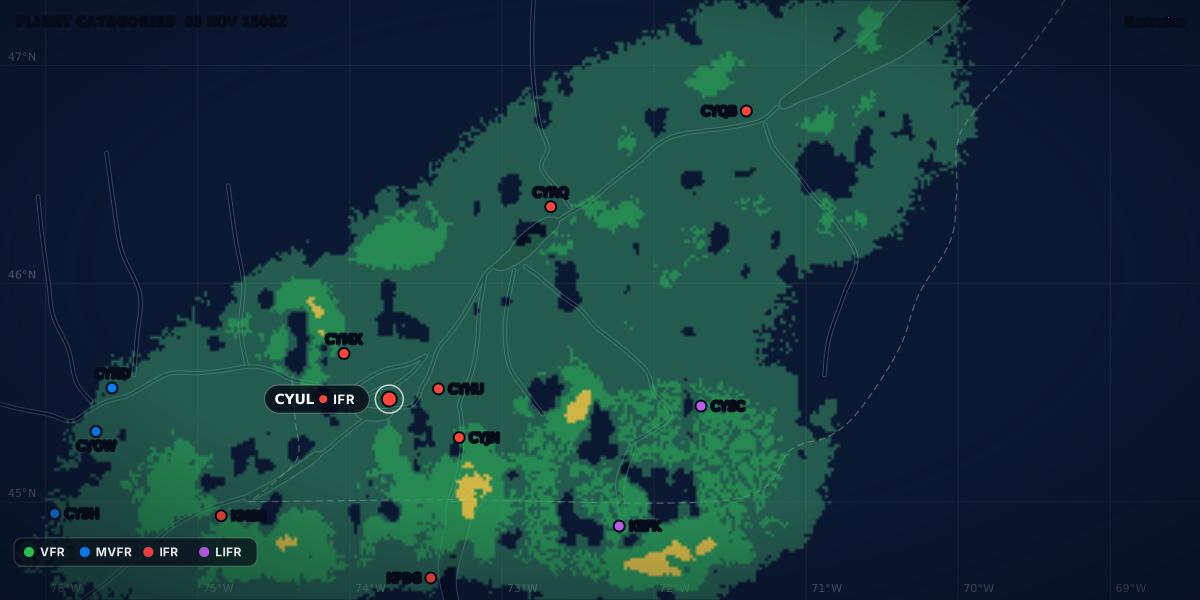
FLIGHT CATEGORIES 06 NOV 1400Z
VFRMVFRIFRLIFR
Illustration
Instrument rating in Canada: groups, INRAT, hours and cost
Standard 421.46 in plain language: groups 1 to 4, the INRAT exam, 40 hours of instrument time, the flight test, recency since June 2026, and a 2026 budget.
 Jp Valery
13 min read
The instrument rating is not a licence of its own. Transport Canada endorses it on your pilot licence, for one group of aircraft (CARs 401.46). The requirements are in Standard 421.46. This page reads them clause by clause, from the groups to the flight test and the cost. To compare Canada with the US and Europe, start with how to get an instrument rating.
I am a private pilot, not an instrument pilot or instructor. This guide summarizes the regulations; your school, examiner and authority have the final word.
The requirements in one table
| Item | What you need | Rule |
|---|---|---|
| Licence | A pilot licence for aeroplanes or for helicopters | CARs 401.46(1) |
| Group | Group 1, 2 or 3 (aeroplanes) or Group 4 (helicopters), set by the aircraft of your flight test | Standard 421.46(1) |
| Before the written exam | 5 hours of instrument flight or ground time | Standard 421.13(4)(d) |
| Written exam | The INRAT, with at least 70 % | Standard 421.46(2)(a) |
| Cross-country | 50 hours as pilot-in-command, 10 of them in the category | 421.46(2)(b)(i) |
| Instrument time | 40 hours, of which at most 20 are instrument ground time | 421.46(2)(b)(ii) |
| Dual inside the 40 hours | 5 hours from a flight instructor rating holder, and 15 hours from a person qualified under Standard 425.21(9) | 421.46(2)(b)(ii)(A) and (C) |
| In the aircraft | 5 hours in aeroplanes (Groups 1 to 3) or in helicopters (Group 4) | 421.46(2)(b)(ii)(B) |
| Long IFR flight | One dual cross-country of at least 100 NM on an IFR flight plan, with an approach to minima at two different locations | 421.46(2)(b)(ii)(D) |
| Flight test | Schedule 8 of Standard 428, flown to the guide TP 9939E; pass mark 39 (60 %) | 421.46(2)(c); TP 9939E |
| Keeping it | A flight test or proficiency check within 24 months; from the first day of the seventh month after it, 6 approaches in the 6 months before each flight | CARs 401.05(3) and (3.1) |
What the rating allows
The privileges are in CARs 401.47. You may exercise “the privileges of the licence under IFR” for “the group of aircraft endorsed on the licence” (401.47(a)). You also get “the privileges accorded by a VFR OTT rating” (401.47(b)). So you need no separate VFR over-the-top rating. The guide VFR over the top explains what those privileges allow.
The rating alone is not enough on the day of a flight. You must also meet the recency rules of CARs 401.05 (below).
The four groups
Standard 421.46(1) issues the rating in four groups. The aircraft of your flight test decides the group.
| Group | Covers | Flight test aircraft |
|---|---|---|
| 1 | All aeroplanes | A multi-engine aeroplane |
| 2 | Multi-engine centre-line thrust aeroplanes and single-engine aeroplanes | A multi-engine centre-line thrust aeroplane |
| 3 | Single-engine aeroplanes | A single-engine aeroplane |
| 4 | Helicopters | A helicopter |
The flight test guide repeats the rule: the group “must correspond to the class and category of aircraft or representative FSTD used for the instrument rating flight test” (TP 9939E, “Instrument Rating Groups”). For Group 1, it names a multi-engine aeroplane “other than a center-thrust multi-engine aeroplane”.
You can move up later. A first move from Group 2, 3 or 4 to Group 1 by an instrument proficiency check is flown in an aeroplane or a full-flight simulator. TP 9939E does not allow a flight training device for it.
Prerequisites
- A pilot licence. CARs 401.46(1) endorses two licences: “pilot licence — aeroplane” and “pilot licence — helicopter”.
- A medical. Standard 421.46 names no medical category of its own. At the flight test, you show “a valid Pilot Licence booklet with a valid medical certification” (TP 9939E).
- 5 hours before the exam. To write the INRAT, you need “a minimum of 5 hours of instrument flight or ground time” (Standard 421.13(4)(d)).
- 50 hours of cross-country. You log them as pilot-in-command, in aeroplanes or helicopters, with 10 in the category (421.46(2)(b)(i)). The clause does not ask for IFR. Cross-country flight time is flight time that follows standard navigation procedures “along a pre-planned route to a destination that is at least 25 nautical miles from the point of departure” (CARs 400.01). That definition is in force since December 17, 2025 (SOR/2025-241).
Experience: Standard 421.46 clause by clause
Paragraph 421.46(2)(b) has two parts: cross-country time and instrument time.
| Clause | The text says | In plain words |
|---|---|---|
| (i) | “50 hours of cross-country flight as pilot-in-command in aeroplanes or helicopters” … “of which 10 hours must be in the appropriate category” | 10 of the 50 hours are in the category of your rating. |
| (ii) | “40 hours of instrument time of which a maximum of 20 hours may be instrument ground time” | At least 20 of the 40 hours are in flight (computed: 40 − 20). |
| (ii)(A) | “5 hours of dual instrument flight time acquired from the holder of a flight instructor rating” | This dual comes from a flight instructor. |
| (ii)(B) | “5 hours in aeroplanes where the applicant is applying for a Group 1, 2 or 3 instrument rating” | In helicopters for Group 4. |
| (ii)(C) | “Fifteen (15) hours of dual instrument flight time provided by a qualified person as specified in section 425.21(9)” | The qualified person does not have to be an instructor (next section). |
| (ii)(D) | “one dual cross-country flight under simulated or actual IMC conditions of a minimum of 100 nautical miles” | It is flown on “an IFR flight plan”, with “an instrument approach to minima” at “two different locations”. |
“Instrument time” is defined in CARs 101.01. It is instrument ground time, actual instrument flight time or simulated instrument flight time.
The text does not say whether the 5 hours of (A) count inside the 15 hours of (C), or on top of them. So this page gives no total of dual hours. Ask your school how it counts them, and log who gave each hour.
Two more clauses can help. Military experience gets credits under 421.46(3). Under 421.46(4), the experience can be gained with foreign instructors whose qualifications are equivalent.
Who can teach you
Standard 425.21(9) sets who may give the training: “A person who conducts flight training toward the issuance of an instrument rating shall be the holder of a Commercial Pilot Licence or an Airline Transport Pilot Licence, have an instrument rating and:”
- (a) “have a flight instructor rating; or”
- (b) “have experience of not less than 500 hours pilot-in-command flight time”, of which “not less than 100 hours shall be on the applicable aircraft group”. For Group I, “not less than 10 hours shall be on the type of multi-engine aeroplane used for the training”.
So a commercial or airline pilot with an instrument rating and 500 hours as pilot-in-command, 100 of them on the aircraft group, can give you the 15 hours of clause (C), with no instructor rating. The 5 hours of clause (A) still come from a flight instructor rating holder.
This person also signs your recommendation for the flight test. TP 9939E asks for “a letter of recommendation from a person qualified in accordance with CAR Standard 425.21(9)”. Standard 421.14(3) asks for “a recommendation dated within 30 days prior to the date of the flight test”, and TP 9939E refers to “the 30-day validity period of the original recommendation letter”.
The INRAT exam
| INRAT (Instrument Rating) | |
|---|---|
| Pass mark | 70 % (Standard 421.46(2)(a)) |
| Subjects | Canadian Aviation Regulations; Instrument Flight Rules and Procedures; Meteorology; Instruments; Radio and Radar systems; Navigation (421.46(2)(a)) |
| Prerequisite | 5 hours of instrument flight or ground time (421.13(4)(d)) |
| Format | 50 multiple-choice questions in 3 hours: general IFR questions and questions on a simulated IFR flight (TP 691E, 2013) |
| What to bring | Proof of medical fitness, and identification with your signature and photograph (TP 691E) |
| Instructor recommendation | Not required (TP 691E) |
| Valid for | 24 months: a pass “within the previous 24 months” admits you to the flight test (TP 9939E), and exams count for 24 months before the application for the rating (CARs 400.03) |
Two cautions about the study guide, TP 691E (17th edition, 2013):
- It still asks for 20 hours of instrument flight or ground time before the exam. Standard 421.13(4)(d) says 5 hours, and it carries the mark “amended 2024/10/10”.
- Its format numbers are from 2013. Check the format when you book.
You book on Transport Canada’s exam site. Exams are by appointment, at a Transport Canada service centre or with an authorized invigilator. The site says fees “range from $35.00 to $131.54”. It does not list the fee of each exam.
The flight test (TP 9939E)
Aeroplane candidates fly the test to TP 9939E, the flight test guide for Groups 1, 2 and 3, 12th edition (January 2021). Helicopter candidates use TP 15099E, 1st edition (March 2011) (TC flight test guides).
Admission. You bring your licence with a valid medical, the recommendation letter and proof of an INRAT pass within the previous 24 months.
The aircraft. The initial test is flown in an aeroplane or in “a Level A or higher FFS”. The aeroplane is approved for IFR. Its GNSS receiver is “a certified and approved installation” for RNAV(GNSS) approaches. For the LPV approach, the GNSS (WAAS) receiver is certified and approved. Its databases are current. Its transponder was “tested and recertified within the previous 24 months”. You also bring a means to block the outside view, current charts and, in Canada, a current Canada Flight Supplement.
| Item | What is tested | Note |
|---|---|---|
| 1.A | Obtaining weather information | Ground item |
| 1.B | Flight planning | Ground item |
| 1.C | Cockpit checks | |
| 2 | IFR operational knowledge | Ground and air item |
| 3 | Air traffic control clearances | |
| 4 | Departure | |
| 5 | Enroute | |
| 6 | Arrival | |
| 7 | Holding | |
| 8.A | Non-precision approach (LOC, VOR or NDB) | |
| 8.B | ILS or LPV approach | |
| 8.C | RNAV(GNSS) approach | |
| 9 | Missed approach | |
| 10 | Transition to landing | |
| 11 | Emergency procedures | Groups 1 and 2: at least one engine failure (11.A). Group 3: 11.B, 11.C and 11.D only |
You fly two different approaches, not all three of item 8. One is an RNAV(GNSS) approach, and an initial test also needs an ILS. If an LPV approach replaces the ILS, the other approach is a non-precision approach without vertical guidance (TP 9939E, item 8).
How it is marked. Each item gets a mark from 4 (well executed) to 1 (critical errors, or the aim is not achieved). You complete every required item and reach “the minimum pass mark for the Instrument Rating flight test of 39 (60%)”.
- If you fail a ground item (1.A, 1.B or 2), you take a complete retest. The air part does not take place.
- If you fail one air item and still reach the pass mark, you can take a partial retest of that item within 30 days (TP 9939E; CARs 408.18(3)). You get one partial retest for each complete test.
- If more than three items get a 1 or a 2, you take a complete retest.
Automation. You show the use of the autopilot or FMS on one approach. “At least one of the approaches will be hand-flown”. The test is flown on a filed IFR flight plan “whenever practicable”.
Item 1.A: the weather
The aim of item 1.A is to “retrieve and interpret the aviation weather information necessary for the safe conduct of a flight in accordance with the Instrument Flight Rules”. The examiner assesses items such as weather reports and forecasts, graphic area forecasts, the surface analysis chart, radar and satellite imagery, WxCam, significant weather prognostic charts, winds and temperatures aloft, SIGMETs, PIREPs, and NOTAMs, “including WAAS NOTAMS and RAIM Predictions”.
A report like this one is where you start. It is a real-format example, not a real observation:
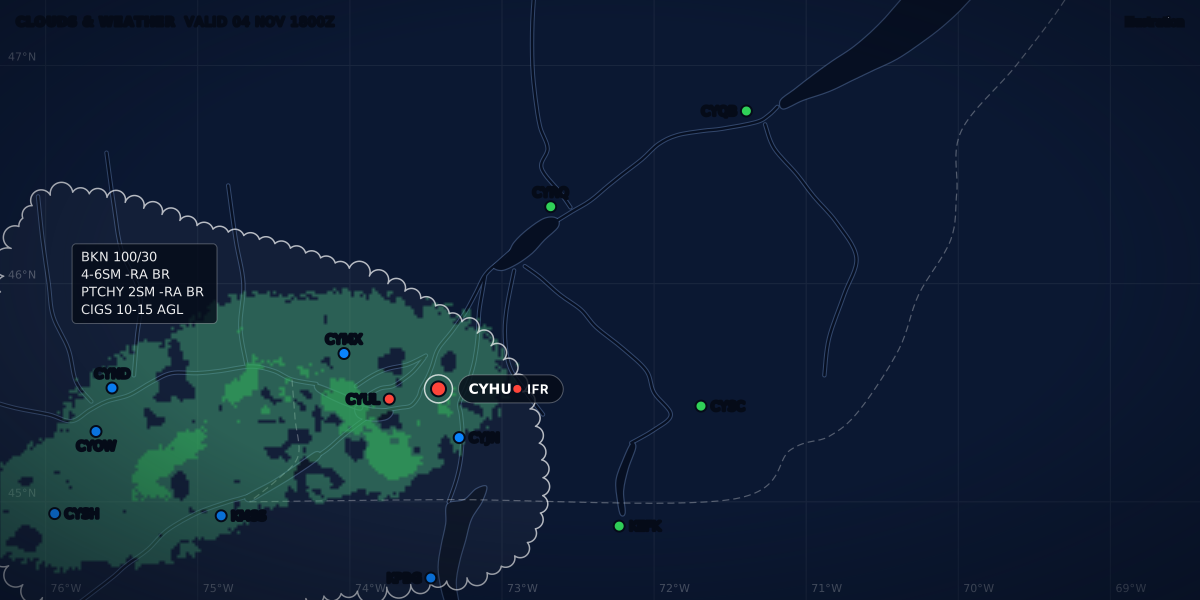
METAR CYHU 061400Z 05010KT 2SM -RA BR OVC006 07/06 A2984St-Hubert at 14:00 UTC on the 6th: wind from 050° at 10 knots, visibility 2 SM in light rain and mist, overcast at 600 ft, temperature 7 °C, dew point 6 °C, altimeter 29.84 inHg. The ceiling (600 ft) and the visibility (2 SM) both put the report in the IFR category. The category is a summary, not a rule: flight categories explains the difference.
The forecasts come next. For two of them, read how to read a TAF and how to read a GFA. Item 1.B then asks you to “select an appropriate route, altitude and alternate”. The weather rules for the alternate are in IFR alternate requirements.
ClearMETAR decodes each METAR and TAF group into plain words. Use it to check your own decode, not as your briefing.
After the test
- The examiner can endorse your licence with the initial instrument rating privileges. That endorsement is valid “for 90 days from the date of the endorsement or upon receipt of a new licence label” (TP 9939E, “Validity Periods”).
- You apply “directly to a Transport Canada office or through the services of an Authorized Person” (TP 9939E).
- Your written exam must fall within the 24 months before that application (CARs 400.03(1)).
Keeping it
The rating does not expire (TP 9939E, “Validity Periods”), but its privileges need a flight test or proficiency check within the 24 months before the flight (CARs 401.05(3)). Since June 17, 2026, you also need six instrument approaches in the six months before each flight, from the first day of the seventh month after that test or check (401.05(3.1)), and the IFR currency guide works through the dates.
Already FAA instrument rated?
Transport Canada has a shorter route for FAA pilots: AC 401-001, Issue 03, effective March 20, 2020. Its section 6.4, “Conditions for Conversion – Instrument Rating – Aeroplane”, lists:
- At least an FAA private pilot certificate with airplane category and class ratings, with airplane instrument privileges.
- The FAAIA written exam (Conversion – Instrument Rating – Aeroplane), on air law and communications procedures. TP 691E lists 20 multiple-choice questions in 1 hour, with a 70 % pass mark.
- An FAA instrument proficiency check “in accordance with 14 CFR §61.57(d)(1) and (2)”, in an airplane or an airplane FSTD, in the 24 months before the application.
- A TCCA Category 1 or Category 3 medical certificate.
- No additional experience.
You also need “English Language Proficiency” on your FAA certificate, or proof of ICAO Level 4 (section 5.0(7)). A certificate “issued on the basis of another foreign pilot licence” is not eligible (section 1.2(2)).
The list has no INRAT and no Canadian flight test. AC 401-001 does not say which group Transport Canada endorses after a conversion, so ask before you plan on one. For the US rating itself, read FAA instrument rating requirements.
Cost and time
Costs depend on the school, the aircraft and you. The figures below come from schools (secondary sources), read on November 6, 2026.
Brampton Flight Centre (Ontario), rates effective September 1, 2026, all taxes excluded. The sheet calls its prices “approximate and subject to change without notice”.
| Item | Group 3 (single-engine) | Group 1 (multi-engine) |
|---|---|---|
| Instrument ground school | C$770 | C$770 |
| Dual in the aircraft | 20 h C-172R/S at C$307: C$6,140 | 10 h PA-44 at C$498 and 10 h C-172R/S at C$307: C$8,050 |
| Simulator | 20 h at C$198: C$3,960 | 20 h at C$198: C$3,960 |
| Briefing | 8 h at C$88: C$704 | 8 h at C$88: C$704 |
| Flight test (aircraft 2.0 h, pilot examiner, TC written, licence fee) | C$1,148 | C$1,530 |
| Total | C$12,722 | C$15,014 |
The lines add up to the sheet’s totals (computed). The multi-engine version costs C$2,292 more (computed).
- The sheet prices 40 hours: 20 in the aircraft and 20 in a simulator. 40 hours is the minimum instrument time of 421.46(2)(b)(ii).
- The sheet says: “The amount of flight training necessary fluctuates with each student.”
- Its prerequisite is a Canadian private pilot licence – aeroplane. It has no line for the 50 hours of cross-country as pilot-in-command. If you do not have them yet, add the cost of those hours.
Other schools give other numbers. Collège Air Richelieu (Québec) gives “Estimate $30,000 (includes multi-engine training and taxes)” and a training time of 4 to 6 months; its page shows no date. The Edmonton Flying Club says the course takes “2-3 weeks if full time and 2 months if part-time”.
Sources
- Standard 421: Flight Crew Permits, Licences and Ratings (421.13(4)(d), 421.14(3), 421.46), Transport Canada
- Standard 425: Flight Training (425.21(9)), Transport Canada
- CARs 401.46: Instrument rating, endorsement of the licence, Justice Laws Website
- CARs 401.47: Instrument rating, privileges, Justice Laws Website
- CARs 401.05: Recency requirements (subsections (3) and (3.1)), Justice Laws Website
- CARs 400.01: Interpretation (cross-country flight time), Justice Laws Website
- CARs 400.03: Validity period of written examinations, Justice Laws Website
- CARs 408.18: Failure and re-test (subsection (3)), Justice Laws Website
- CARs 101.01: Interpretation (instrument time), Justice Laws Website
- SOR/2025-241: Regulations Amending the Canadian Aviation Regulations (Personnel Licensing and Training), Canada Gazette, Part II
- TP 9939E: Flight Test Guide, Instrument Rating, Groups 1, 2 and 3 Aeroplane, 12th edition (January 2021), Transport Canada
- Flight test guides (TP 9939E, TP 15099E), Transport Canada
- TP 691E: Study and Reference Guide, Written Examinations, Instrument Rating, 17th edition (2013), Transport Canada
- Schedule an exam, Transport Canada
- AC 401-001, Issue 03: Application Guidelines for Aeroplane FAA to TCCA Licence Conversion Agreement, Transport Canada
- Instrument Rating price sheet, rates effective September 1, 2026 (secondary), Brampton Flight Centre
- Instrument rating course, read November 6, 2026 (secondary), Collège Air Richelieu
- Instrument rating course, read November 6, 2026 (secondary), Edmonton Flying Club
Rules checked on
Common questions
Group 1 or Group 3: which should I choose?
Standard 421.46(1) sets the group by the flight test aircraft: Group 3 covers single-engine aeroplanes, and Group 1 covers all aeroplanes but needs a test in a multi-engine aeroplane. If you fly only single-engine aeroplanes, Group 3 fits, and a later first move to Group 1 by proficiency check is flown in an aeroplane or a full-flight simulator, not a flight training device (TP 9939E).
How many hours do I need for a Canadian instrument rating?
Standard 421.46(2)(b) asks for 50 hours of cross-country flight as pilot-in-command (10 in the category) and 40 hours of instrument time, of which at most 20 may be instrument ground time. The 40 hours include 5 hours of dual from a flight instructor rating holder, 5 hours in aeroplanes (helicopters for Group 4), 15 hours of dual from a person qualified under Standard 425.21(9) and one dual IFR cross-country of at least 100 NM; the text does not say whether the 5 dual hours count inside the 15.
Does a Canadian instrument rating expire?
No: TP 9939E says instrument ratings no longer expire since Global Exemption NCR-040-2015. To use the rating, CARs 401.05(3) asks for a flight test or instrument proficiency check within the 24 months before the flight, and since June 17, 2026, CARs 401.05(3.1) adds six approaches within six months, from the first day of the seventh month after that test or check.
Let the app do the decoding.
ClearMETAR turns every METAR and TAF into one plain sentence. Free on iPhone.