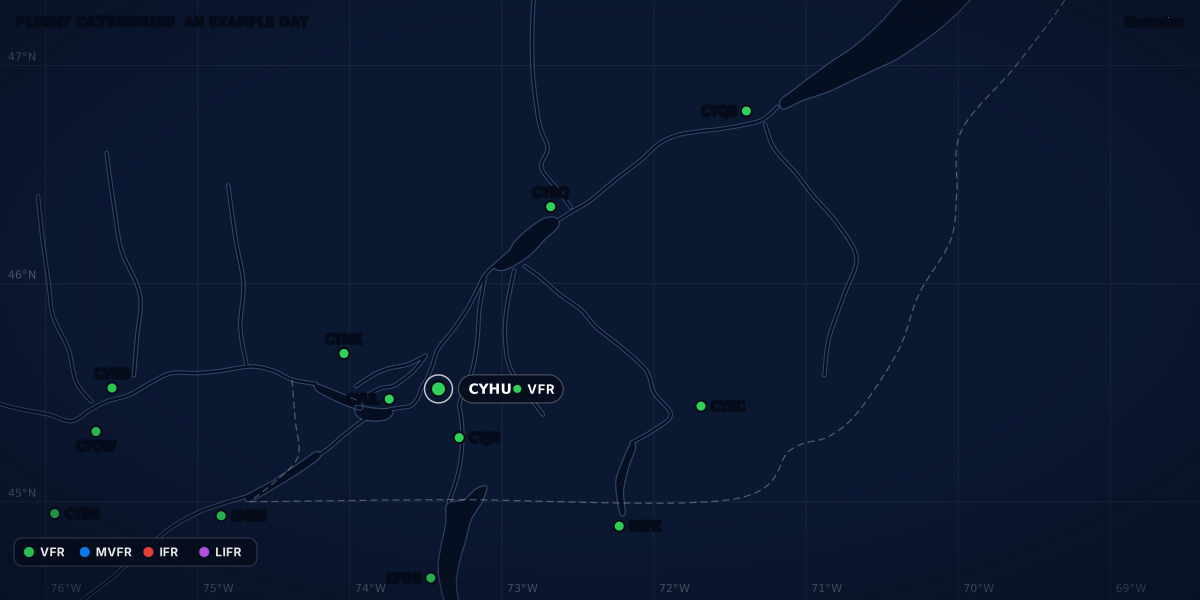
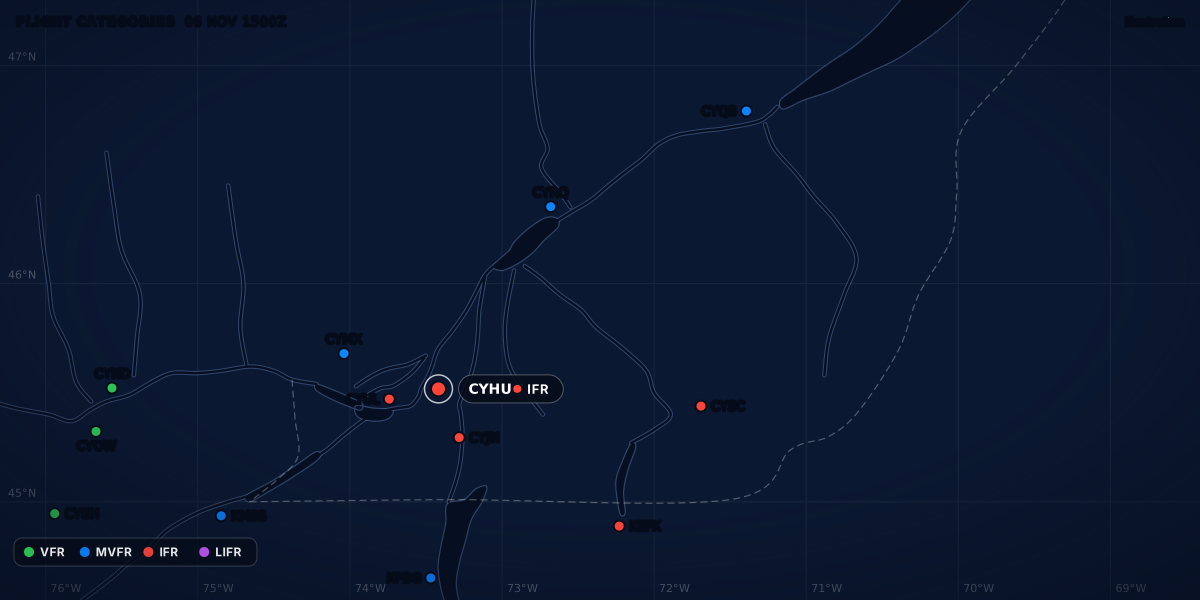
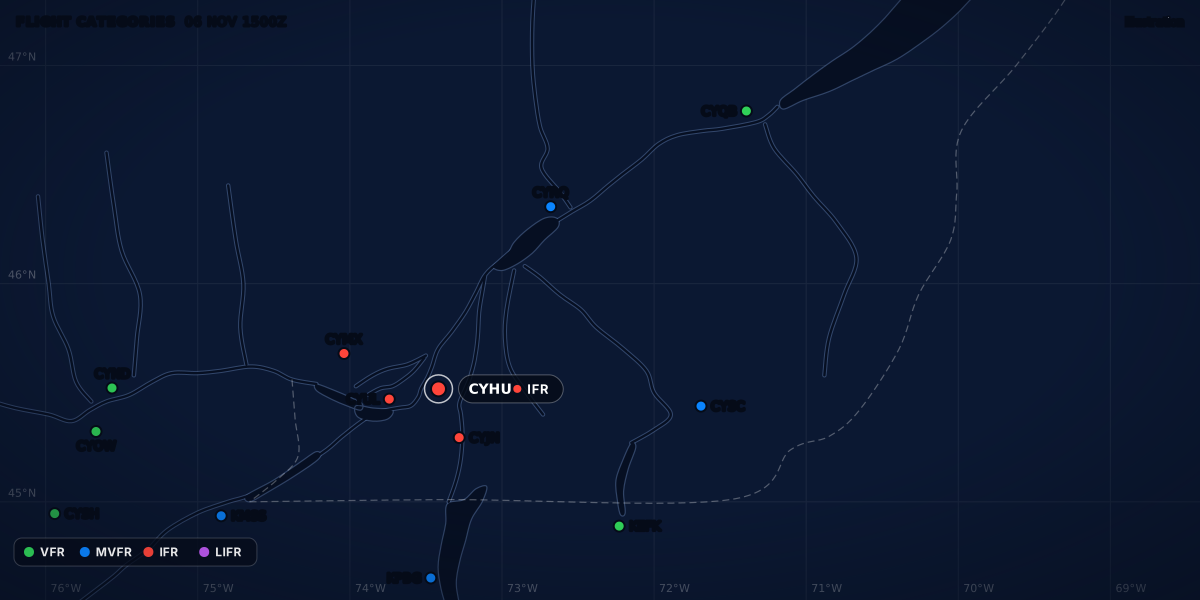
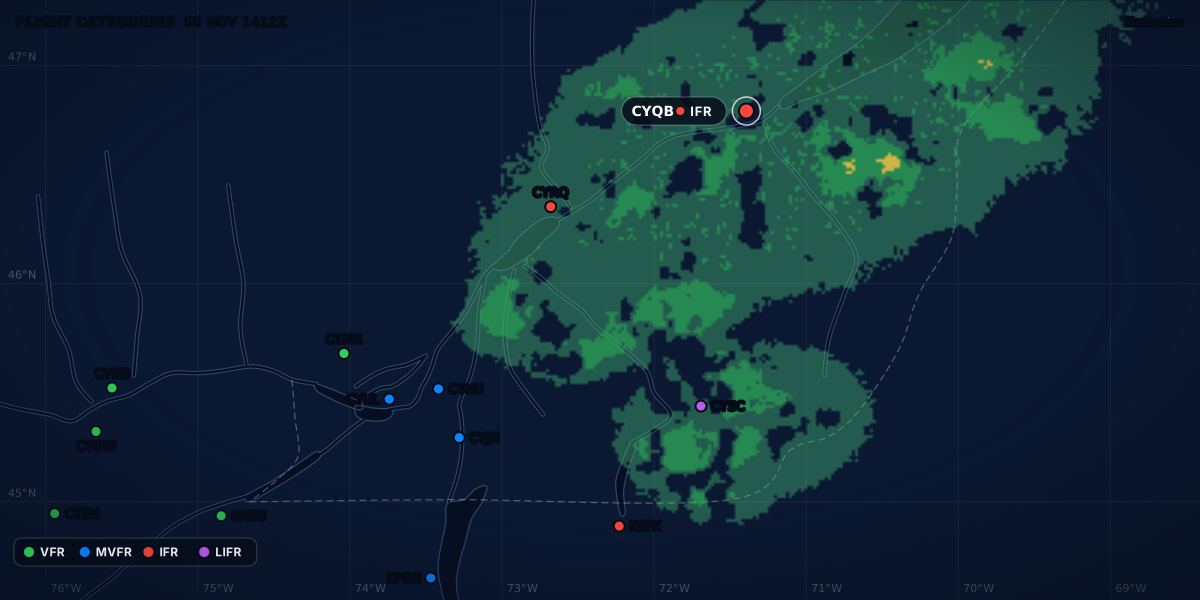
FLIGHT CATEGORIES 06 NOV 1500Z
VFRMVFRIFRLIFR
Illustration
VFR vs IFR: the types of flight rules, and VMC vs IMC
VFR and IFR are rules, VMC and IMC are conditions, MVFR is a weather category. The difference, who may fly IFR, and the other rules: special VFR, CVFR, VFR OTT.
 Jp Valery
12 min read
VFR and IFR are the two sets of flight rules. Under VFR, the visual flight rules, you fly by looking outside: in Canada, a VFR flight must be operated “with visual reference to the surface” (CARs 602.114 and 602.115). Under IFR, the instrument flight rules, you can fly in weather below the VFR minimums, on instruments, with an instrument rating. You choose the rules. The weather does not choose them for you.
Three things share the same letters, and they are easy to mix up: the rules (VFR, IFR), the conditions (VMC, IMC) and the flight categories of a weather report (VFR, MVFR, IFR, LIFR). This guide separates them for Canada, the United States and Europe. The other guides in this series go deeper:
- Airspace classes A to G: what each class asks of a VFR flight.
- VFR weather minimums: the legal visibility and cloud distances, country by country.
- Special VFR: VFR in a control zone with permission from air traffic control.
- VFR cruising altitudes: which altitude goes with your direction of flight.
- VFR on top and VFR over the top: VFR above a cloud layer, and five terms that sound alike.
Rules, not weather
VFR and IFR differ in what the pilot and the flight need, not in what the sky looks like. An IFR flight under a clear sky is still an IFR flight.
| VFR | IFR | |
|---|---|---|
| Weather | At or above the VMC minima: visibility and distance from cloud (CARs 602.114 and 602.115, 14 CFR 91.155, SERA.5005(a)) | Can continue below them, in IMC (14 CFR 61.3(e)) |
| Pilot | Your licence or permit | An instrument rating (CARs 401.47, 14 CFR 61.3(e), Part-FCL FCL.600) |
| Flight plan in Canada | A VFR flight plan or flight itinerary, except within 25 NM of the departure aerodrome (TC AIM RAC 3.5.1) | An IFR flight plan; an IFR flight itinerary only in two cases, for example a flight partly outside controlled airspace (RAC 3.5.1) |
| ATC clearance | Only in some airspace, for example Canada’s Class B (controlled VFR, below) | In controlled airspace (14 CFR 91.173; SERA.6001, classes A to E) |
| Other traffic | You see and avoid | You see and avoid too, when the weather permits (14 CFR 91.113(b)) |
The weather report is not in this table. A METAR gives the weather at one station. The rules say what you may do in it.
What VFR and IFR mean
VFR means visual flight rules, and IFR means instrument flight rules. A “VFR flight” is “a flight conducted in accordance with the visual flight rules”, and an “IFR flight” is “a flight conducted in accordance with the instrument flight rules” (CARs 101.01). The US uses the same abbreviations (14 CFR 1.2), and the EU defines both flights in the same words (SERA, Article 2, points 88 and 140).
VFR is flight by sight. “VFR flights shall be conducted so that the aircraft is flown in conditions of visibility and distance from clouds equal to or greater than” the minima (SERA.5005(a)). In Canada, the VFR minima also require visual reference to the surface (CARs 602.114(a) and 602.115(a)). VFR over the top is the Canadian exception to that rule: CARs 602.116 opens with “Despite paragraphs 602.114(a) and 602.115(a)”.
IFR is flight by instruments. An IFR flight can continue in cloud and low visibility, so the rules ask more of the pilot, the aircraft and the paperwork:
- Canada. “No pilot-in-command shall operate an aircraft in IFR flight unless an IFR flight plan has been filed.” An IFR flight itinerary is allowed instead when the flight is partly or wholly outside controlled airspace, or when the facilities cannot pass the flight plan on (TC AIM RAC 3.5.1, from CARs 602.73). The aircraft counts too: a controlled VFR flight that meets IFR weather may ask for an IFR clearance only “if the pilot has a valid instrument rating and the aircraft is equipped for IFR flight” (RAC 5.6).
- United States. “No person may operate an aircraft in controlled airspace under IFR unless that person has— (a) Filed an IFR flight plan; and (b) Received an appropriate ATC clearance” (14 CFR 91.173). The rule is about controlled airspace only.
- Europe. In every class of controlled airspace, A to E, IFR flights are subject to an ATC clearance (SERA.6001). A VFR flight that wants to change to IFR must pass the changes to its flight plan, or file one and get a clearance before it proceeds IFR in controlled airspace (SERA.5005(j)).
IFR is not a weather word. An IFR pilot in good weather still looks outside: “When weather conditions permit, regardless of whether an operation is conducted under instrument flight rules or visual flight rules”, every pilot must see and avoid other aircraft (14 CFR 91.113(b)).
Rules, conditions and categories
| Words | What they are | Defined by | What decides them |
|---|---|---|---|
| VFR, IFR | Flight rules | CARs 101.01, 14 CFR 1.2, SERA Article 2 | The pilot, on the flight plan (letter V or I, TC AIM RAC 3.15.2.1) |
| VMC, IMC | Weather conditions where the aircraft flies, compared with the VFR minima | CARs 101.01, SERA Article 2 (14 CFR 1.1: “IFR conditions”) | Visibility and distance from cloud, plus the ceiling in SERA |
| VFR, MVFR, IFR, LIFR | Flight categories: a summary of one weather report | Published by the US Aviation Weather Center (AWC GFA help) | Ceiling and visibility at the station, the worse of the two |
The trap is the name. The flight category borrows the words VFR and IFR, but it describes the weather at one station, not the rules of your flight. The category is a summary; the minimums are the law.
Here is a real-format example (constructed, not a real observation) for Montréal / St-Hubert (CYHU):
The visibility is 2 SM: IFR, because the IFR band is “1 mile to less than 3 miles” (AWC GFA help). The ceiling, overcast at 1,500 ft, would be MVFR on its own. The worse of the two counts, so the report is IFR in category. The guide to flight categories explains the four bands.
That word does not make your flight IFR. It does not make a VFR flight illegal, and it does not make one legal. The answer depends on the airspace, the altitude and the country, and the VFR weather minimums guide works through reports like this one.
VMC and IMC: the official definitions
| Where | VMC | IMC |
|---|---|---|
| Canada, CARs 101.01 | Conditions “equal to or greater than the minima” of Division VI, Visual Flight Rules, “expressed in terms of visibility and distance from cloud” | Conditions “less than the minima” for VMC, “expressed in terms of visibility and distance from cloud” |
| United States, 14 CFR 1.1 | Not defined | Not defined. “IFR conditions means weather conditions below the minimum for flight under visual flight rules.” |
| European Union, SERA Article 2 | Point 142: conditions “expressed in terms of visibility, distance from cloud, and ceiling, equal to or better than specified minima” | Point 91: conditions “expressed in terms of visibility, distance from cloud, and ceiling, less than the minima specified” for VMC |
Two differences matter. Canada’s definitions name the visibility and the distance from cloud only; SERA adds the ceiling. And 14 CFR 1.1 does not define VMC or IMC at all: it defines “IFR conditions” against the minimum for VFR flight, and 14 CFR 91.155 gives the basic VFR minimums.
IMC does not mean “in cloud”. It means below the minima: haze that cuts the visibility below the minimum is IMC, and so is a cloud closer than the minimum distance.
VMC also depends on where you fly, because the minima change with the airspace. In Canada, “Weather minima are specified for controlled or uncontrolled airspace, not for each class of airspace” (TC AIM RAC 2.8). In the US, they depend on “the corresponding altitude and class of airspace” (14 CFR 91.155(a)). The VFR weather minimums guide gives the numbers.
Who may fly IFR
All three systems ask for an instrument rating:
- Canada. A licence “endorsed with an instrument rating” gives “the privileges of the licence under IFR” for the group of aircraft endorsed on it, and “the privileges accorded by a VFR OTT rating” (CARs 401.47).
- United States. No person may act as pilot in command of a civil aircraft “under IFR or in weather conditions less than the minimums prescribed for VFR flight” unless that person holds an instrument rating with the right aircraft category and class, or an airline transport pilot certificate with the right ratings (14 CFR 61.3(e)). The US rule covers the weather as well as the rules.
- European Union. IFR flight is for holders of a PPL, CPL, MPL or ATPL “with an IR appropriate to the category of aircraft”, except as FCL.835, the basic instrument rating (BIR), allows, and except during skill tests or dual instruction (Part-FCL FCL.600).
I hold a private licence with night and float ratings and no instrument rating, so this section rests on the regulations only. The steps to the rating, country by country, are in how to get an instrument rating.
Where VFR is not allowed
Class A airspace is IFR airspace: “All operations must be conducted under IFR” in Canada (TC AIM RAC 2.8.1), every operation must be under IFR in the US unless ATC authorizes a deviation (14 CFR 91.135), and “IFR flights only are permitted” in the EU (SERA.6001(a)(1)). Canada’s Class B takes VFR flights only as controlled VFR (below), and SERA allows no VFR above FL 195, except in an airspace reservation or, up to FL 285, with an authorization from the ATS unit (SERA.5005(d)); the guide to airspace classes in Canada, the US and Europe gives the rules of every class.
The other flight rules
VFR has variants. Each one has its own guide:
- Special VFR is a VFR flight in a control zone with permission from air traffic control: Canada says it is conducted “under VMC” (CARs 101.01), and SERA says “below VMC” (Article 2, point 122). The guide to special VFR minima and night rules compares the countries.
- VFR over the top (VFR OTT) in Canada is a VFR flight above cloud, in cruise and by day, that need not keep visual reference to the surface (CARs 602.116); an instrument rating includes its privileges (CARs 401.47). It is not the American VFR-on-top, “which is not allowed in Canadian Domestic Airspace” (TC AIM RAC 8.7), and the guide to VFR on top vs VFR over the top sorts out the five similar terms.
- Night VFR is VFR between the end of evening civil twilight and the beginning of morning civil twilight, the “night” of CARs 101.01 and 14 CFR 1.1. What changes after dark is in night VFR.
Controlled VFR (CVFR) in Canada
A CVFR flight is “a flight conducted under the visual flight rules within Class B Airspace and in accordance with an air traffic control clearance” (CARs 101.01). You fly VFR, but you follow “procedures designed for use by IFR flights” (TC AIM RAC 5.6).
Where. “All low-level controlled airspace above 12 500 ft ASL or at and above the MEA, whichever is higher, up to but not including 18 000 ft ASL, will be Class B airspace.” Control zones and their terminal control areas may be Class B too. ATC separates all aircraft there (TC AIM RAC 2.8.2).
What you need (RAC 2.8.2, note 1):
- two-way radio with the ATS facility, radio navigation equipment to fly the flight plan, and a transponder with automatic pressure-altitude reporting;
- a continuous listening watch on the frequency that ATC assigns;
- a position report over each reporting point, unless ATC says otherwise;
- VMC at all times.
The list names equipment and procedures. It does not name an instrument rating.
How. “Pilots intending to fly CVFR shall file a flight plan and obtain an ATC clearance prior to entering Class B airspace” (RAC 5.6). The type of flight on the flight plan is C, “for controlled VFR” (RAC 3.15.2.2). ATC does not normally clear you before takeoff, unless the control zone itself is Class B. It normally clears you when you report “upon reaching the last 1 000 feet altitude below the base of Class B or before entering laterally”, and the clearance contains “MAINTAIN (altitude) VFR” (RAC 5.6).
Altitudes. Below 18,000 ft ASL, CVFR flights cruise at the IFR altitudes, odd or even thousands, not at the VFR thousands plus 500 (RAC 2.3.1, Table 2.1). The VFR cruising altitudes guide has the full table.
If the weather closes in. When VMC is not possible on your altitude or route, ask for a clearance that keeps you in VMC to your destination or another aerodrome. With a valid instrument rating, ask for an IFR clearance. In a Class B control zone, ask for special VFR. If none of these works, stay in VMC, leave Class B “by the safest and shortest route, either exiting horizontally or descending” (or land, in a control zone), and tell ATC as soon as possible (RAC 2.8.2, notes 2 and 3).
Across the border. ATS “must not accept flight itineraries, composite flight plans, or CVFR flight plans for flights between Canada and the U.S.” (RAC 3.5.3).
Changing rules in flight: I, V, Y and Z
The flight plan gives the flight rules with one letter, in item 8 (TC AIM RAC 3.15.2.1, Canadian and ICAO):
| Letter | Meaning |
|---|---|
| I | The entire flight under IFR |
| V | The entire flight under VFR |
| Y | IFR first, then one or more changes of flight rules |
| Z | VFR first, then one or more changes of flight rules |
With Y or Z, write the points of change in the route, item 15. With more than one change, the letter gives the first rule: “use ‘Z’ for VFR/IFR/VFR” (RAC 3.15.2.1).
Canada calls this a composite flight plan or flight itinerary: “All rules governing VFR or IFR apply to that portion of the route of flight” (RAC 3.7). If you start IFR, ATC clears you to the point where the IFR part ends. If you start VFR, contact ATC for the IFR clearance before you reach the IFR point (through a flight information centre if you cannot reach ATC directly), and stay in VFR conditions until ATC issues the clearance and you acknowledge it (RAC 3.7).
A composite plan “shall not be filed for an aircraft that will enter airspace controlled by the FAA”, because NAV CANADA and FAA systems cannot process composite data correctly (RAC 3.7). A flight between Canada and the US needs a VFR or an IFR flight plan (RAC 3.5.3).
What ClearMETAR shows: category, not legality
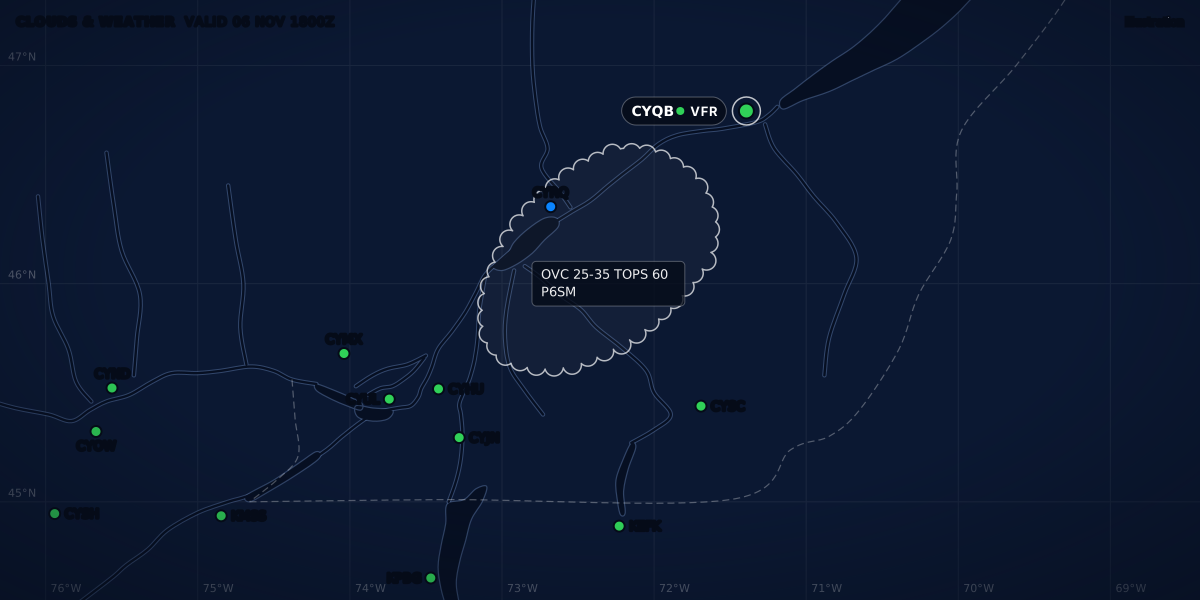
The app colors the whole screen by flight category, VFR, MVFR, IFR or LIFR, with the US thresholds, and it takes the worse of the ceiling and the visibility. Its decoder explains each group: which cloud layer is the ceiling, and which band the visibility falls in. It does not know your airspace, your licence or your flight rules, so it never tells you whether a VFR flight is legal. The category tells you where to look closer. The minimums decide.
Next: airspace classes A to G, the first guide of this series.
Sources
- Canadian Aviation Regulations, 101.01 Interpretation (VFR flight, IFR flight, VMC, IMC, CVFR, special VFR flight), Justice Laws Website
- CARs 401.47: privileges of the instrument rating, Justice Laws Website
- CARs 602.114 and 602.115: minimum visual meteorological conditions for VFR flight, Justice Laws Website
- CARs 602.116: VFR over-the-top, Justice Laws Website
- TC AIM (TP 14371) 2026-2, RAC 2.3.1, 2.8, 2.8.1, 2.8.2, 3.5.1, 3.5.3, 3.7, 3.15.2, 5.6 and 8.7, Transport Canada
- 14 CFR 1.1 and 1.2: definitions and abbreviations, eCFR
- 14 CFR 61.3(e): instrument rating required, eCFR
- 14 CFR 91.113(b), 91.135, 91.155 and 91.173, eCFR
- Regulation (EU) No 923/2012 (SERA), Article 2, SERA.5005, Table S5-1 and SERA.6001, consolidated text of 1 May 2025, EUR-Lex
- Regulation (EU) No 1178/2011 (Part-FCL), FCL.600, consolidated text of 30 April 2026, EUR-Lex
- Graphical Forecasts for Aviation (GFA) help: flight category limits, NOAA Aviation Weather Center
Rules checked on
Common questions
Is VFR the same as VMC?
No. VFR is a set of rules, and VMC is weather at or above the VFR minima, in visibility and distance from cloud in Canada (CARs 101.01) and with the ceiling added in Europe (SERA Article 2); a VFR flight must stay in VMC (SERA.5005(a)), and an IFR flight can fly in VMC too.
Can I fly VFR in IMC?
No. A VFR flight must stay at or above the VMC minima (CARs 602.114 and 602.115, 14 CFR 91.155, SERA.5005(a)), and flight below them needs IFR and an instrument rating (CARs 401.47, 14 CFR 61.3(e)); special VFR in a control zone has its own rules: SERA defines it as flight "below VMC" (Article 2), and Canada as flight "under VMC" (CARs 101.01).
What is a Y or Z flight plan?
Y means the flight starts under IFR and then changes flight rules, Z means it starts under VFR and then changes, and the route item gives the points of change (TC AIM RAC 3.15.2.1). Canada does not accept a composite flight plan for a flight between Canada and the US (TC AIM RAC 3.5.3).

Let the app do the decoding.
ClearMETAR turns every METAR and TAF into one plain sentence. Free on iPhone.