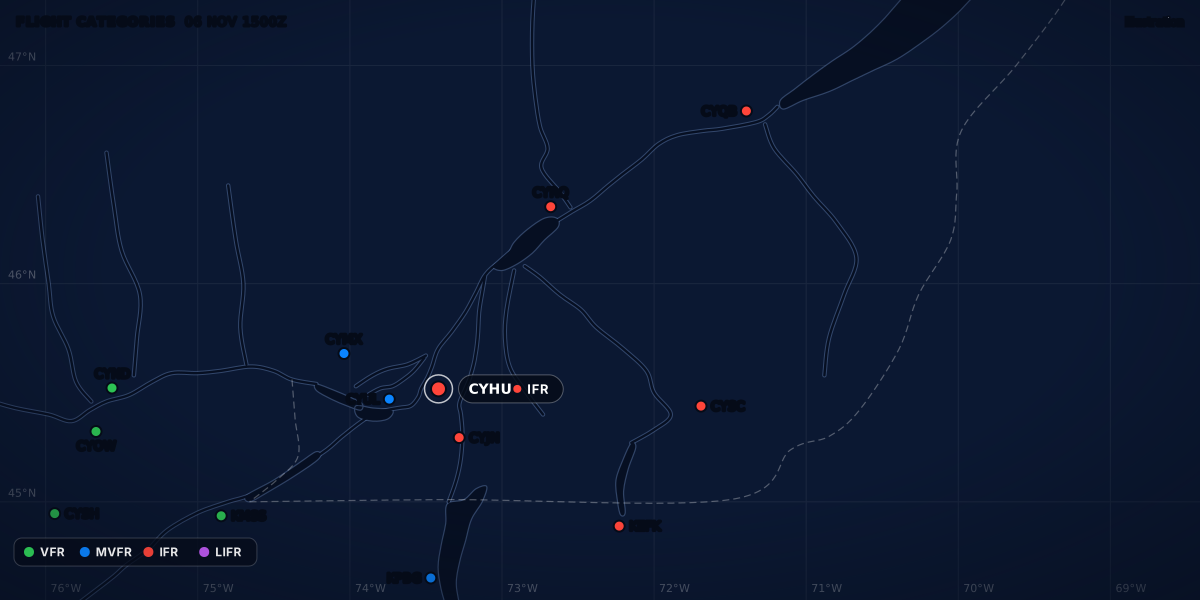
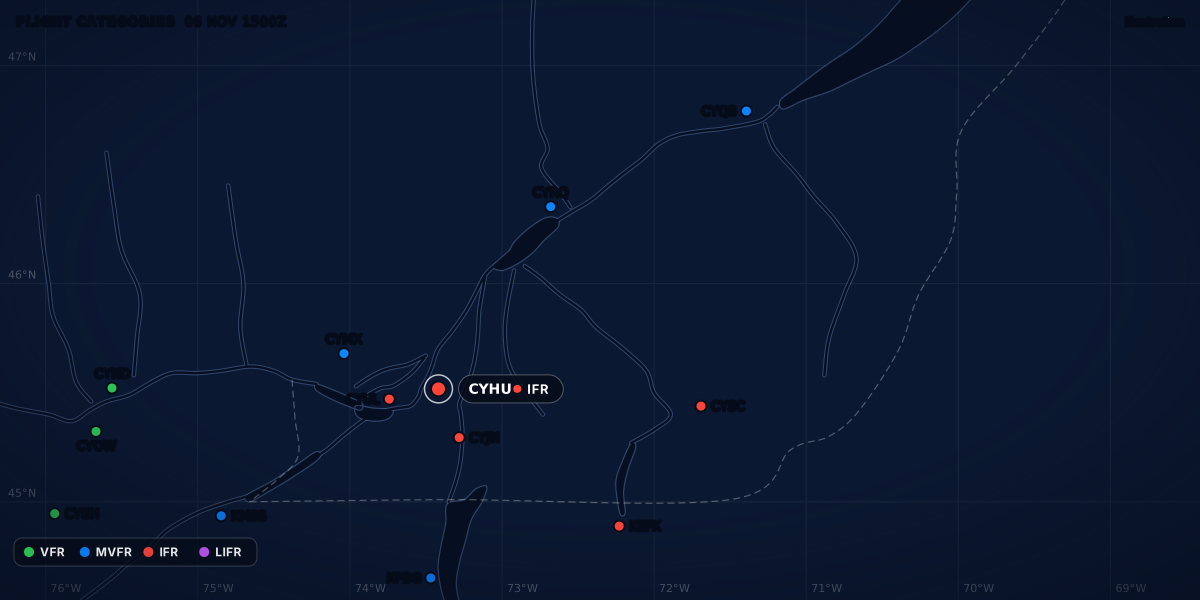
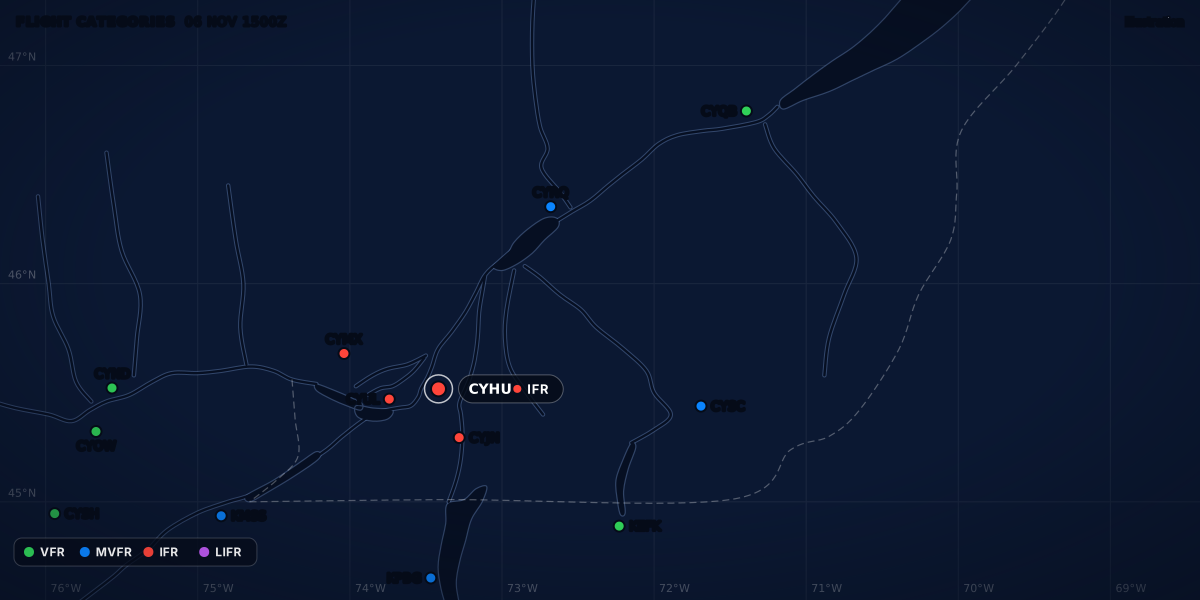
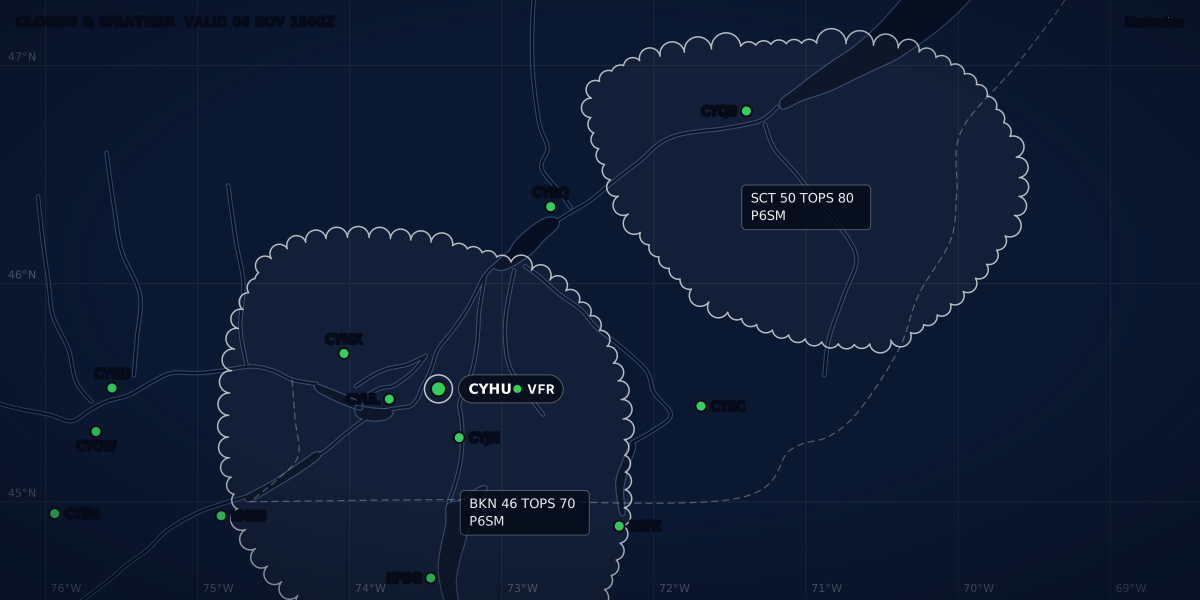
FLIGHT CATEGORIES AN EXAMPLE DAY
VFRMVFRIFRLIFR
Illustration
Airspace classes A to G: Canada, the US and Europe compared
Class C in Canada needs a clearance; in the US, radio contact. Classes A to G in Canada, the US and Europe: VFR entry, transponder and speed limits.
 Jp Valery
19 min read
An airspace class is a letter from A to G. It tells you what air traffic control (ATC) does in that airspace, and what you must do before you enter it as a VFR pilot: get a clearance, make radio contact, or nothing. Canada, the United States and Europe all use these letters. They do not give them the same rules.
This guide compares the classes letter by letter, with the section of each rule. It covers what a VFR pilot must do, not what ATC does for IFR traffic. It is part of the flight-rules series: VFR vs IFR and the other flight rules explains the rules themselves.
Short answer
What a VFR pilot must do before entering, by class:
| Class | Canada | United States | Europe (SERA) | France |
|---|---|---|---|---|
| A | No VFR without an authorization from the Minister (CARs 601.06) | No VFR: IFR only (14 CFR 91.135) | No VFR: IFR only (SERA.6001(a)(1)) | No VFR (SERA) |
| B | ATC clearance (CARs 601.07), as controlled VFR | ATC clearance (91.131(a)(1)), and a pilot certificate rule (91.131(b)) | ATC clearance (6001(a)(2)) | Not used (ENR 1.4) |
| C | ATC clearance (CARs 601.08(1)) | Two-way radio communications, no clearance (91.130(c)(1)) | ATC clearance (6001(a)(3)) | ATC clearance (SERA) |
| D | Two-way radio contact (CARs 601.09) | Two-way radio communications (91.129(c)(1)) | ATC clearance (6001(a)(4)) | ATC clearance (SERA), transponder (GEN 1.5) |
| E | Nothing, except in a mandatory frequency area (TC AIM RAC 2.8.5) | Nothing, except radio contact for a flight to or through a towered airport (91.127(c)) | No clearance; an RMZ or TMZ adds radio or transponder (6001(a)(5), 6005) | No clearance (SERA) |
| F | Restricted: permission (CARs 601.04(2)). Advisory: your own discretion (RAC 2.8.6.3) | Not designated (Part 71) | No clearance (6001(a)(6)) | Not used (ENR 1.4) |
| G | Nothing, except in a mandatory frequency area (RAC 4.5.4) | Nothing, except radio contact for a flight to or through a towered airport (91.126(d)) | No clearance (6001(a)(7)); an RMZ adds radio (6005) | No clearance (SERA) |
The traps are in the same letters:
- Class C. In Canada it needs a clearance. In the US it needs only radio contact.
- Class D. In Europe it needs a clearance. In Canada and the US it needs only radio contact.
- Class B. In Canada it is the low-level controlled airspace above 12,500 ft ASL and below 18,000 ft, plus some control zones and TCAs. VFR flights enter it only as controlled VFR. In the US it surrounds a primary airport.
- Class E. Canada uses it for some control zones. Europe never does.
- Class F. In Canada it is special use airspace. The US does not designate it.
- After hours. In Canada, Class C and D become Class E when the ATC unit closes.
Controlled and uncontrolled airspace
Classes A to E are controlled airspace. Class G is uncontrolled. Class F sits on either side in Canada.
- Canada. CARs 601.02 gives controlled airspace one of the classes A, B, C, D or E, or “Class F Special Use Restricted” or “Class F Special Use Advisory”. Uncontrolled airspace is Class G or one of the two Class F types. The Designated Airspace Handbook (DAH) says which class applies where.
- United States. “Controlled airspace is a generic term that covers Class A, Class B, Class C, Class D, and Class E airspace” (14 CFR 1.1). 14 CFR Part 71 designates Classes A to E only. Its subparts F and G are reserved.
- Europe. SERA defines controlled airspace as airspace where air traffic control service is provided “in accordance with the airspace classification” (Article 2(58)). Classes A to D give that service to all flights, and Class E to IFR flights. In Classes F and G, “ATC clearance is not required” (SERA.6001(a)(6) and (7)).
In Canada, the name of a block does not set the rules. The class does. “The air traffic services available and the rules for operating within a particular portion of airspace depend on the classification of that airspace and not on the name by which it is commonly known” (TC AIM RAC 2.8). A control zone can be Class B, C, D or E (RAC 2.7.3). A terminal control area (TCA) can be Class B, C or D (RAC 2.8.2 to 2.8.4).
The structure differs too. Canada splits its airspace at 18,000 ft ASL: low-level airspace below, high-level airspace at and above (RAC 2.3). Below 18,000 ft, controlled airspace is a set of defined blocks. For example, low-level airways and control area extensions usually start at 2,200 ft AGL (RAC 2.7.1, 2.7.2), transition areas at 700 ft AGL (RAC 2.7.5), and terminal control areas and control zones have their own limits (RAC 2.7.3, 2.7.6). Outside these blocks, the airspace is uncontrolled. “In effect, Class G is all uncontrolled domestic airspace” (RAC 2.8.7). The US instead has a blanket of Class E from 14,500 ft MSL up to 18,000 ft (14 CFR 71.71(a)), plus Class E areas from 700 ft or 1,200 ft above the surface (71.71(c)).
Weather minima follow the airspace
The legal VFR weather minima depend on the airspace, in different ways:
- Canada: “Weather minima are specified for controlled or uncontrolled airspace, not for each class of airspace” (TC AIM RAC 2.8).
- United States: the table of 14 CFR 91.155(a) has a row per class, and Class E and G rows by altitude.
- Europe: Table S5-1 of SERA.5001 gives the minima by class and by three altitude bands.
The numbers are in VFR weather minimums. ClearMETAR decodes the ceiling and visibility of a report, but it shows no airspace: the class tells you which minima apply to those numbers.
Class A
Class A is for IFR flights in all three systems.
- Canada. “Class A airspace is designated where an operational need exists to exclude VFR aircraft” (TC AIM RAC 2.8.1). It starts at the base of high-level controlled airspace or 700 ft AGL, whichever is higher, and goes up to and including FL 600. In the southern control area, the base is 18,000 ft ASL, or 700 ft AGL where that is higher. In the northern and arctic control areas, it is FL 230 and FL 270 (DAH glossary). No one may fly VFR in Class A without an authorization from the Minister (CARs 601.06). Every aircraft needs a transponder with altitude reporting and ADS-B (RAC 2.8.1).
- United States. Class A is the airspace from 18,000 ft MSL to and including FL 600 over the 48 contiguous states and their coastal waters out to 12 NM (14 CFR 71.33(a)). Alaska has its own description in 71.33(b). Flights must be IFR, under a clearance received before entry (14 CFR 91.135).
- Europe. “IFR flights only are permitted” (SERA.6001(a)(1)). All airspace above FL 195 is Class C (SERA.6001(b)), so Class A in Europe can only lie below FL 195 (derived). VFR flights do not fly above FL 195, except in an airspace reservation for them, or up to FL 285 when the ATS unit authorizes it under procedures published in the AIP (SERA.5005(d)).
Class B
Here the letter means three different things.
- Canada. “All low-level controlled airspace above 12 500 ft ASL or at and above the MEA, whichever is higher, up to but not including 18 000 ft ASL, will be Class B airspace” (TC AIM RAC 2.8.2). Control zones and TCAs may also be Class B. In the Montréal FIR, the DAH prints “Class B airspace – Above 12,500´” over the transition areas and control area extensions (DAH 3.5.1-1 and 3.5.2-1).
- United States. Class B surrounds at least one primary airport (14 CFR 71.41). You need an ATC clearance before entry (14 CFR 91.131(a)(1)). The pilot in command must hold at least a private pilot certificate, or meet the recreational, sport or student pilot conditions of 91.131(b)(1). To take off or land at the airports in section 4 of Appendix D, the pilot in command needs at least a private pilot certificate (91.131(b)(2)).
- Europe. IFR and VFR flights are allowed, all flights are separated from each other, and every flight needs a clearance (SERA.6001(a)(2)). France does not use Class B (ENR 1.4).
In Canada, you may fly VFR in Class B only under an ATC clearance or an authorization from the Minister (CARs 601.07(1)). “VFR flights are conducted as controlled VFR flights” (RAC 2.8.2), and a controlled VFR (CVFR) pilot files a flight plan and gets a clearance before entry (RAC 5.6). The flight rules hub explains CVFR as a flight rule.
The aircraft needs a two-way radio, navigation equipment for the flight plan route, and a transponder with altitude reporting (RAC 2.8.2, note 1). It also needs ADS-B Out: the mandate came into force on May 16, 2024 (NAV CANADA).
Class C
Class C is the biggest trap for pilots who cross the border.
- Canada. “No person operating a VFR aircraft shall enter Class C airspace unless the person receives a clearance to enter from the appropriate air traffic control unit before entering the airspace” (CARs 601.08(1)). An aircraft with no two-way radio may enter by day in VMC with an authorization from ATC (601.08(2)). You need a two-way radio, a transponder with altitude reporting, and a listening watch on the frequency ATC gives you (TC AIM RAC 2.8.3). ATC separates IFR aircraft from each other, gives traffic information to all, and resolves conflicts between VFR and IFR aircraft when necessary (RAC 2.8.3).
- United States. You must establish two-way radio communications with the ATC facility before entering, and keep them while inside (14 CFR 91.130(c)(1)). The rule asks for no clearance. The aircraft needs the transponder and ADS-B Out of 91.215 and 91.225 (91.130(d)).
- Europe. Every flight needs a clearance (SERA.6001(a)(3)). VFR flights are separated from IFR flights and get traffic information on other VFR flights. All airspace above FL 195 is Class C (SERA.6001(b)). In France, the upper control area from FL 195 to FL 660 is Class C (ENR 1.4).
So “radio contact” is enough to enter a US Class C area, and not enough to enter a Canadian one. In the Montréal FIR, the Class C control zones include Montréal/Trudeau (CYUL), St-Hubert (CYHU), Mirabel (CYMX) and Québec (CYQB) (DAH 3.5.4). Before entry, TC AIM RAC 5.8 asks you to contact ATC with your aircraft type and identification, position, altitude, destination and route, transponder code and the ATIS code.
When the weather is below the VFR minima, you may ask for a special VFR authorization to enter a control zone, normally through the tower or FSS. ATS never offers it first (TC AIM RAC 2.7.3). Special VFR covers the minima and the night rules.
Class D
- Canada. You must establish two-way radio contact with the ATC unit before entering (CARs 601.09(1)). An aircraft with no two-way radio may enter by day in VMC with an authorization from ATC (601.09(2)). “ATC separation is provided only between IFR aircraft” (TC AIM RAC 2.8.4). You need a transponder only where the DAH lists the Class D airspace as transponder airspace (RAC 2.8.4, CARs 601.03(b)).
- United States. You must establish two-way radio communications with the ATC facility before entering, and keep them (14 CFR 91.129(c)(1)). A Class D area surrounds at least one primary airport (14 CFR 71.61).
- Europe. “All flights shall be subject to ATC clearance”, and every flight keeps continuous air-ground voice communications (SERA.6001(a)(4)).
- France. The lower control area (LTA) is Class D. It runs from the higher of FL 115 and 3,000 ft above the surface (ASFC) up to FL 195, outside the terminal areas, airways and other control areas published on their own. Over the mountain regions listed in ENR 1.4, it is Class E (AIP France ENR 1.4). A VFR aircraft in Class A, B, C or D needs a transponder with altitude reporting (AIP France GEN 1.5 3.2.1).
Class E
Class E is controlled airspace, but a VFR flight needs no clearance to enter it in any of the three systems.
- Canada. “VFR aircraft do not require permission to enter Class E airspace and, except for mandatory frequency areas (see RAC 4.5.4), are not required to establish communication with an ATS unit prior to entering” (TC AIM RAC 2.8.5). Low-level airways, control area extensions, transition areas and control zones with no operating control tower may be Class E (RAC 2.8.5). So is all high-level controlled airspace above FL 600 (DAH glossary). Where the DAH lists Class E as transponder airspace, you need a transponder with altitude reporting (RAC 2.8.5). ATC may give traffic information on request, workload permitting, and you keep your own watch for traffic (RAC 2.8.5).
- United States. Class E runs from 14,500 ft MSL up to, but not including, 18,000 ft MSL, and above FL 600 (14 CFR 71.71(a)). The blanket leaves out the airspace below 1,500 ft above the surface and the Alaska Peninsula west of 160° W. Class E also includes the areas designated for an airport (71.71(b)), areas from 700 ft or 1,200 ft or more above the surface (71.71(c)), and the Federal airways (71.71(d)). To fly to, from, through or on an airport with an operating control tower, you must keep two-way radio communications with the tower. You establish them before 4 NM from the airport, up to and including 2,500 ft AGL (14 CFR 91.127(c)).
- Europe. VFR flights need no clearance. IFR flights need one, and keep continuous voice communications. “Class E shall not be used for control zones” (SERA.6001(a)(5)). A competent authority can still make part of Class E a radio mandatory zone (RMZ) or a transponder mandatory zone (TMZ) (SERA.6005).
Class F
- Canada. Class F is special use airspace. It “may be restricted airspace, advisory airspace, military operations areas, or danger areas and can be controlled airspace, uncontrolled airspace, or a combination of both” (TC AIM RAC 2.8.6). Unless otherwise specified, the rules of the surrounding airspace apply. Each area has a code: CY, then R (restricted), A (advisory) or D (danger), then a number by region (601 to 699 in Québec). An advisory area also gets an activity letter, for example (P) for parachuting or (T) for training (RAC 2.8.6.1).
- Restricted (CYR). No one may fly in Class F Special Use Restricted airspace without an authorization from the person that the DAH names (CARs 601.04(2)). In the TC AIM, that is the user agency’s permission for active restricted airspace (RAC 2.8.6.4).
- Advisory (CYA). “If necessary, pilots of non-participating flights may enter advisory areas at their own discretion; however, extra vigilance is recommended” (RAC 2.8.6.3). In an uncontrolled advisory area, 126.7 MHz “would be an appropriate frequency”.
- A forest-fire restriction by NOTAM (CARs 601.16) or a restriction under section 5.1 of the Aeronautics Act is not Class F (RAC 2.8.6.6).
- United States. Part 71 designates no Class F: subparts F and G are reserved (14 CFR Part 71).
- Europe. No clearance is required. Participating IFR flights get an air traffic advisory service (SERA.6001(a)(6)). “Implementation of Class F shall be considered as a temporary measure” (SERA.6001(a)(8)). France does not use Class F (ENR 1.4).
Class G
- Canada. In Class G, “ATC has neither the authority nor the responsibility to exercise control over air traffic”, but ATS units give flight information and alerting services (TC AIM RAC 2.8.7). Below 18,000 ft ASL, Class G fills the gaps between the controlled blocks, so in southern Canada it can reach up to 18,000 ft ASL (derived from RAC 2.3, 2.7 and 2.8.7). In a mandatory frequency (MF) area, you need a working two-way radio and you make the reports of CARs 602.97 to 602.103 (RAC 4.5.4). The Canada Flight Supplement gives each MF’s frequency, distance and altitude. VFR en route in uncontrolled airspace, you should monitor 126.7 MHz when you are not on an MF or ATF (RAC 4.5.6, note).
- United States. Class G is not controlled airspace: 14 CFR 1.1 calls only Classes A to E controlled, and Part 71 designates no Class G (derived). When you approach to land at a Class G airport with no operating control tower, a powered fixed-wing aircraft makes all turns to the left, unless approved lights or markings call for right turns (14 CFR 91.126(b)(1)). For a towered airport, the radio rule is the same as in Class E: contact before 4 NM, up to and including 2,500 ft AGL (91.126(d)).
- Europe. IFR and VFR flights “receive flight information service if requested”, and no clearance is required (SERA.6001(a)(7)). An RMZ can make radio contact compulsory (SERA.6005(a)). In France, the flight information regions are Class G from the surface to FL 195, except the control areas and control zones (ENR 1.4).
Transponder and ADS-B by country
| Canada | United States | France | |
|---|---|---|---|
| Transponder with altitude reporting | All Class A, B and C. Class D or E only where the DAH lists it (CARs 601.03). Balloons and gliders are exempt (CARs 605.35(1)). | Class A, B and C. Within 30 NM of the airports in Appendix D, section 1, from the surface to 10,000 ft MSL. Above the ceiling of a Class B or C area, within its lateral limits, up to 10,000 ft MSL. At and above 10,000 ft MSL over the 48 states, except at and below 2,500 ft above the surface. Within 10 NM of the airports in Appendix D, section 2, from the surface to 10,000 ft MSL, except below 1,200 ft outside their surface area (14 CFR 91.215(b)). | Class A, B, C and D; some published routes and areas; a night VFR flight that leaves the aerodrome vicinity (GEN 1.5 3.2.1). Every TMZ (ENR 1.4, SERA.6005(b)). |
| ADS-B Out | Class A since August 2023 and Class B since May 16, 2024 (NAV CANADA). Classes C, D and E: “no sooner than 2028”. | Class A (91.225(a)). Class B and C, the same 30 NM areas, above Class B and C ceilings to 10,000 ft MSL, Class E at and above 10,000 ft MSL except at and below 2,500 ft above the surface, and Class E at and above 3,000 ft MSL over the Gulf of Mexico, out to 12 NM from the coast (91.225(d)). | Not covered here. |
CARs 601.03 defines transponder airspace. CARs 605.35 requires the equipment in it, and lets an ATC unit authorize a flight without it on a request made before entry (605.35(3)). Two examples from DAH Issue 324:
- Every flight information region lists “the controlled airspace 10,000´ to 12,500´ within radar coverage” as transponder airspace (Montréal: DAH 3.5.5-21).
- Around Montréal, a large Class E area from 700 ft AGL is transponder airspace (DAH 3.5.5-11).
The FAA calls the 30 NM area of 91.215(b)(2) the Mode C veil (79 FR 57431, 2014). The CARs set no such ring in Canada: Class D or E airspace is transponder airspace only where the DAH lists it (CARs 601.03(b)). In the US, 91.215 and 91.225 exempt aircraft that were not originally certificated with an engine-driven electrical system, balloons and gliders from some of these areas.
Speed limits by country
| Canada (CARs 602.32) | United States (14 CFR 91.117) | Europe (SERA.6001) and France (ENR 1.4) | |
|---|---|---|---|
| Low altitude | 250 KIAS below 10,000 ft ASL | 250 KIAS below 10,000 ft MSL | SERA: 250 kt IAS below 10,000 ft AMSL for VFR flights in Class C, and for all flights in Classes D to G. France: all flights below 10,000 ft AMSL; in Classes A and C, ATC can allow more for IFR flights. |
| Near airports | 200 KIAS below 3,000 ft AGL within 10 NM of a controlled aerodrome, unless an ATC clearance allows more | 200 KIAS at or below 2,500 ft above the surface within 4 NM of the primary airport of a Class C or D area (not in Class B). 200 KIAS under a Class B area or in a VFR corridor through it. | None in SERA.6001 |
In Canada, the 200-knot limit depends on a controlled aerodrome, not on the class. Canada and the US allow the minimum safe airspeed when it is higher than the limit (CARs 602.32(3), 14 CFR 91.117(d)). SERA and France let the authority exempt aircraft types that cannot keep 250 kt (SERA.6001, ENR 1.4).
When the tower closes
In Canada, “Class C airspace becomes Class E airspace when the appropriate air traffic control unit is not in operation” (CARs 601.08(3)). The same is true for Class D (CARs 601.09(3)). Two consequences:
- You no longer need a clearance or ATC contact by class (TC AIM RAC 2.8.5). Some aerodromes have a mandatory frequency when they are uncontrolled: check the Canada Flight Supplement (RAC 4.5.4).
- The DAH can still list the airspace as transponder airspace. Example: the Mirabel control zone when the tower is not in operation (DAH 3.5.5-12).
In the US, the radio rules near a towered airport in Class E and G (91.127(c), 91.126(d)), and from a satellite airport in Class D (91.129(c)(2)), depend on whether the tower is operating. This guide does not cover what each US Class D area becomes after hours.
Worked examples
All the Canadian airspace below is from DAH Issue 324, effective 0901Z 29 October 2026 to 0901Z 24 December 2026. The DAH is reissued every 56 days, and a NOTAM can change it. This is not a navigation source: use the current charts and CFS.
Flying into St-Hubert (CYHU)
The St-Hubert control zone is Class C, “to 2000´ (1900´ AAE)”, inside parts of 7 NM and 5 NM circles around the airport (DAH 3.5.4-13 and 3.5.4-14). Above it, the Montréal TCA is also Class C, in layers from 1,500 ft up to 12,500 ft (DAH 3.5.3-8 to 3.5.3-14).
- You call ATC before the boundary, with the details of RAC 5.8.
- You wait for the clearance to enter (CARs 601.08(1)). Two-way contact alone is not enough.
- Your aircraft has a two-way radio and a transponder with altitude reporting (CARs 601.03, RAC 2.8.3).
- Below 3,000 ft AGL within 10 NM of the airport, you stay at or below 200 KIAS unless ATC allows more (CARs 602.32(1)(b)).
At a US Class C airport, step 2 would be different: two-way radio communications are enough (14 CFR 91.130(c)(1)).
St-Jean (CYJN) and Mont-Tremblant: same size, different letters
Both control zones are 5 NM circles.
| St-Jean (CYJN) | La Macaza/Mont-Tremblant | |
|---|---|---|
| Class | D (DAH 3.5.4-18 and 3.5.4-19) | E (DAH 3.5.4-30 and 3.5.4-31) |
| Top | “3000´ (2900´ AAE)” | Not printed; a control zone is capped at 3,000 ft AAE unless otherwise specified (RAC 2.7.3) |
| Before you enter | Two-way radio contact with ATC (CARs 601.09(1)) | No permission and no ATC contact by class (TC AIM RAC 2.8.5) |
| Also check | Transponder only if the DAH lists it (RAC 2.8.4) | A mandatory frequency in the CFS (RAC 4.5.4) |
Climbing to 13,500 ft over southern Québec
Above 12,500 ft ASL, the transition areas and control area extensions of the Montréal FIR are Class B (DAH 3.5.1-1 and 3.5.2-1; TC AIM RAC 2.8.2). 13,500 ft is 1,000 ft into that layer.
- If you climb inside controlled airspace, you cross 10,000 to 12,500 ft. Within radar coverage, that layer is transponder airspace (DAH 3.5.5-21).
- To enter the Class B layer under VFR, you need a clearance (CARs 601.07(1)), as controlled VFR with a flight plan (RAC 5.6). The aircraft needs ADS-B Out (NAV CANADA, May 16, 2024).
- Outside the controlled blocks, the same altitude is uncontrolled, usually Class G (RAC 2.8.7). There, no clearance is needed.
The altitude you may cruise at for your direction of flight is a separate rule: see VFR cruising altitudes.
France: a VFR climb above FL 115
In mainland France, outside the published terminal areas and other control areas, the LTA begins at the higher of FL 115 and 3,000 ft ASFC, and it is Class D up to FL 195 (ENR 1.4). Before you climb into it, you need:
- an ATC clearance and continuous two-way voice communications (SERA.6001(a)(4));
- a transponder with altitude reporting (GEN 1.5 3.2.1).
Over the mountain regions listed in ENR 1.4, the LTA is Class E: no clearance for VFR. Below the LTA, outside the control areas and control zones, the airspace is Class G (ENR 1.4).
Next: VFR weather minimums gives the numbers for each kind of airspace, and special VFR covers flight below them in a control zone.
Sources
- Canadian Aviation Regulations 601.02 to 601.09: airspace classification, transponder airspace, VFR flight in Class A, B, C and D airspace, Justice Laws Website
- Canadian Aviation Regulations 602.32 (airspeed limitations) and 605.35 (transponder and automatic pressure-altitude reporting equipment), Justice Laws Website
- TC AIM (TP 14371) 2026-2, RAC 2.3, 2.5.2, 2.7, 2.8 to 2.8.7, 4.5.4, 4.5.6, 5.6 and 5.8, Transport Canada
- Designated Airspace Handbook (TP 1820E), Issue 324, effective 29 October 2026: glossary, 3.5.1 to 3.5.5 (Montréal FIR), NAV CANADA
- ADS-B mandate comes into effect in Canadian domestic Class B airspace (May 16, 2024), NAV CANADA
- 14 CFR 1.1 (controlled airspace) and Part 71: 71.33, 71.41, 71.51, 71.61 and 71.71, eCFR
- 14 CFR 91.117, 91.126, 91.127, 91.129, 91.130, 91.131, 91.135 and 91.155: speed, operations by airspace class, VFR minimums, eCFR
- 14 CFR 91.215 (transponder) and 91.225 (ADS-B Out), eCFR
- FAA final rule, Airports/Locations: Special Operating Restrictions (Amendment 91-333), 79 FR 57431, September 25, 2014: the Mode C veil, Federal Register (GovInfo)
- Regulation (EU) No 923/2012 (SERA), consolidated text of 1 May 2025: SERA.5001, SERA.5005(d), SERA.6001, SERA.6005, EUR-Lex
- AIP France ENR 1.4 (valid 16 April 2026): classification of airspace, SIA (DGAC)
- AIP France GEN 1.5 (27 November 2025), 3.2.1: transponder for VFR flights, SIA (DGAC)
Rules checked on
Common questions
Is Class C in Canada the same as in the US?
No. In Canada, a VFR pilot needs a clearance from ATC before entering Class C (CARs 601.08(1)). In the US, two-way radio communications with ATC before entering are enough (14 CFR 91.130(c)(1)).
Can I fly VFR in Class B in Canada?
Yes, but only under an ATC clearance (CARs 601.07(1)), as a controlled VFR flight with a flight plan (TC AIM RAC 2.8.2 and 5.6). Since May 16, 2024, the aircraft also needs ADS-B Out there (NAV CANADA).
What is Class F airspace in Canada?
Special use airspace: restricted, advisory, military operations or danger areas, controlled or uncontrolled (TC AIM RAC 2.8.6). You need permission to fly in active restricted airspace (CARs 601.04(2), RAC 2.8.6.4); you may enter an advisory area at your own discretion, with extra vigilance (RAC 2.8.6.3).
Does Europe use Class E for control zones?
No. SERA.6001(a)(5) says "Class E shall not be used for control zones." Canada does: a control zone with no operating control tower may be Class E (TC AIM RAC 2.8.5).
Let the app do the decoding.
ClearMETAR turns every METAR and TAF into one plain sentence. Free on iPhone.