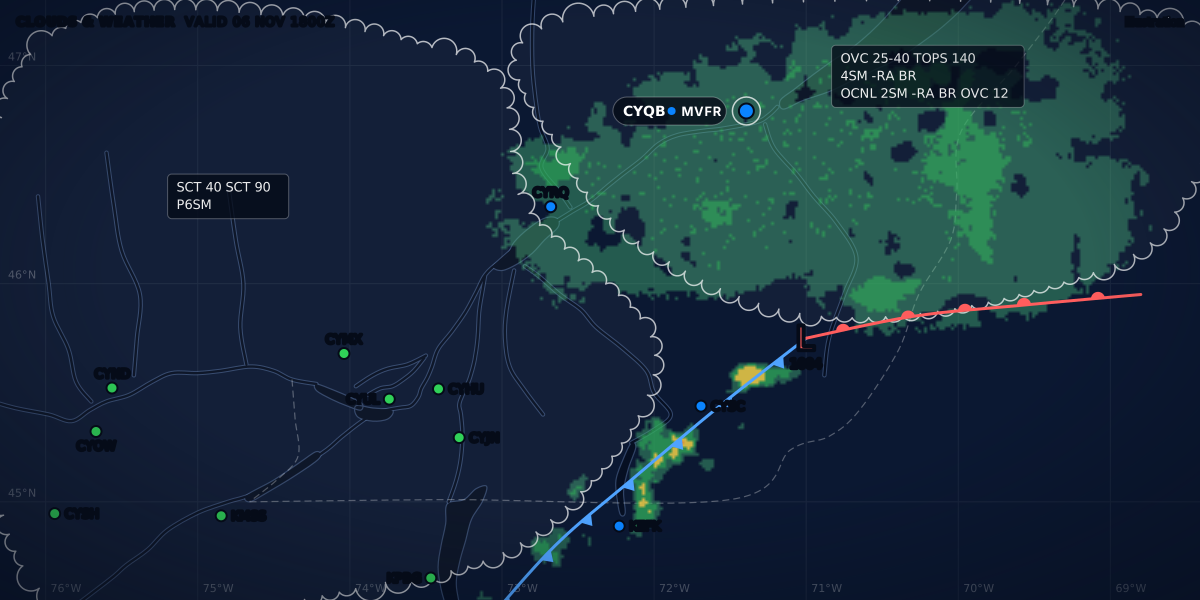
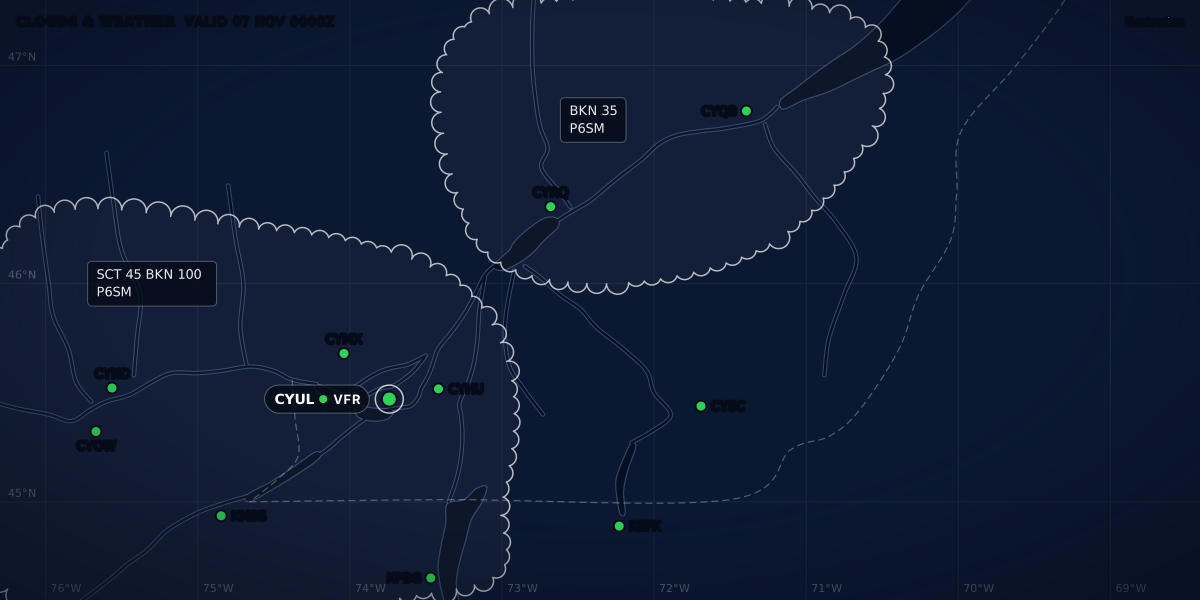
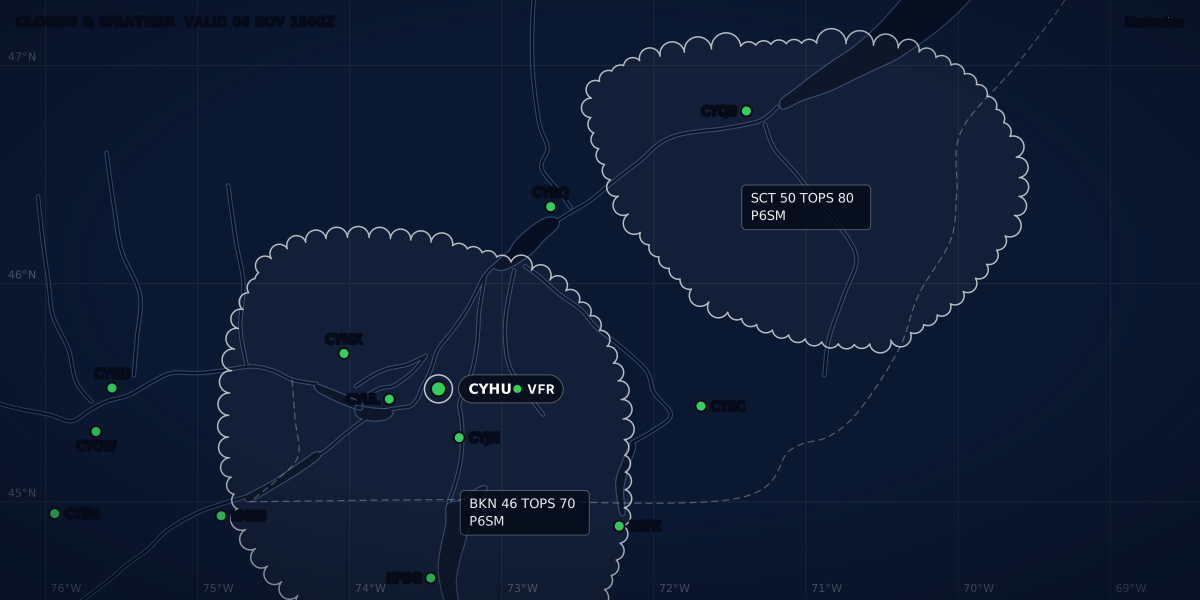
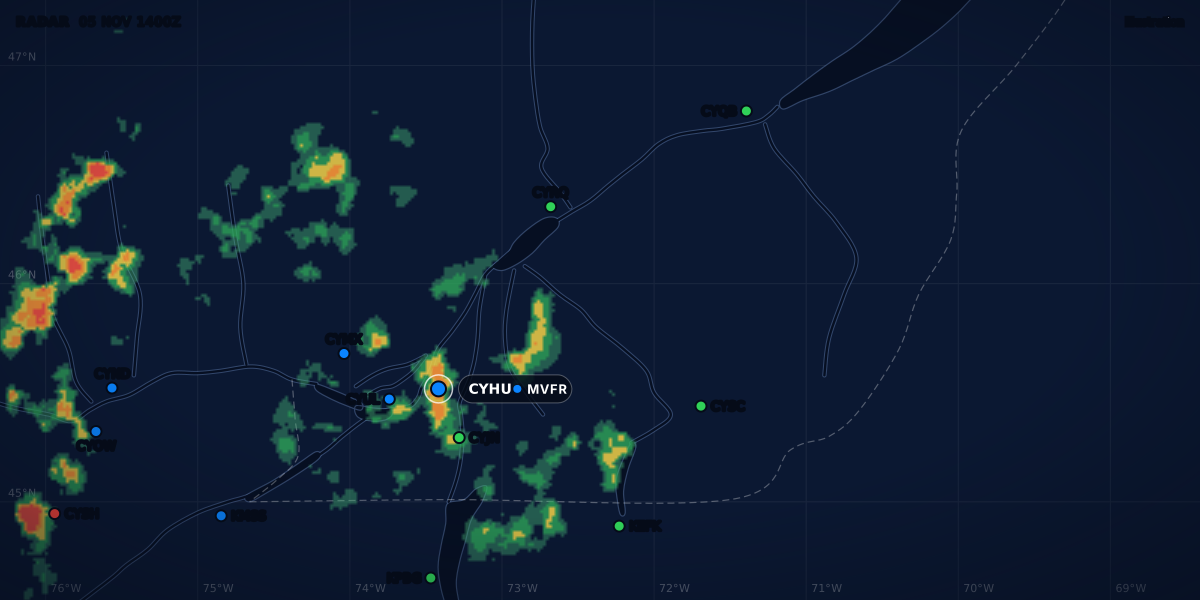
FLIGHT CATEGORIES 07 NOV 1800Z
VFRMVFRIFRLIFR
Illustration
Headwinds and cruise altitude: pick a level from winds aloft
A 20-knot headwind adds about 20% to a Cessna 172's time and fuel. Compare the winds at each level, see why a round trip never pays back, and pick an altitude.
 Jp Valery
9 min read
A headwind costs you twice: the trip takes longer, and every extra minute burns fuel. The winds aloft forecast tells you which level has the least of it. This guide is one step of a preflight weather briefing: read the winds at your levels, turn them into ground speed, time and fuel, then pick the level.
Wind costs more than you think
Take the trip from Montréal / St-Hubert (CYHU) to Québec / Jean Lesage (CYQB), in an aircraft that cruises at 119 knots true airspeed (KTAS) and burns 10.6 US gallons an hour. Those are the cruise speed and fuel flow on trimcarbon.com’s Cessna 172 page (a secondary source, read on 2026-11-06); this guide takes the 119 knots as true airspeed. trimcarbon.com is made by the same team as ClearMETAR.
| Headwind | Ground speed | Time | Extra time | Fuel |
|---|---|---|---|---|
| 0 kt | 119 kt | 57 min | none | 10.1 gal |
| 10 kt | 109 kt | 63 min | +9% | 11.1 gal |
| 20 kt | 99 kt | 69 min | +20% | 12.2 gal |
| 30 kt | 89 kt | 77 min | +34% | 13.5 gal |
Computed. Time is distance ÷ ground speed, and fuel is time × 10.6 gal/h. The distance is 113.7 NM: the great circle, on a spherical Earth, between the aerodrome positions in NAV CANADA’s Designated Airspace Handbook (Issue 324, 3.5.4). The true course is 047° from CYHU.
The extra share is the headwind divided by the ground speed: 20 ÷ 99 = 20%. It grows faster than the wind. Ten knots cost 9%, and thirty knots cost 34%.
Where to get the winds at your levels
Canada. The FB (upper-level wind and temperature forecast) gives the wind and the temperature at 3,000, 6,000, 9,000, 12,000 and 18,000 ft above sea level, for sites across Canada. The Canadian Centre for Meteorological and Environmental Prediction issues it four times a day, under the headers FBCN31, FBCN33 and FBCN35 CWAO (TC AIM MET 1.3.7). You read it on NAV CANADA’s CFPS, which may display it differently from the raw code (MET 9.2).
What you need from the code for this page:
- The wind is in knots, to the nearest 10° true (MET 9.2).
2523is 250° true at 23 knots. 9900is light and variable: less than 5 knots.- The 3,000-ft level never has a temperature, and it is left out where the terrain is higher than 1,500 ft (MET 1.3.7).
- Each FB has a period of use. Take the one that covers your flight (MET Table 3.1).
Winds over 100 knots, the higher levels and the rest of the format are in how to read winds aloft.
On the evening of 6 November 2026, after the US change below, CFPS still served FBCN31, FBCN33 and FBCN35 CWAO for Montréal (YUL) and Québec (YQB).
United States. The National Weather Service ended the US text FB tables on 3 November 2026 at 1200 UTC, with the retirement of the NAM model (SCN 26-47). The aviationweather.gov winds/temps page says that the CONUS, Alaska and Hawaii tables “have been discontinued”, and recommends the GFA wind and temperature forecast instead.
France. Météo-France publishes WINTEM charts. The France chart gives the wind and temperature at FL020, FL050 and FL100, every 3 hours from 00 UTC (Guide aviation 2024, p. 13).
The wind group of a METAR is the wind at the aerodrome (how to read a METAR), not at your cruising level. ClearMETAR shows that surface wind, and the headwind and crosswind on the best runway end. It does not show winds aloft: get them from CFPS or the GFA.
Ground speed, time and fuel at each level
Do these steps for each level you could fly:
- Find the angle between the wind direction and your true course. FB winds are true, so do not mix in a magnetic course (true or magnetic?).
- Split the wind. Headwind = wind speed × cos(angle). Crosswind = wind speed × sin(angle). A tailwind is a negative headwind.
- Get the ground speed. Ground speed = √(TAS² − crosswind²) − headwind.
- Get the time and the fuel. Time = distance ÷ ground speed. Fuel = time × fuel flow.
When there is an FB site near each end of the route, give each half of the route the wind of its own site.
In a real plan, take the true airspeed and the fuel flow for each level from your POH cruise figures. The examples on this page keep 119 KTAS and 10.6 gal/h at every level, so that they show the wind alone.
A round trip never pays back
Fly out into a steady wind and back with it. The tailwind leg is shorter in time than the headwind leg. So you spend less time with the help than with the loss, and the round trip always takes longer than in still air.
| Wind on the track | Out (headwind) | Back (tailwind) | Round trip | Extra vs still air (114.7 min) |
|---|---|---|---|---|
| 10 kt | 62.6 min | 52.9 min | 115.5 min | +0.8 min (+0.7%) |
| 20 kt | 68.9 min | 49.1 min | 118.0 min | +3.3 min (+2.9%) |
| 30 kt | 76.7 min | 45.8 min | 122.4 min | +7.8 min (+6.8%) |
Computed for CYHU ⇄ CYQB at 119 KTAS. The extra share is wind² ÷ (TAS² − wind²). At 20 knots: 400 ÷ (14,161 − 400) = 2.9%.
A wind at an angle does the same. Take a wind from 250° true at 25 knots (an example value, not a forecast). The ground speed is 141.6 kt out (047°) and 95.4 kt back (228°). That is 48.2 minutes out and 71.5 minutes back: 119.7 minutes, 4.4% more than in still air.
The wind is rarely the same at every level, though. A different level in each direction is how you win time back. The worked example below does it.
A crosswind still slows you
To hold your track in a crosswind, you turn the nose into the wind. Part of your airspeed then cancels the drift and does not move you along the track. With the wind at 90° to the track, ground speed = √(TAS² − crosswind²).
| Crosswind | Wind correction angle | Ground speed | Extra time |
|---|---|---|---|
| 10 kt | 5° | 118.6 kt | +0.4% |
| 20 kt | 10° | 117.3 kt | +1.4% |
| 30 kt | 15° | 115.2 kt | +3.3% |
Computed at 119 KTAS. A 30-knot crosswind cuts the ground speed by 3.2%, so the leg takes 3.3% longer. That is small next to a headwind, but it is not zero.
Pick the level
Choose among the legal levels, not the FB levels. Above 3,000 ft AGL, a VFR flight cruises at odd thousands plus 500 ft on a magnetic track from 000° to 179°, and at even thousands plus 500 ft from 180° to 359° (CARs 602.34, 14 CFR 91.159). The exceptions, such as the true track in Canada’s north, are in VFR cruising altitudes.
Then compare the legal levels with the winds near them, and take the best ground speed that the clouds and the airspace allow. Count the climb too: a higher level costs climb time and fuel that the arithmetic above leaves out.
Worked example: CYHU to CYQB
The forecast is real: FBCN35 CWAO, issued on 6 November 2026 at 21:30Z from 18Z data, valid on 7 November at 18:00Z, for use from 12:00Z to 00:00Z. Here are its header and the lines for YUL and YQB, from the bulletin on the Meteorological Service of Canada’s Datamart, read on 7 November 2026 at about 04:20Z (23:20 EST on the 6th):
FBCN35 CWAO 062130
DATA BASED ON 061800Z
VALID 071800Z FOR USE 1200-0000Z.
    3000 6000    9000    12000   18000
YUL 0511 1109+02 1306-02 1410-07 1624-18
YQB 0827 1012+02 1408-01 1808-06 1917-17
Decoded:
| Level | YUL (Montréal) | YQB (Québec) |
|---|---|---|
| 3,000 ft | 050° true, 11 kt | 080° true, 27 kt |
| 6,000 ft | 110° true, 9 kt, +2 °C | 100° true, 12 kt, +2 °C |
| 9,000 ft | 130° true, 6 kt, −2 °C | 140° true, 8 kt, −1 °C |
| 12,000 ft | 140° true, 10 kt, −7 °C | 180° true, 8 kt, −6 °C |
The FB also gives 18,000 ft. Assume the weather is VFR all along the route (check the METARs, TAFs and GFA), and you fly both legs inside the period of use, out around 18:00Z (13:00 EST). The true course is 047° out and 228° back, 113.7 NM each way. Each half of the route gets the wind of its FB site.
Out, CYHU to CYQB (047° true):
| FB level | Wind component YUL / YQB | Average ground speed | Time | Fuel |
|---|---|---|---|---|
| 3,000 ft | 11 / 23 kt head | 101 kt | 67.3 min | 11.9 gal |
| 6,000 ft | 4 / 7 kt head | 113 kt | 60.4 min | 10.7 gal |
| 9,000 ft | 1 kt head / 0 | 119 kt | 57.5 min | 10.2 gal |
| 12,000 ft | 1 / 5 kt tail | 122 kt | 56.1 min | 9.9 gal |
Back, CYQB to CYHU (228° true):
| FB level | Wind component YUL / YQB | Average ground speed | Time | Fuel |
|---|---|---|---|---|
| 3,000 ft | 11 / 23 kt tail | 135 kt | 50.4 min | 8.9 gal |
| 6,000 ft | 4 / 7 kt tail | 125 kt | 54.8 min | 9.7 gal |
| 9,000 ft | 1 kt tail / 0 | 119 kt | 57.3 min | 10.1 gal |
| 12,000 ft | 0 / 5 kt head | 116 kt | 58.9 min | 10.4 gal |
Computed. Still air is 57.3 minutes and 10.1 gallons each way.
What the numbers say:
- Out, go high. The low easterly near Québec costs 10 minutes at 3,000 ft. With the 9,000-ft winds, the trip is almost as fast as in still air. Eastbound, the legal levels near there are 9,500 ft and, closer to the 6,000-ft winds, 5,500 ft. The 6,000-ft winds cost 3 more minutes, for a shorter climb. The 12,000-ft winds save 1.4 more minutes, for 2,000 ft more climb (11,500 ft instead of 9,500 ft).
- Back, stay low. The same easterly is now behind you: 50 minutes at 3,000 ft. Below 3,000 ft AGL the cruising-altitude rule does not apply. Above it, westbound levels are even thousands plus 500 ft, such as 4,500 ft.
- The variation does not change the band. A 047° or 228° true course stays in its 000°–179° or 180°–359° band with any magnetic variation smaller than 47°. Read the variation on your chart.
- The round trip. Out with the 9,000-ft winds and back at 3,000 ft: 108 minutes and 19.1 gallons, 7 minutes less than in still air. Both legs at 3,000 ft: 118 minutes and 20.8 gallons. Both legs at 9,000 ft: 115 minutes, about the same as still air. The climbs are not counted.
What the trip emits
Each US gallon of aviation gasoline makes 8.31 kg of CO₂ when it burns (EIA). For CYHU to CYQB at 119 KTAS and 10.6 gal/h:
| Case | Fuel | CO₂ |
|---|---|---|
| One leg, still air | 10.1 gal | 84 kg |
| One leg, 20-knot headwind | 12.2 gal | 101 kg |
| Worked example, round trip, both legs at 3,000 ft | 20.8 gal | 173 kg |
| Worked example, round trip, out at 9,000 ft and back at 3,000 ft | 19.1 gal | 158 kg |
Computed: CO₂ = fuel × 8.31 kg, from the unrounded fuel. The better levels save 1.7 gallons, or 14 kg of CO₂, on the round trip.
The Cessna 172 page linked above gives 88 kg of CO₂ per hour, and 74 kg per 100 NM at its 119-knot cruise speed, a still-air figure. For a year of flying in another type, use the trimcarbon.com emissions calculator. Leaning, power settings and other ways to burn less are in trimcarbon’s guide to cutting fuel burn. This page covers the wind only.
Sources
- TC AIM (TP 14371) 2026-2, MET 1.3.7, 9.2 and Table 3.1: upper-level wind and temperature forecasts (FB), Transport Canada
- Service Change Notice 26-47, updated 2026-11-05: termination of the NAM, with the FB winds aloft headers, National Weather Service
- Winds/Temps Data (the wind/temp tables are discontinued), NOAA Aviation Weather Center
- CARs 602.34: cruising altitudes and cruising flight levels, Justice Laws Website
- 14 CFR 91.159: VFR cruising altitude or flight level, eCFR
- MSC Datamart, bulletin FBCN35 CWAO 062130 (data based on 061800Z, valid 071800Z), lines YUL and YQB, Environment and Climate Change Canada
- Designated Airspace Handbook (TP 1820E), Issue 324, 3.5.4 control zones: aerodrome positions of CYQB (3.5.4-10) and CYHU (3.5.4-14), NAV CANADA
- Guide aviation 2024, p. 13: WINTEM charts, Météo-France
- Carbon Dioxide Emissions Coefficients (aviation gasoline: 8.31 kg CO₂ per gallon), U.S. Energy Information Administration
Rules checked on
Common questions
How much does a headwind cost?
At 119 knots true airspeed, a 20-knot headwind cuts the ground speed to 99 knots and adds 20% to the time and the fuel. The extra share is the headwind divided by the ground speed.
Does the tailwind on the way back make up for the headwind?
No. In a steady wind the round trip always takes longer than in still air, 2.9% longer with 20 knots at 119 knots true airspeed; only a level with a different wind on one leg can win time back.
Does a crosswind slow me down?
Yes. To hold your track you point into the wind, so the ground speed is √(TAS² − crosswind²): a 30-knot crosswind at 119 knots costs 3.2% of the ground speed.
Let the app do the decoding.
ClearMETAR turns every METAR and TAF into one plain sentence. Free on iPhone.